
Reviews
Review: Paddington the Musical: Marmalade and Musical Heaven
The musical about the beloved bear Paddington comes to the West End’s Savoy Theatre.
 |
|
|
|
December 2, 2025

(© Johan Persson)
It’s fair to say that few stage adaptations arrive with the sheer, impossibly high expectation that Paddington the Musical carried into its opening night.
After all, the source material is sacred territory: not only Michael Bond’s beloved 1958 novel, an indelible piece of British childhood, but also the recent cinematic iterations. Filled with wit, genuine pathos, and a visual style that rivals the best of Wes Anderson, these are often cited as some of the greatest British films of the 21st century.
To take a bear of such gentle, nuanced CGI and transfer him to a West End stage—where the magic must be tangible, immediate, and bewitching—is a feat of cutting-edge engineering and creative nerve. Happily, director Luke Sheppard and his team have not just met expectations, they’ve plastered them with marmalade and sent them on a joyful trip through the roof of the Savoy Theatre.
The resounding triumph here lies squarely in the performance of the titular bear. Paddington is brought to breathtaking life by a dual performance that is itself a technical wonder.
Inside the custom-designed bear suit (designed by Tahra Zafar) is the physically expressive Arti Shah, who embodies all of Paddington’s movement, from his distinctive waddle to the swift, clumsy, earnest chaos that follows any attempt at a good deed. Supplementing this is James Hameed, who supplies the instantly recognizable voice and remote puppeteering of the face’s subtle expressions, all while also playing the charming “Young Man” at the same time.
The fusion of Shah’s bodily comedy and Hameed’s vocal sincerity is seamless, creating a character far more complex and emotionally available than a simple costume might suggest.
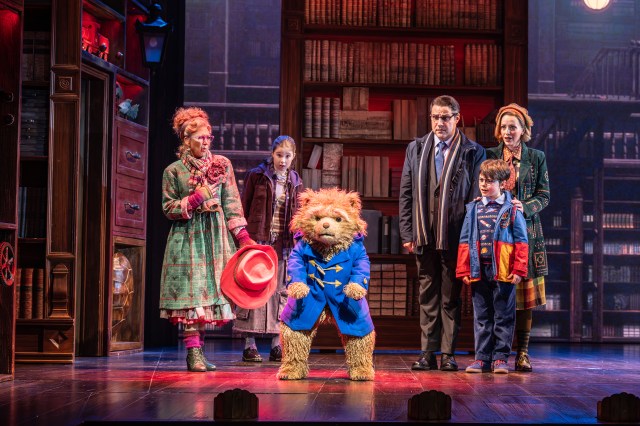
(© Johan Persson)
When Paddington first walked out onstage, suitcase and label in hand, the entire auditorium, packed with press and excitable punters, erupted in what felt like a thousand collective gasps of delight and relief.
Sheppard, who proved his mastery of crowd-pleasing spectacle with the smash hit & Juliet, takes everything he learned about stage dynamism from that show and elevates it, though in a subtler key.
Where & Juliet was all neon and pop maximalism, here, Sheppard delivers a real sense of assured, happy-go-lucky drive that never once lets up, yet feels grounded in the domestic warmth of the Brown household. The staging of the action is relentless, the visual gags are sharp (two scenes in the fictitious “geographer’s guild” in particular), and the emotional beats land perfectly—a testament to a director who knows how to keep the big stage feeling intimate. It isn’t perfect, and Act 2 feels slightly overdrawn and self-indulgent, yet the sheer intoxicating splendor of it all means you’re happy to accept an extra portion or two.
He is backed by a superb book from Jessica Swale, who manages the tricky balancing act of paying loving tribute to the source material—the train station tag, the sticky messes, the sheer decency of it all—while adding lashings of novelty and big, theatrical fun. One moment where a lone performer dressed as a giant marmalade sandwich interrupts proceedings may be my stage highlight of the year. Swale’s genius lies in sidestepping the episodic charm of the books while giving the show a compelling, cinematic through-line via a perfectly pitched antagonist. She gives the supporting cast genuine substance, allowing them all to shine.
And what a supporting cast it is. Victoria Hamilton-Barritt, as the deliciously wicked taxidermist Millicent Clyde, is given free rein to be fantastically arch and bloodthirsty. Her evil-yet-catchy number, “Pretty Little Dead Things,” is a masterclass in musical-theater villainy, cementing her as a theatrical antagonist you love to hate, full of grand-scale, slightly unhinged torment.
Meanwhile, Tom Fletcher’s tunes are stellar, demonstrating a surprising range that moves from joyous ensemble numbers to introspective character pieces. The Act 2 opener, “Marmalade,” is a genuinely infectious ensemble piece that is destined to be the earworm of the season, a glorious celebration of the sticky, sweet foundation of Paddington’s life. A real emotional gut-punch is the solo number given to Amy Ellen Richardson’s Mrs. Brown.
Often a warm, motherly figure, Richardson’s Brown is surprisingly steely and complex, given a moment of real, powerful contemplation that reveals the emotional core holding the Brown family together.
Further cast delights include Bonnie Langford bringing her unique, irresistible energy and comedic timing to the role of Mrs. Bird, and Tom Edden offering a wonderful, perfectly pitched spin on the perpetually frustrated and eternally snooping neighbor, Mr. Curry.
But beyond the spectacle and the songs, Paddington achieves something truly resonant and important. Paddington is an immigrant, a foreigner adopted by a community, and in turn, he enriches that community beyond measure. His gentle, yet firm, moral code challenges the rigidness of those around him (looking at you, Mr. Curry), and makes the world a kinder, better place. This moral clarity, delivered without cynicism or saccharine overdose, is a beautifully drawn lesson of acceptance that many nations across the world could stand to learn from right now.
Could such a uniquely British phenomenon—so rooted in our charm, our polite chaos—ever transfer to Broadway? While the technical requirements and costs are daunting, the universal themes of family and acceptance, and the sheer, irreducible joy of seeing Paddington onstage make it feel almost inevitable. This bear is ready to take Manhattan.

(© Johan Persson)




Latest Reviews
See all


Latest Videos
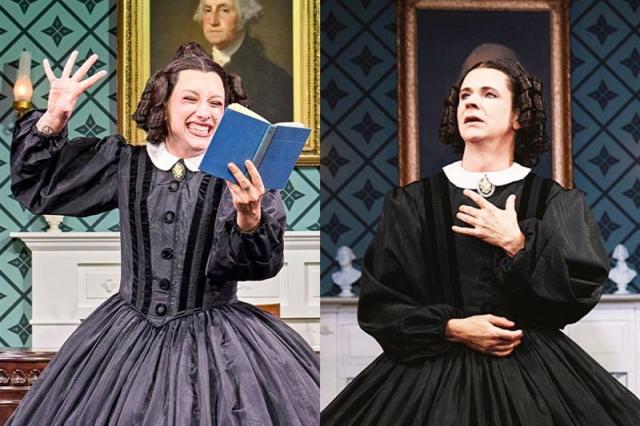
West End vs Broadway: Oh, Mary!—From an Angry Inch to an Angry First Lady, With John Cameron Mitchell and Mason Alexander Park
Mitchell and Park celebrate a decade-long friendship in our latest installment.