
Review: New Musical The Paparazzi Tells a Story That’s Old News
Albert Tapper and Tony Sportiello’s show makes its world premiere at AMT Theater.
 |
Off-Broadway
|
|
Off-Broadway
|
March 16, 2026
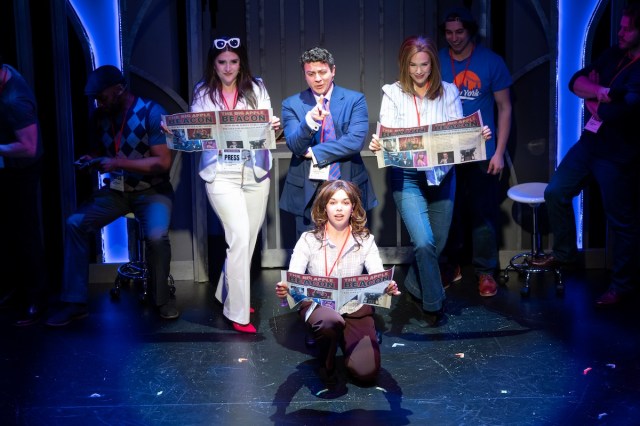
(© Jillian Nelson)
Tabloid journalism has the power to hurt celebrities and kill careers with sensationalistic reporting!
If this sounds like a genuine newsflash to you, then perhaps you will enjoy The Paparazzi, the new Albert Tapper (music and lyrics) and Tony Sportiello (book) musical currently running at AMT Theater. Others, though, would do well to approach this material with the kind of caution that one needs to exercise with media these days in this world of “alternative facts” and scarily realistic-looking AI images.
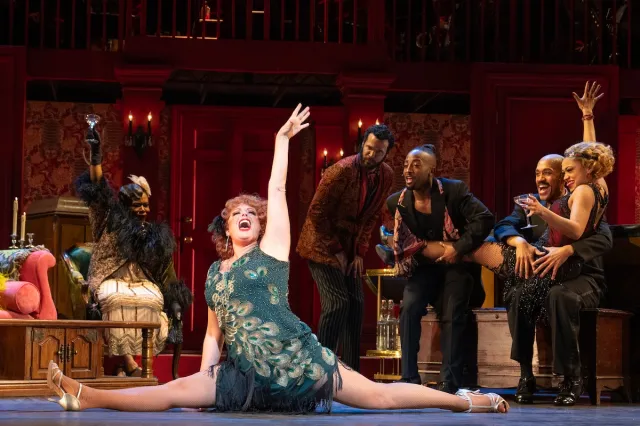
Christie (Brogan Nelson) has traveled from her home state of Kansas to New York City to try to establish a journalism career. She’s full of noble aspirations: principally, a desire to do meaningful reporting for a prestigious outlet like the New York Times. Instead, she lands her first job with the New York Beacon, a tabloid publication that reports extensively on celebrity news; it’s the kind of trashy outlet willing to go so far as to flat-out make up stories for the sake of grabbing readers’ attention. Through a variety of circumstances—including a cutthroat rivalry that develops between her and more seasoned Beacon reporter Betty (Julia Meadows)—Christie herself soon gets sucked into the race for big scoops, running the risk of corrupting whatever moral compass she previously had.
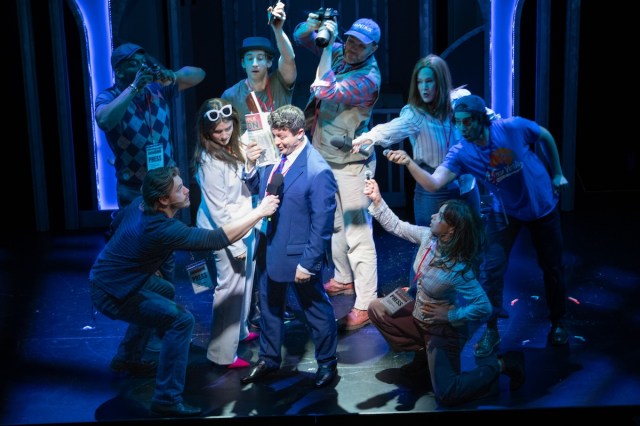
(© Jillian Nelson)
In a note included in the program, Tapper explicitly states his and Sportiello’s desire to address the world today with their musical. They signal their serious intent right at the beginning with their inclusion of legendary gossip columnist Walter Winchell (PJ Cirino) as the show’s narrator, having him define the term “paparazzi” for us and noting its origin, from a news-photographer character in Federico Fellini’s 1960 film classic La Dolce Vita.
The inclusion of Winchell isn’t the only retro element in The Paparazzi. Tapper’s score is a mix of old-fashioned jazzy and brassy idioms, with faint flavors of tango and Kurt Weill-like irony. If Tapper’s lyrics and Sportiello’s book didn’t pepper in so many shout-outs to modern celebrities—Taylor Swift, Timothée Chalamet, Denzel Washington, and many more—one could easily mistake this for being set in, say, the 1950s, during the height of Winchell’s popularity. That impression is furthered by one character mentioning in passing the Winchell-inspired 1957 film Sweet Smell of Success, to which the musical’s predictable plot owes considerable debt.
More worrying than the musical’s jarring out-of-time feel is a nagging sense that, while the writers’ anger at media demagoguery is appropriate, their knowledge of the targets of that anger is superficial at best. Even at infamous New York tabloid papers like the New York Post, the most salacious stories usually have some factual basis, however exaggerated, unconfirmed, or otherwise. It’s difficult to fully accept the notion The Paparazzi posits that even the most unprincipled of journalists would outright advise colleagues to just make stuff up, as Betty, Beacon editor Mike (Jake Evans), and others advise Christie throughout. If Tapper and Sportiello had set their show in the virtual halls of an online website, their attempt to blow the lid off modern-day journalistic malfeasance would have carried more weight.
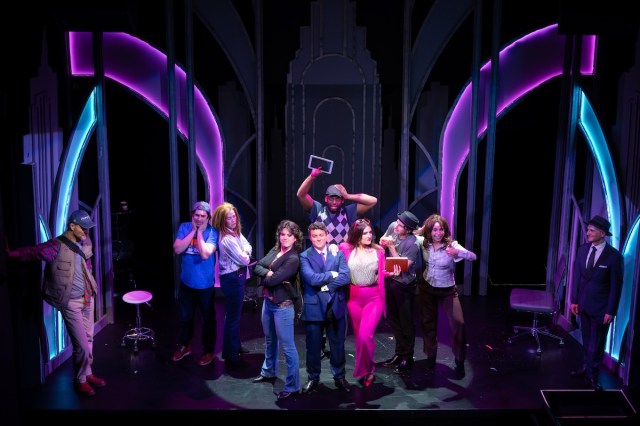
(© Jillian Nelson)
Stronger tunes and performances would have compensated for the show’s shallow cynicism. Tapper’s songs aren’t so much bad as they are bland, though his lyrics are sometimes worse than that. The awkward phrase “a heartbeat away from genius” that makes up the chorus of the Act 1 number of the same name, for instance, doesn’t get cleverer when it’s repeated eight times. Director Nancy Robillard does what she can to move the action fluidly between different settings on scenic designer Ryan Howell’s art deco-on-a-budget set. At least the words are audible in Steven Fine’s sound design.
Most of the cast sing well and inhabit their characters with spirit and relish. That includes lead Nelson, though she’s better at conveying naïveté than inhabiting the conniving backstabber she becomes. One performance, however, stands above the rest. Dan Olson plays Tom, a grizzled, alcoholic, world-weary veteran photographer who, he tells Christie at one point, was even at the scene of Princess Diana’s paparazzi-fueled death in 1997. Olson brings so much depth of feeling to the role that he even comes close to redeeming the lyrical clumsiness of his one solo number, “Loneliness Train.” Only during his scenes does The Paparazzi suggest the scorching media critique that this musical ought to have been.




Featured In This Story
Latest Reviews
See all

Latest Videos
West End vs Broadway: Oh, Mary!—From an Angry Inch to an Angry First Lady, With John Cameron Mitchell and Mason Alexander Park
Mitchell and Park celebrate a decade-long friendship in our latest installment.