
Review: Matthew Broderick Brings a Reserved Malevolence to Ulster American
David Ireland’s savage comedy gets it US premiere at Irish Repertory Theatre.
 |
Off-Broadway
|
|
Off-Broadway
|
March 17, 2026
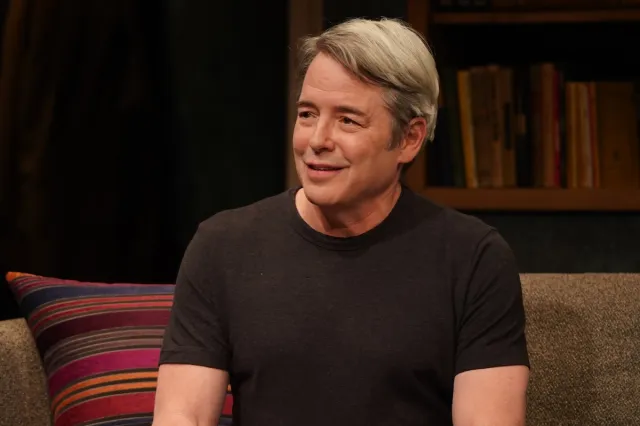
(© Carol Rosegg)
“I find it really hard to end plays without violence,” Belfast-born playwright David Ireland told The Guardian in 2019, after Ulster American premiered in Edinburgh.
Ireland’s work was last seen in New York eight years ago when the Public Theater produced Cyprus Avenue, about a British loyalist in Belfast plotting to murder his newborn granddaughter whom he believes is an Irish republican politician in disguise. That play was all fizzing id, but the same explosive ingredients seem to be swirling around Ulster American, which, at least at first, stays relatively corked in Ciarán O’Reilly’s mostly shrewd production at the Irish Repertory Theatre.
Ireland shifts his overtly violent streak to a play-within-a-play. Ruth (Geraldine Hughes), a Belfast playwright on the cusp of a London premiere, owes a career boost to English director Leigh (Max Baker) and the Irish-American Hollywood legend Jay Conway (Matthew Broderick). Ruth is from Belfast but identifies as British, a fact that Jay, who’s been focused elsewhere on his rough accent work and desire for an onstage eyepatch, can’t comprehend. And his reading comprehension’s apparently not that great either, since he initially loved the script about a guy who goes around decapitating priests: “Now I find it’s a story about the murder of Irish Catholics written by a British Protestant, someone I would consider a traitor to the cause of Ireland,” he gasps, horrified.
On the eve of rehearsals, Jay and Ruth have joined Leigh at his home to talk about the play (which sounds quite a bit like the gorily unhinged Cyprus Avenue). Ireland’s wickedly sharp satire extends to Jay’s self-professed Irishness despite never having visited the country, to Leigh’s English self-importance in claiming responsibility for Ruth’s career, and to Ruth’s political contradictions, although she’s pretty sympathetic until late in the game.
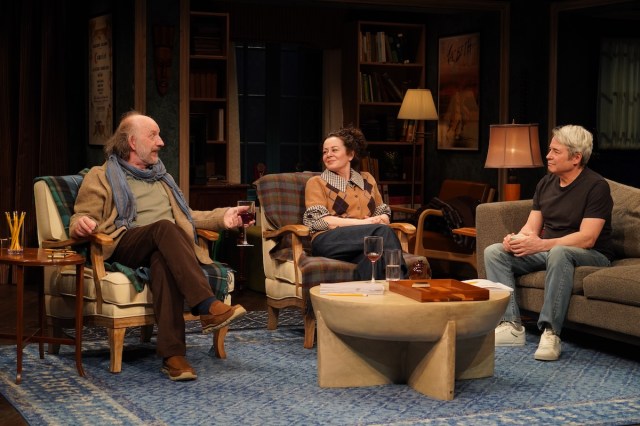
(© Carol Rosegg)
The affectless yet affable Broderick, in a role performed by Woody Harrelson in London, is out-of-left-field casting as the crude, loose-cannon Jay. But for most of the play, the naïveté that seems to undergird Jay’s increasingly appalling statements add to the production’s zanily horrid sense of humor. “I love to swear,” Jay tells Ruth with fixed placidity in his eyes. “I swear like Liza Minnelli with a twelve-inch cock in her ass.” There’s not even a flicker of curiosity about Ruth’s response; Jay says shocking things while his face stays parked in neutral.
Playing up Jay’s cluelessness about how he’s impacting others paints a darkly delightful contrast with the depravity of his imagination, and this suits Broderick much better than the hypocritical self-awareness required of his recent Tartuffe. But eventually, Ireland’s script asks for Jay to unleash his ugly machismo, which isn’t a gear Broderick can readily access, and it becomes clear that he can’t convincingly carry the role across the fiery finish.
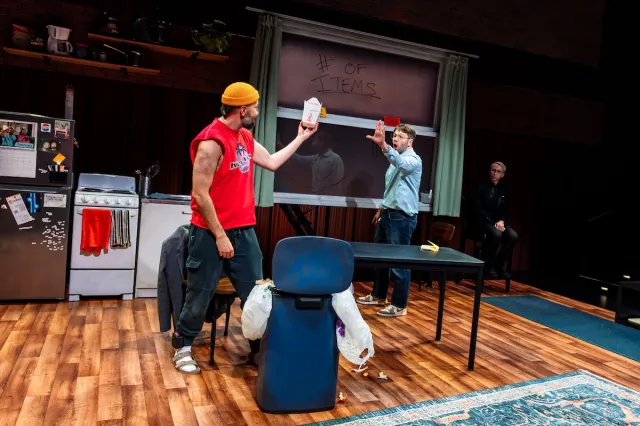
Baker’s just perfect, though, as the stuffy would-be mediator between playwright and actor: he seems to blend into his pretentious living room, handsomely decked out with National Theatre-y paraphernalia by Charlie Corcoran. And Hughes carries Ruth’s boiling fury persuasively, entering in a blaze of malice—she’s just come from a car crash that left her mother hospitalized—intermixed with giggly glee at meeting the film star who’s agreed to take on her play.
For most of Ulster American, Ruth seems like the audience surrogate, both because she’s the lone woman in a room oozing with misogyny very thinly disguised in faux-woke sentiment (“I love women. I respect all women. My first manager was a woman. A Black woman! Of color!”) and also because Ireland identifies with her cultural self-entanglement. The knotty personal struggle of the Northern Irish denizens who stayed loyal to Britain through the Troubles—the “Ulster Protestants”—is pulsing under most of Ireland’s work.
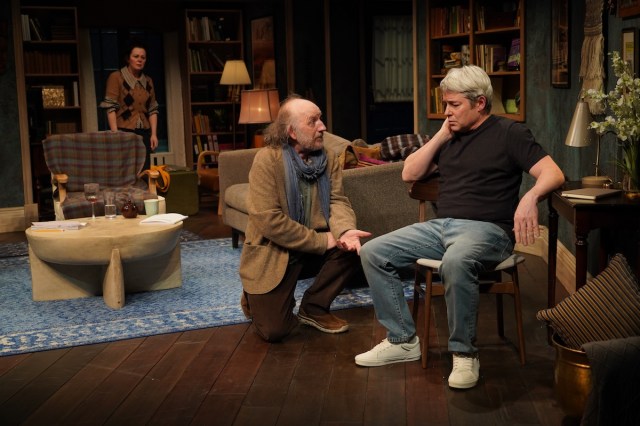
(© Carol Rosegg)
That makes Ulster American, however universally vicious in its bursting of the egos of playwrights, directors, and actors alike, a very specific play with pre-eminent local concerns. To understand the play’s emotional heat beyond the free-flowing laugh lines, Ulster American requires more cross-cultural literacy than most New York audiences possess: the play is unusually successful in its venomous amusements, but the historical anger and pain beneath that isn’t instantly explicable.
Ireland is the sort of playwright who seems to know exactly what effect he’s creating: there’s a gymnast’s precision in how Jay’s awful pronouncements stick their horrifying landings, as when he ickily demands Leigh declare the name of a woman he would choose to rape if forced to do so at gunpoint. Even coming from the mouths of obviously despicable people, it doesn’t always feel like the payoffs merit staging such queasy conversations in the first place. Is there a difference between laughing at how shocking Jay’s jokes are and laughing at the jokes themselves? Ireland seems to relish that metatheatrical tension, the degree to which the audience discomforts itself by finding his play funny.
Ulster American, in other words, isn’t for everyone, even if anyone is welcome to find offense. It’s not even safe for critics. “We should do with them what we do with animals, kill them and eat them,” Jay pontificates, Broderick’s features set in a gauzily pastoral smile. “Only thing I ever want to read from a theater critic is a suicide note.” Here’s hoping he learns to live with mixed reviews.




Featured In This Story
Latest Reviews
See all


Latest Videos
West End vs Broadway: Oh, Mary!—From an Angry Inch to an Angry First Lady, With John Cameron Mitchell and Mason Alexander Park
Mitchell and Park celebrate a decade-long friendship in our latest installment.