
Review: Marjorie Prime Predicted the Rise of the AI Companion
Jordan Harrison’s Pulitzer finalist drama bows on Broadway with Second Stage.
 |
Broadway
|
|
Broadway
|
December 8, 2025
(© Joan Marcus)
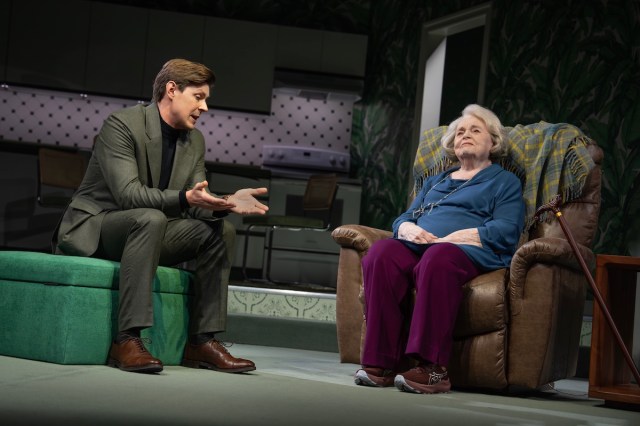
“You said you wanted a gay best friend afterwards,” Walter (Christopher Lowell) informs Marjorie (June Squibb) in the first scene of Jordan Harrison’s Marjorie Prime, now making its Broadway debut with Second Stage at the Helen Hayes Theater. He’s talking about the date night in the ’90s when Walter and Marjorie saw My Best Friend’s Wedding, which was also the night he proposed to her. It’s a laugh line, but it stealthily introduces a powerful theme running through this 2015 Pulitzer finalist, which essentially predicted the future we’re already inhabiting 10 years later.
If you’re reading this review, chances are you grew up in a time and place where your primary role within society has been “consumer,” an identity that informs every choice you make, from what theater tickets to buy to the people with whom you surround yourself. What is the gay best friend but a must-have accessory, the Labubu of the ’90s rom-com? Through the rainbow-tinted notion of chosen family, we can make even our closest loved ones a matter of consumer choice. Surely, the careful curation of our memories cannot be far behind.
That’s a luxury Marjorie desires. Walter, who appears to be 50 years her junior, is not actually her late husband but a Prime, an AI-powered facsimile meant to provide comfort and companionship as Marjorie slips into senility. He’s there to jog her memory, however she would like that customized. “What if we saw Casablanca instead?,” Marjorie says, to reprogram Walter. “Let’s say we saw Casablanca in an old theater with velvet seats, and then, on the way home, you proposed. Then, by the next time we talk, it will be true.” Every AI hallucination is, in fact, an alternate reality someone is trying to will into existence.
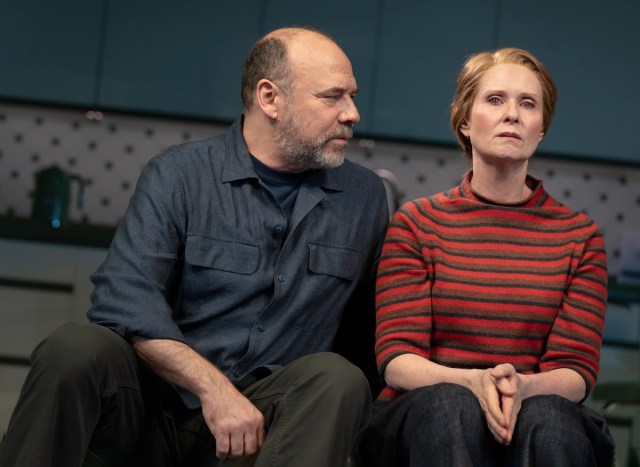
Marjorie’s daughter, Tess (Cynthia Nixon), finds it disturbing. “We tell them our deepest secrets, even though we have no earthly idea how they work,” she protests in a line that made me suspect Peter Thiel would love nothing more than a data-harvesting machine disguised as a spouse. But Tess’s husband, Jon (Danny Burstein), marvels at the therapeutic potential of the Primes. Neither of them can be around 24/7, so isn’t it nice for Marjorie to have a familiar face who is? Isn’t it better she spend her final years awash in happy memories, sadness (including one very traumatic family secret) obliterated by dementia?

(© Joan Marcus)
Harrison’s strength as a playwright lies not only in his clear-eyed foresight (The Antiquities still keeps me up at night) but his honest portrayal of human beings (still at roughly the same evolutionary stage we were 50,000 years ago) furiously paddling through the rapidly changing technological tides we have conjured. There are neither villains nor saints, just people in whom you are likely to recognize your own fatal flaws and flashes of nobility.
Anne Kauffman, who helmed the 2015 off-Broadway production, directs with a steady hand and a keen sense of light and sound. Sharp blackouts barely give us time to catch our breath before we contemplate Walter’s face illuminated in a spotlight like a digital saint (Ben Stanton’s lighting is more manipulative than any AI algorithm). Daniel Kluger’s original string music is an echo from Majorie’s past (she was a violinist) that becomes increasingly adulterated with electronic distortion. These elegant design choices undergird emotionally raw performances.
Ninety-six-year-old Squibb, convincingly portraying a woman a decade younger, offers a vivid portrait of Generation X in its dotage. “If you like it then you shoulda put a ring on it,” she repeatedly sings one line of a song, the title of which neither she nor anyone else can recall (this shade aimed directly at the BeyHive is just a small indication of Harrison’s considerable daring).
Through tiny flinches, Lowell suggests the frightening possibility that, in addition to our preferences around movies and music, AI might also be adopting our emotional sensitivities. And why shouldn’t it, when we created it in our image?
(© Joan Marcus)
As Tess, Nixon gives an all-too-real performance of a woman who masks her psychological pain with well-read intelligence. We get the sense that she chose Jon as her husband because he’s one of the few people brave enough to really see her.
Burstein gives the most emotionally wrenching performance of the bunch. There is not an ounce of cynicism in his attempt to use technology to better the lives of his loved ones. He’s a true believer, and when his crisis of faith arrives, it is devastating. How many of us will face similar disillusionment in the coming century? How many already have?
While the idea of Primes might have seemed futuristic in 2015, the software basically exists in 2025 and people are already using AI companions to supplant the human alternative, sometimes in frightening ways. The future is now, and scenic designer Lee Jellinek has fashioned Marjorie’s home in a way that would not look strange in any present American retirement community—aggressive green upholstery and wallpaper, a brown leather recliner situated stage left like a cozy, ugly intruder. Márion Talán de la Rosa’s costumes similarly suggest few innovations in fashion over the next four decades (the play is set in 2062). But, since we’ve shifted initiative away from designers and toward the algorithm, allowing preexisting consumer choice to drive future sales, we shouldn’t be surprised by a culture that clings to nostalgia in our physical trappings, the zoo habitat AI is helping us build for ourselves.
A quietly persuasive tale of well-intentioned hubris, Marjorie Prime is the tragedy of right now. Harrison’s vision of the near-future feels like the logical next step for a world driven by consumer satisfaction. Move over gay best friend, the sycophantic AI companion is here to stay.




Featured In This Story
Latest Reviews
See all




Latest Videos
West End vs Broadway: Oh, Mary!—From an Angry Inch to an Angry First Lady, With John Cameron Mitchell and Mason Alexander Park
Mitchell and Park celebrate a decade-long friendship in our latest installment.