
Review: Jesse Tyler Ferguson Plays Truman Capote in Tru
Jay Presson Allen’s drama receives an intimate revival at House of the Redeemer.
 |
Off-Broadway
|
|
Off-Broadway
|
March 19, 2026
(© Marc J. Franklin)
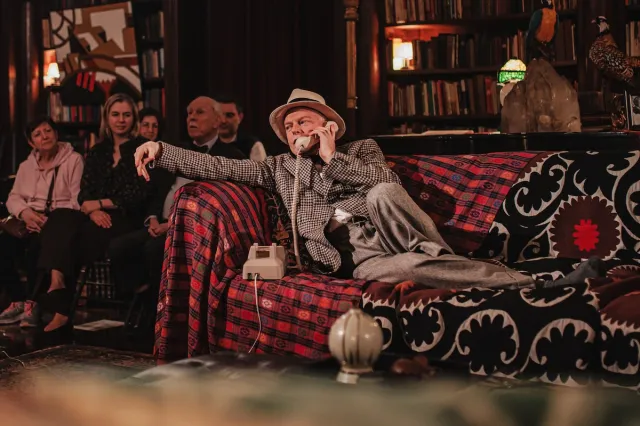
I can think of no place I would rather experience a dark night of the soul than the spectacular baroque library at House of the Redeemer, an Episcopal church and cultural space on East 95th Street. That’s where you’ll find Truman Capote hanging out for the next few weeks. Tony winner Jesse Tyler Ferguson plays the late author of In Cold Blood, most famous for being famous, in an off-Broadway revival of Jay Presson Allen’s Tru, which depicts Capote in crisis.
It’s coming on Christmas 1975 and Esquire has just published “La Côte Basque, 1965,” a chapter from Answered Prayers, Capote’s unfinished novel based largely on his observations of the lives of the rich and well-connected. Happy Rockefeller, Gloria Vanderbilt, Babe Paley…these socialites, these swans, invited Capote into their homes and onto their yachts; they confided their secrets in him; and he published thinly veiled versions of those secrets in a magazine. Now they have collectively blacklisted him, to his indignation.
“Any serious writer hanging out for years with the rich…You would have to be deluded to the point of derangement not to know that that writer was taking notes,” he argues to the audience, a silent jury of ghosts. “What did they think I was there for? The intellectual stimulation? The wit? The spiritual uplift? I’m the one who brought intellect and wit to the party!”
And yet the great zircon in the diadem of American literature (to borrow an epitaph from Capote’s nemesissy Gore Vidal) is not quite ready to doff his party tiara. Holding a cigarette as scepter and crystal scotch tumbler as orb, our queen plots a comeback—through strategic party attendance, television appearances, and Christmas Eve grand gestures that would make a West Village florist weep. Whatever it takes, he will swim with the swans again.
(© Marc J. Franklin)
Ferguson has ambitiously taken on a role originated on stage by Robert Morse in the 1989 Broadway production. Capote has famously been played on screen by Philip Seymour Hoffman, Tom Hollander, and (most recently) Jane Don’t. Capote’s imitable voice, the pinched and lisping southern drawl, is something anyone can try, like an impression of Donald Trump or Liza Minnelli; but it takes a real master of dialect and affect to capture the subtleties. A smart suit and jaunty chapeau (which costume designer Sam Spector dutifully supplies) is not enough to complete the illusion.
Ferguson is not a perfect mimic. In the play’s shoutier moments, it is impossible not to hear a hysterical Mitchell from Modern Family. Sauced and saucy in his lower register, it’s Carol Channing. But when it comes to the emotional coloring of this theatricalized gay breakdown—the scarlet rage, the emerald resentment, the self-pity of deepest indigo—Ferguson paints like an old master. There’s emotional truth undergirding every moment, even the ones that are patently bullshit. Sure, he’s playing the role of the worldly and acerbic bon vivant, but Ferguson never lets us lose sight of the wounded little gay boy who somehow managed to scale the Everest of American society only to find himself completely alone.
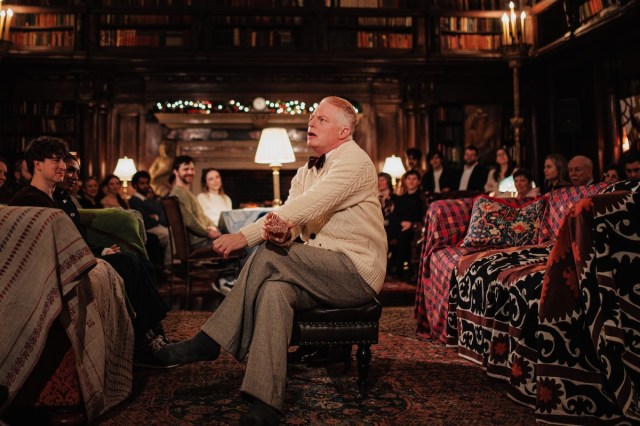
Director Rob Ashford stages Tru so that everyone gets an up-close-and-personal moment with our gracious host as he moves through the library, gesturing toward mementos and spinning tales. “This one was given to me many years ago by Colette,” he points out a crystal paperweight on his desk, “Baccarat. It’s now worth fifteen grand,” he tells us, eying the closest audience member suspiciously before pocketing the tchotchke. His movement sometimes feels a bit too rote, like a Roomba on patrol. But Ferguson easily sells this as the nervous pacing of a man who sees life as he knows it coming to an end. Like a fish, if he stops moving (or drinking), he’ll die. And if the booze isn’t working, there’s always harder stuff in the desk drawer.
Scenic designer Mike Harrison decorates that workspace with a typewriter, yellow legal pads, and a bottle of Alka-Seltzer. The Persian rugs, antique sofas, and framed photos he has selected mesh seamlessly with the library, creating the ideal habitat for a high society exile. Emily Schmit’s mellow incandescent lighting further enhances the mood and has the power to pull us into flashbacks with only the slightest shift. When a window shade is opened following a night of heavy partying, Schmidt creates the authentic lighting of a New York City hangover, with the sounds of the city emanating from far below (excellent sound design by Christopher Darbassie). In that moment, Capote’s deep loneliness washes over us like so much spilled gin.
(© Marc J. Franklin)
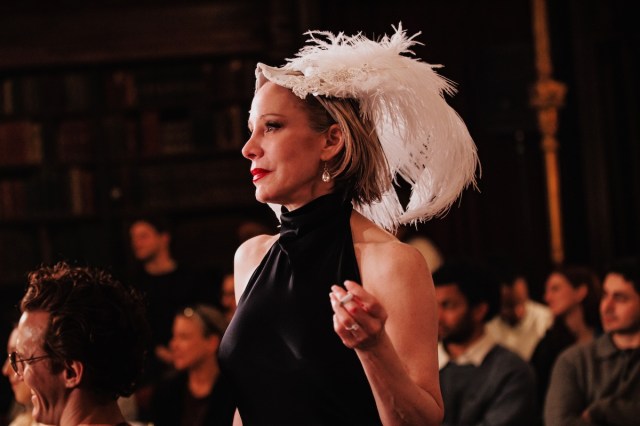
And yet our protagonist is never quite alone. Charlotte d’Amboise stalks the stage in a chic black dress. We instantly clock her as a swan from the white plumes on her masquerade mask. She’s a stylish reveler from Capote’s black and white ball, elegant and terrifying in her silent judgement.
Allen’s script sags near the end, weighed down by wheel-spinning biographical exposition (at one point Capote reads aloud from “A Christmas Memory”) and the failure to arrive of a satisfying climax. As disappointing as that is in a play, it also feels true to life—certainly Capote’s. “Life is a moderately good play with a badly written third act,” our protagonist observes, deep into the third act of Tru. I couldn’t agree more with that review.




Featured In This Story

Latest Reviews
See all

Latest Videos
West End vs Broadway: Oh, Mary!—From an Angry Inch to an Angry First Lady, With John Cameron Mitchell and Mason Alexander Park
Mitchell and Park celebrate a decade-long friendship in our latest installment.