
Review: Giant on Broadway, How Roald Dahl Accepted His Antisemitism
John Lithgow stars in Mark Rosenblatt’s drama about the children’s author.
 |
Broadway
|
|
Broadway
|
March 23, 2026
(© Joan Marcus)
Thirty-six years after his death, Roald Dahl continues to be one of the most celebrated children’s authors ever, with copies of Charlie and the Chocolate Factory, James and the Giant Peach, and Matilda occupying prime real estate in libraries and bookstores across the anglosphere. All have been the subject of major film and stage adaptations. Dahl is not canceled and never was.
We know this going into Mark Rosenblatt’s Giant, now riding a wave of acclaim from London to make its Broadway debut at the Music Box. The masterfully written and thrillingly performed drama depicts Dahl obstinately refusing to extinguish a fire of his own making. Far from a cautionary tale, Giant proves that, with a sufficient level of fame, an artist can do that and get away with it.
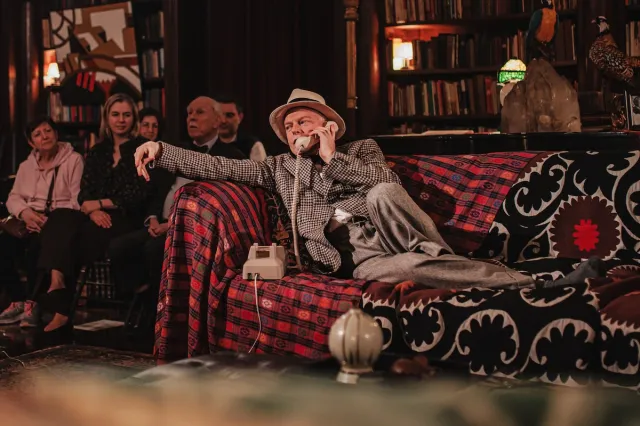
It’s 1983 and Roald Dahl (John Lithgow) is preparing The Witches for publication. He grumbles to his publisher, Tom Maschler (Elliot Levey), about the share of royalties going to illustrator Quentin Blake and the disruption caused by an extensive renovation of his home initiated by his fiancée, Felicity Crosland (Rachel Stirling).
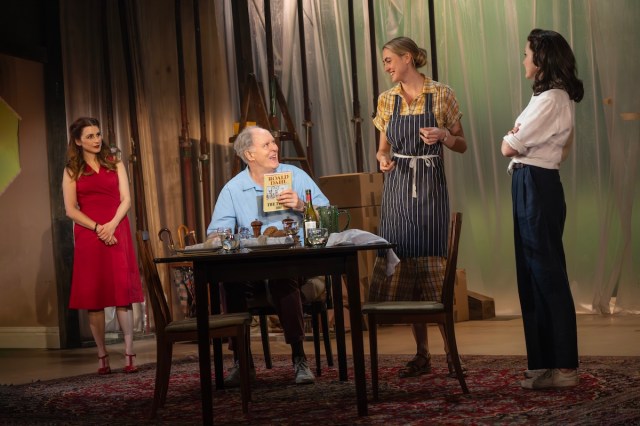
Designer Bob Crowley delivers a half-finished room decorated with little huddles of antique furniture and encased in plastic sheets—a hermetically sealed chamber for rhetorical combat, warmly illuminated by Anna Watson’s natural lighting and underscored by the gentle clang of construction (sound design by Darron L. West). Somehow, Dahl seems more perturbed by this home improvement than the recent death threat he received in a late-night telephone call.
(© Joan Marcus)
An alarming American voice penetrates the plastic. “HELLO?” It’s Jessie Stone (Aya Cash), an envoy from Dahl’s publisher across the pond. Crowley, who also did the costumes, outfits her in a bright red dress and heels. She’s an urgent e-mail in human form come to discuss the fallout of a recent book review Dahl has written about Tony Clifton and Catherine Leroy’s God Cried, documenting Israel’s siege of Beirut during the 1982 War, which has left thousands of civilians dead. In it, Dahl has written about the Jewish people, “Never before in the history of man has a race of people switched so rapidly from being much pitied victims to barbarous murderers.” This is what prompted the death threat.
Maschler worries that the controversy will impact book sales. He would like Dahl to walk back his comments, but he knows his prickly star author must be gently led. It cannot appear that he is being handled. Stone, who seems more personally offended by Dahl’s comments than Maschler (though both are Jewish), takes a more direct approach.
She informs him that The New York Times has been sniffing around. If the newspaper attacks, the American Library Association could turn against Dahl. She also relays the story of a Jewish bookseller who is refusing to carry Dahl’s books, and who is part of a network of hundreds of bookstores that might join the boycott. “It’s not that it will happen,” she cooly tells him, sounding less like the representative of a publisher than a protection racket. “It’s just that it might. It might.” She also explains how his forthcoming book, about a secretive coven of witches who print money and murder children, might be read as thinly veiled blood libel—a suggestions that enrages Dahl.

(© Joan Marcus)
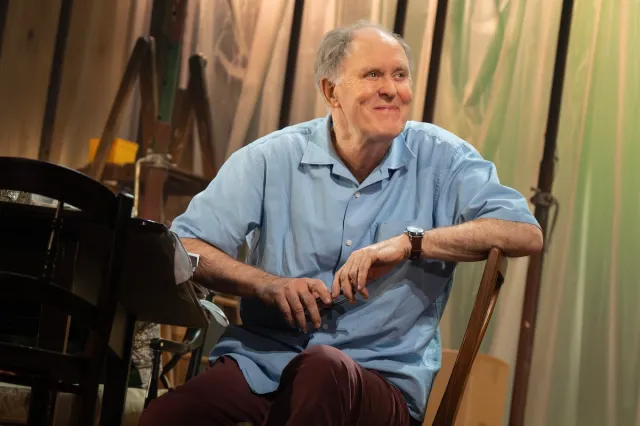
But he asked for it. Lithgow plays Dahl like an old-growth college sophomore. Clever and accustomed to being told so, he drives the conversation with impertinent questions and sarcastic asides, rarely allowing his guests to complete a sentence. Lithgow’s physical appearance seems to have transformed in this role, his hunched frame that of a giant on the wane, his face a sour pucker that occasionally twists in sadistic delight, or melts into genuine grief. It’s a performance that never hides what a bastard Dahl could be while also making us feel genuine empathy for an artist whose principled stance against murder has been interpreted as bigotry.
Nicholas Hytner directs a riveting production that feels much shorter than its two-hour, 15-minute run time, with the supporting cast rising to the high bar Lithgow sets. All wound-up energy from the moment she steps onstage, Cash embodies a woman whose own principles are threatened by the demands of her job. She lets Dahl have it, speaking clearly and assertively to the giant, even as her voice trembles. Levey’s Maschler is harder to read. A tennis racket in one hand, he looks like he wants to whack this controversy over the garden wall. They are a study in contrasting approaches to the scourge of antisemitism—to directly confront or merely deflect?
As Dahl’s saintly fiancée, Stirling performs a balancing act that should feel familiar to any spouse, defending her man in his absence but tearfully appealing to his sense of duty when they are alone. Her performance is so convincing that I briefly suspected Dahl would comply, even though I knew better.
(© Joan Marcus)
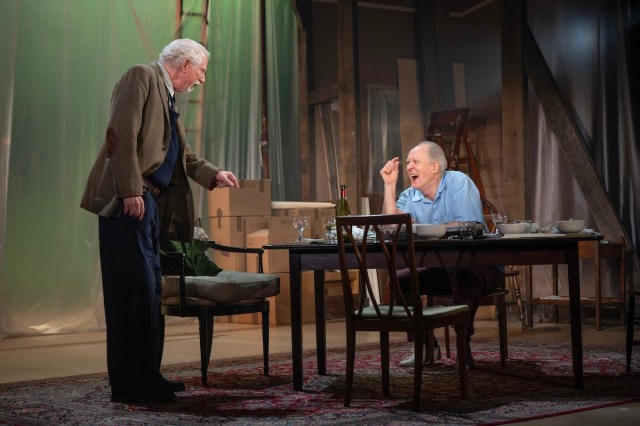
Most interesting are the two servants Dahl approaches for advice. “No one gives a shit what I think,” says chef Hallie (Stella Everett with a gentle Kiwi accent and a Mona Lisa smile). She’s like most of us: Get the job done and get out alive. But groundskeeper Wally (David Manis, emerging from a time machine) offers Dahl the affirmation he craves: “Don’t let yersel’ be pushed about. Mr. Dahl. Not by no one.” A gardener in a wool suit, he is England. If he’s on Dahl’s side, how could he go wrong?
Giant is not just a dramatization of one man’s descent into antisemitism, but a tragedy depicting the failure of the fight against antisemitism, which has mostly been a triumph of manners over genuine persuasion—and the taboo is cracking. An overwhelming majority of Democrats now sympathize with Palestinians over Israelis, and according to a recent survey by the conservative Manhattan Institute, 25 percent of Republican voters under 50 now self-identify as antisemitic, a proportion that discounts all those antisemites who won’t admit it.
“I’m certainly anti-Israeli and I’ve become antisemitic,” Dahl told The Independent in the last year of his life, a confession that Rosenblatt has transposed into Giant. He leaves us to contemplate how many others have made the same journey, accepting the label of bigot as a fair price for uninhibited free expression.




Featured In This Story
Latest Reviews
See all



Latest Videos

Get a First Look at Megan Thee Stallion as Zidler in Moulin Rouge! on Broadway
Megan Thee Stallion starts performances on Tuesday, March 24.