
Review: Eugene Ionesco's Rhinoceros Is Too Capitulating at Yale Rep
Lydia S. Diamond directs Reg Rogers and Philip Taratula in this timely absurdist farce from 1959.
 |
|
|
|
March 18, 2026
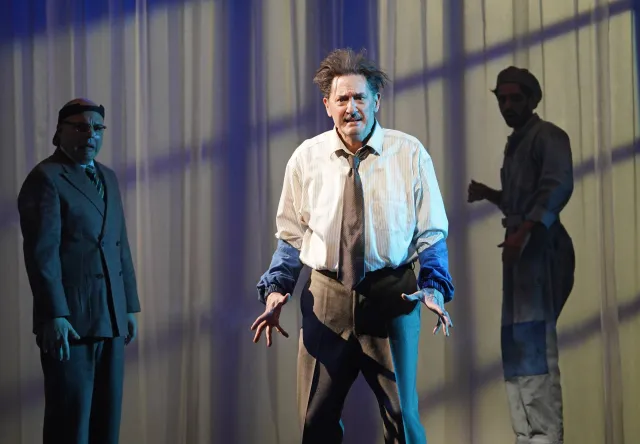
(© Carol Rosegg)
Rhinoceros is both a farcical romp and terrifying warning. Eugene Ionesco’s 1959 play concerns a town whose citizens obediently transform into rhinoceroses—all but for our everyman protagonist, Berenger, the lone nonconformist. A deeply funny tale of profound moral collapse, the play demands those opposing extremes of ridiculous and horrifying coexist on stage. But in Lydia S. Diamond’s tidily arranged revival at Yale Repertory Theatre, the humor far outbalances the dread, making for an amusing production that ultimately lacks bite.
In a French provincial town, the lackadaisical Berenger (a well-deployed Reg Rogers) meets with his friend Gene (a droll Philip Taratula) at an outdoor cafe. Berenger pines after a passing Daisy (a lovely Elizabeth Stahlmann, with little to do); Gene launches into a ritual derision of his friend’s slovenly nature. Normalcy is interrupted by a charging rhinoceros, blowing past with a deafening roar (the thundering sound design is by Xi Lin). Moments later, a second creature tears through in the opposite direction, mauling a cat along its way.
“Oh no,” laments Daisy, as a wailing housewife drifts by cradling the cat’s bloodied corpse. “The rhinoceros ran over her cat. What a tragedy.” It is a startling image, just what the play demands: faced with a truly gruesome horror, society can offer only its feeblest platitudes.
Yet as the animals multiply, Diamond starts shifting the dial towards overt wackiness. At Berenger’s office, a rhinoceros attack leaves its occupant trapped. Recognizing one of the charging creatures as her husband, a woman leaps onto its back in an unfortunate bit of slow-motion choreography (the movement is by Emily Coates, and she includes semi-danced transitions that seem to make fun of themselves).
Gene’s eventual transformation into rhinoceros is also wildly broad. A game Taratula throws himself into the assignment, snorting and snarling with impressive wildness, though he is constrained by strangely orderly blocking. The weight of Beringer’s sharpest, smartest friend disappearing into animality is scarcely felt amid Jennifer Yuqing Cao’s colorless set, where hardly a prop is knocked askew.
A fleet adaptation by Frank Galati knocks Ionesco’s three-act play down to 90 minutes, and does so without sacrificing the stinging satire of his language. Characters speak in useless clichés, repeating meaningless truisms as all succumb, one by one, to numbing conformity.
“Who knows what is evil and what is good?” snorts Berenger’s co-worker Dudard (a perfectly feeble Will Dagger), who today could easily host an alt-right grifter podcast. “It’s just a question of personal preferences.”
In terms of modern resonances, Diamond lets the play do the work. The cynical opportunism of the world’s Dudards, always finding their angle as morals collapse, is maddeningly familiar. So too is Gene’s angry rejection of all sound medical advice, hilariously sustained even while he is mid-transformation into a perissodactyl: “I only have confidence in veterinarians!”
The heart of the play, an inexplicable mob mentality forming around a ludicrous cause, finds clear parallels with the rise of Trumpism. But Ionesco lets no-one off the hook. The feckless townspeople wonder at how such violence could occur in a “civilized” country, insisting this should all be taking place in a far-off land. All find ways to fold each new horror into their existing worldview and soldier on, reminiscent of contemporary musing at a world on fire before we continue idly with our day.
What else can we do? Certainly, Berenger does not know. Far from a hero, he is not even a man of principle. Rogers stays true to Berenger’s essential uselessness, even or especially as he stumbles into a partnership with Daisy, their bond strengthened by a mutual refusal to transform.
It is here, as the two finally lock themselves away, that an enveloping horror should take over. But it simply does not. Diamond closes in on Cao’s straightforward set, shutting out the collapsing world. The idea that years are passing by is not felt at all, and the staging sputters to a conclusion that should stir. Yet the play’s relevance, in a world ever more numbed to its own rising insanity, remains without question.
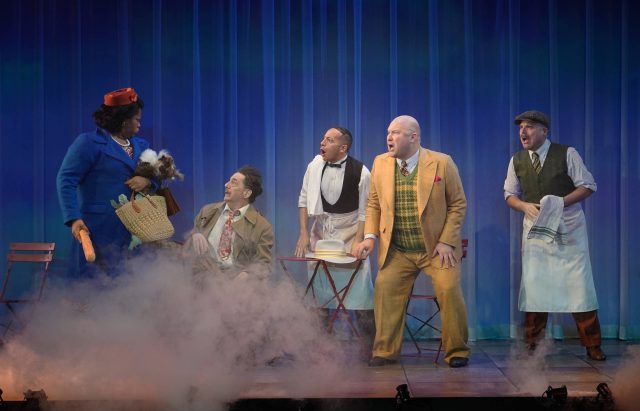
(© Carol Rosegg)




Featured In This Story

Latest Reviews
See all



Latest Videos
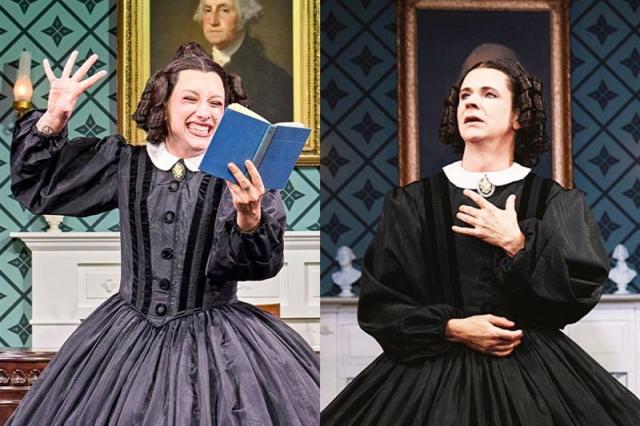
West End vs Broadway: Oh, Mary!—From an Angry Inch to an Angry First Lady, With John Cameron Mitchell and Mason Alexander Park
Mitchell and Park celebrate a decade-long friendship in our latest installment.