
Review: André De Shields Is Tartuffe—Enough Said
Tony winner André De Shields owns the stage again, this time at House of the Redeemer.
 |
Off-Broadway
|
|
Off-Broadway
|
October 20, 2025
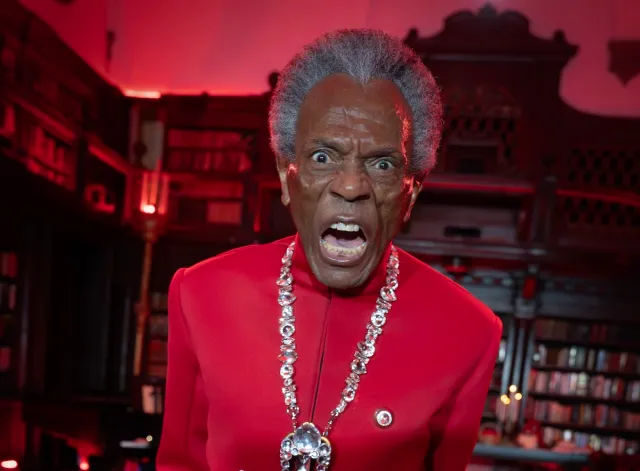
(© Joan Marcus)
André De Shields loves an entrance. He made a name for himself in the title role of The Wiz, bursting onto the stage with “So You Wanted to See the Wizard.” Then, just about 45 years later, he launched the opening moments of Hadestown with a resounding call-and-response as the messenger god Hermes. Last summer, in Cats: The Jellicle Ball, he earned a standing ovation just for standing there, his Old Deuteronomy majestic in an extraordinary long white wig at the head of a runway.
And though there’s no literal runway for De Shields’s Tartuffe, the unscrupulous hypocrite who enters Molière’s satire about halfway through the play, there might as well be. Director Keaton Wooden’s adaptation of Ranjit Bolt’s 2003 translation has literally been retitled André De Shields Is Tartuffe. When Tartuffe enters, first singing “Feelin’ Good” and then a facetiously pious “Ave Maria,” De Shields is accompanied by a prompter dressed in clergyman’s attire and carrying a copy of the script. When the actor needs to call for line, he requests a verse from the gospels—“Chapter Four, Verse 6!” and so forth—so as to fully integrate the promptbook into the storytelling without a whiff of self-consciousness.
In other words, so zealously does this production idolize its star that Tartuffe itself has been, to quote the wordplay in most translations, “Tartuffified.” This is a production set up to celebrate its explosively suave star. And for good reason: De Shields is a commanding, whimsical, and wickedly sensuous Tartuffe.
Just like everything in this production revolves around De Shields, we meet Tartuffe himself as the centripetal force of a household spinning out of control. Orgon (Chris Hahn) has welcomed the impoverished and ostentatiously religious Tartuffe into his home. Quick to call out others’ sins, this guest quickly earns the ire of every member of the household, except for the doting Orgon and his mother Madame Pernelle (a hammy Todd Buonopane). Orgon’s Tartuffe obsession has gotten so bad that he plans to force his daughter, Mariane (Alexandra Socha), to break off her engagement with Valere (a charming Charlie Lubeck) and marry Tartuffe instead.
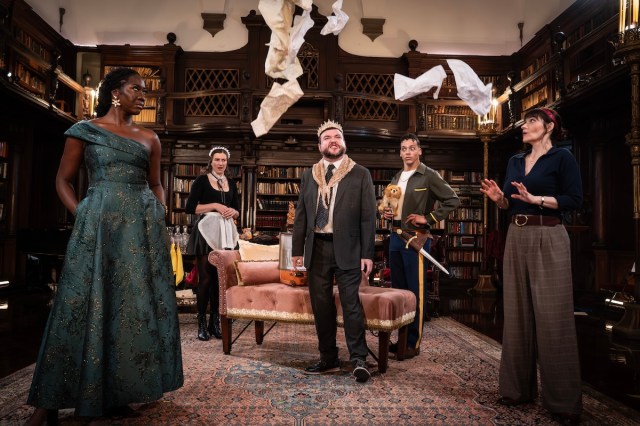
(© Joan Marcus)
When Tartuffe, attempting to turn Orgon against his son (Tyler Hardwick), launches into a self-denigrating, reverse-psychology diatribe, De Shields offers the speech as a divinely inspired, sung-through preacher’s sermon. Tartuffe’s quite obviously performing, but it’s a compelling enough show to understand why Orgon, or even someone a lot smarter, might be won over.
De Shields, then, is reason enough to pay a visit to the 17th-century library of the House of the Redeemer, the extraordinary room on East 95th in which Wooden has staged the play with the audience seated on three sides. The building was constructed to accommodate the original wood ceilings and panels shipped from Italy in World War I, and there’s an uncanny sense crossing the threshold of stepping into the cozily coutured world of the play. More period theater here, please.
The ambience is impeccable. But, except for a dazzling turn from Amber Iman as Elmire, Tartuffe’s would-be paramour who holds her own against him in a pair of scenes that Iman puts across with a magnetically glamorous severity, the ensemble mostly keeps the lights on until the next Tartuffian event.
Playwright Richard Wilbur, in the introduction to his well-regarded translation, wrote, “A fussy anxiety on the part of the director, whereby the dialogue is hurried, cut, or swamped in farcical action, is the commonest cause of failure in productions of Molière. In short, trust the words.” And though Wooden makes great use of the playing space in an animated staging, the rhyming dialogue is indeed hurried, sometimes confusingly over-cut, and swamped in farcical action that either obscures or overexplains.
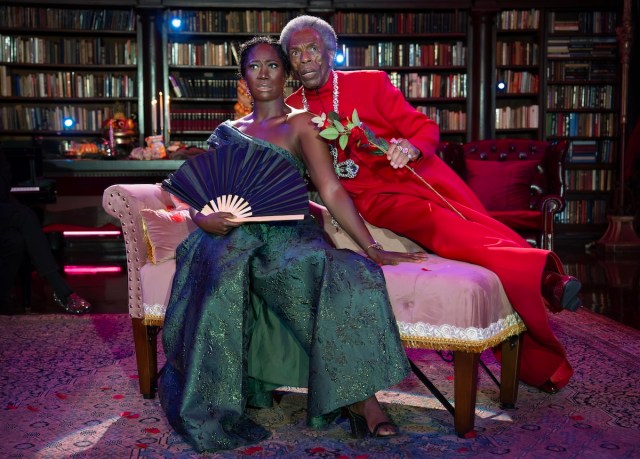
(© Joan Marcus)
That hurrying is problematic, especially in the faceoffs between Orgon and Mariane’s irreverent maid Dorinne (Phoebe Dunn) who relishes telling off the lord of the house. These scenes are oratorical playgrounds in which characters constantly assume viewpoints they don’t hold, usually sarcastically, in order to reveal the vapidity or hypocrisy of their combatants. But the actors speak so quickly here that it’s impossible to keep up with all the rhetorical flourishes; instead, they resort to broad, silly physical gestures to signal those shifts.
Too often the best of Molière’s cleverness is ignored—the subtle persuasiveness of language and the wily ways that characters manipulate words to get what they want—in favor of a blunter physical comedy that’s less engaging over time. Only Iman and De Shields—cool and clear and clever—slow down the pace sufficiently for every carefully launched riposte to land like a grenade.
But don’t worry if you start to lose yourself in the room’s architecture while waiting for the next glorious sighting of De Shields. As the Jellicle Cats put it, “My mind may be wandering, but I confess/I believe it is Old Deuteronomy!”




Featured In This Story
Latest Reviews
See all


Latest Videos
West End vs Broadway: Oh, Mary!—From an Angry Inch to an Angry First Lady, With John Cameron Mitchell and Mason Alexander Park
Mitchell and Park celebrate a decade-long friendship in our latest installment.