
Review: A Cold Murder Case Becomes Dance Theater in Scorched Earth
Luke Murphy’s new piece makes its U.S. premiere at St. Ann’s Warehouse.
 |
Off-Broadway
|
|
Off-Broadway
|
April 9, 2026
(© Teddy Wolff)
Scorched Earth is a fever dream revolving around questions of community and land ownership. Writer/director/choreographer/star Luke Murphy’s new work, making its U.S. premiere at St. Ann’s Warehouse, synthesizes dance and theater into a hybrid that aims for both abstraction and specificity. Though the piece is more successful at the former than the latter, at its best, Murphy’s piece still manages to cast a stark and thought-provoking spell.
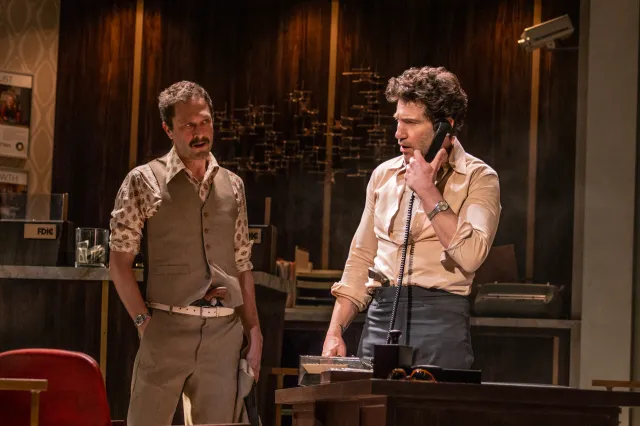
Scorched Earth is, in part, a modern update of John B. Keane’s 1965 play The Field, which tells a based-on-real-events story of a land dispute in an Irish village that leads to a murder and a cover-up. The character names in both works are similar, with Keane’s main character, Thady “Bull” McCabe, becoming John McKay (Murphy) here, and his nemesis William Dee renamed William Dean (Will Thompson). More significantly, Murphy recasts Keane’s narrative as the dethawing of a cold case. Detective Alison Kerr (Sarah Dowling) reinvestigates Dean’s unsolved murder, interviewing both McKay and Leahy (Ryan O’Neill), the sergeant who looked into the killing at the time.
(© Teddy Wolff)
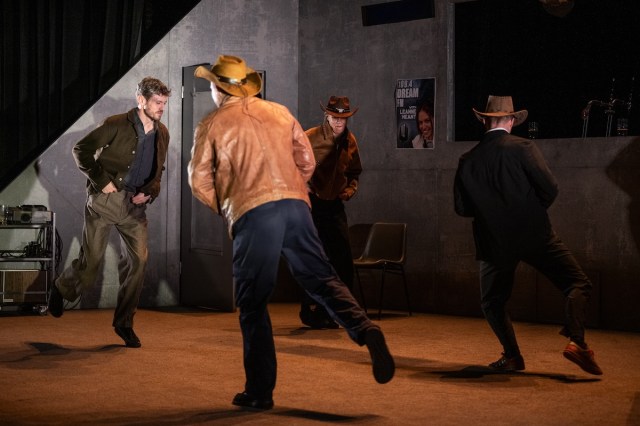
Murphy adopts a narrative and visual style that recalls many contemporary true-crime documentaries, including a fragmented structure that frequently flashes back to the time of the death being investigated. Patricio Cassinoni’s audio-visual design includes numerous police photos, legal documents, and Instagram screengrabs. They are all projected onto Alyson Cummins’s trapezoidal interrogation-room set, with Stephen Dodd suggesting other settings and times of day through his lighting design. Rob Moloney’s original composition and sound design also adopt the dour tone of many nonfiction whodunits, though only in Scorched Earth will you hear a solemn cover of Fleetwood Mac’s “The Chain” underscoring one of its group dances. (In a program note, Murphy cites the documentary TV series The Jinx as another jumping-off point.)
The nature of the land dispute in The Field was more than just personal. The fact that “Bull” McCabe is a lifelong Irish citizen and William Dee a former resident returning to Ireland after many years in England suggests the former sees the latter as an outsider encroaching on his home turf. That nationalistic entitlement, combined with McCabe’s penchant for bullying townspeople into submission, leads an entire village to cover up McCabe’s involvement in Dee’s murder. A similar critique of territorialism undergirds Scorched Earth. Though Murphy sets his piece squarely in Ireland, there’s enough abstraction to allow us to contemplate the universality of how a desire for land ownership is still leading entire nations to commit unconscionable acts of violence.
The downside of that abstraction is that Scorched Earth comes off as less than involving dramatically, especially if you know The Field going in. Murphy in particular isn’t a strong enough actor to make McKay more than an avatar for the themes of nationalism and territorialism he wishes to explore. Though other actors in the ensemble fare better—Thompson comes the closest to evoking a palpable inner life as Dean—Scorched Earth overall reveals a creator who is interested not so much in having anything fresh to add to Keane’s original play as in using its elements as the springboard for inventive dance numbers.
(© Teddy Wolff)
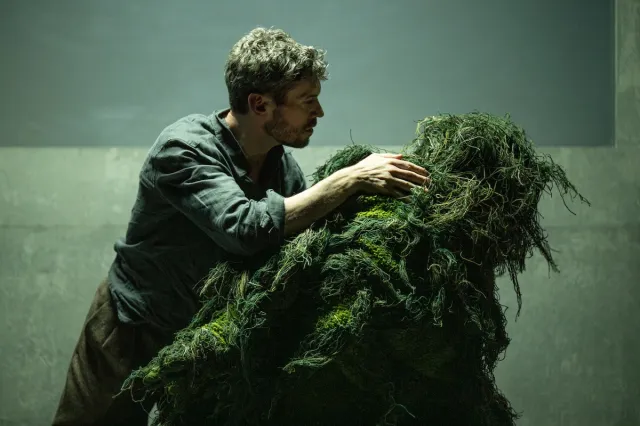
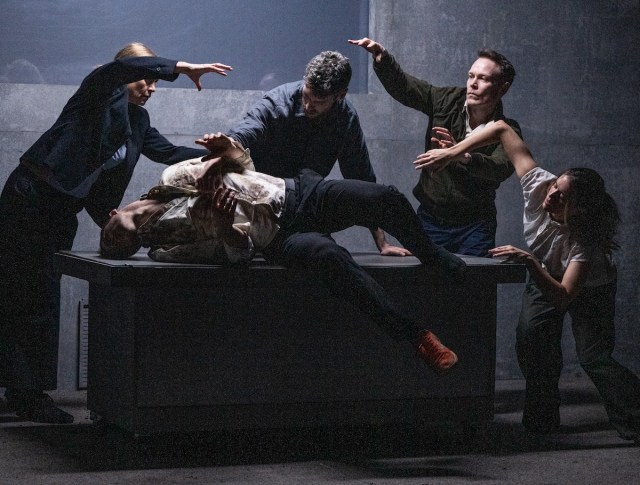
It’s a good thing, then, that the level of invention in Murphy’s choreography is so high and the performers so physically expressive. Right from the ensemble’s opening group dance, the sense of a whole community tenuously bound together is palpable, with all five performers writhing and grabbing one another in ways that signal alternating tension and camaraderie. One sequence doubles as both an interrogation and a dance number as three of the performers, all clad in full-body grass outfits (Cummins also did the costume design), physically menace McKay while he’s giving testimony to Kerr—a bluntly effective evocation of McKay’s inner guilt. More risible is an autopsy scene that risks ridiculousness by featuring a coroner (Tyler Carney-Faleatua) executing dance moves while examining a corpse.
Still, it’s worth sitting through even Murphy’s less successful conceits to get to the show’s breathtaking concluding sequence. In it, the cast members gradually dismantle the set, revealing a large raised patch of grass upon which all five performers try to reach the top, sometimes fighting with each other, other times working in solidarity. All of them repeatedly fall back down amid the Sisyphean effort until Murphy emerges victorious, reaching the top while lamenting, “Look what you’ve made me do.” It is difficult to imagine a more poetic encapsulation of the at-all-costs mentality of not just this particular wannabe landowner, but of all people and nations willing to shed blood to claim property for themselves.




Featured In This Story
Latest Reviews
See all
Latest Videos

Get a First Look at Megan Thee Stallion as Zidler in Moulin Rouge! on Broadway
Megan Thee Stallion starts performances on Tuesday, March 24.