
Playwright David Auburn and Director Thomas Kail on Revisiting Proof at 25
Auburn’s 2001 Pulitzer- and Tony-winning play Proof opens April 16 at the Booth Theatre.
 |
Broadway
|
|
Broadway
|
March 31, 2026
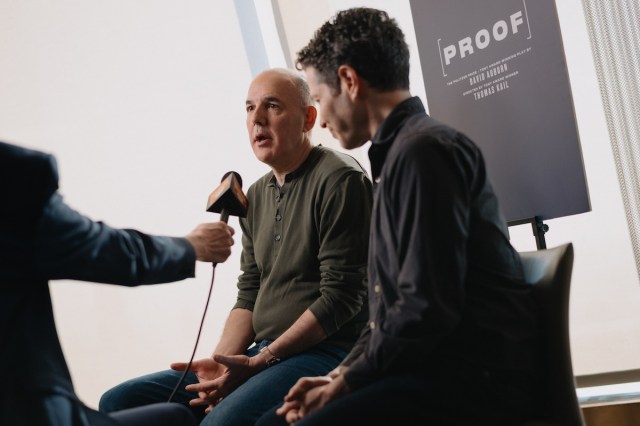
(© Andy Henderson)
In 2000, David Auburn made his Broadway playwriting debut with Proof. It was an unassuming four-person play about a family of mathematicians, and it walked away with both the Pulitzer Prize for Drama and the Tony Award for Best Play in a field that included works by Tom Stoppard, August Wilson, and Charles Busch.
“At every stage it’s exceeded my expectations,” Auburn said at a recent press event for Proof’s first-ever Broadway revival, opening at the Booth Theatre on April 16. Tony-winning director Thomas Kail spearheaded the project, which gathered a starry cast featuring Emmy and Golden Globe Award winner Ayo Edebiri as the young and preternaturally gifted Catherine; Oscar nominee Don Cheadle as her brilliant but mentally deteriorating father, Robert; Jin Ha as his ambitious student Hal; and two-time Tony winner Kara Young as Catherine’s sister Claire (replacing Samira Wiley who recently departed the cast).
Read on for TheaterMania’s interview with Auburn and Kail, who reflected on Proof’s 25-year legacy, their new rehearsal-room discoveries, and the inconspicuous connection between math and art.
This conversation has been condensed and edited for clarity.
When did you start toying with the idea of reviving Proof?
Thomas: I started talking to [Mike] Bosner and Andy [Jones] about the prospect of doing it and we were talking about, where could it live? Could it live off-Broadway in the way of Danny and the Deep Blue Sea? And then we talked to David [Auburn] and David said that what he cared about was, let’s find the right group. We sent the play to Ayo—we all agreed that she’d be a tremendous Catherine—and she said yes really quickly. So we did a reading a little more than a year ago and that lit the fuse. We knew that we had a group that we wanted to try to keep together. And here we are. Somehow, we’re in rehearsal about to open on Broadway.
David, how does it feel for you to revisit this play 25 years after its original Broadway production?
David: It’s a little like looking at an old picture of yourself. You get to say, “Alright, I didn’t look so bad. But why was I wearing that shirt?” There’s a lot that you enjoy seeing again and there are some things that you think you know how to do a little bit better now. but that’s not the point in a lot of ways. The point is what a new group of actors brings to it and what a new director brings to it.
Your actors have said that you’re really digging into what this story means for a Black family living in Chicago in the early aughts. How has that element affected the world of the play?
Thomas: I mean, it’s a central question and something that we talk about as we examine every scene and every moment. It’s the experience that we’re trying to communicate and so we want to be honest about that, and that comes from these conversations with the cast. I feel like the beauty of theater, especially when the writer’s here, is that everything’s possible. We’re doing the play, but we also want it to feel like it’s made for this company. Right now, we’re just kind of chipping away at the thing, but it’s such a good company. They’re all so excellent at their jobs and so deeply committed to trying to do honor to this play.

(© Andy Henderson)
Over the past 25 years, Proof has become a staple in the canon of contemporary theater. Every actor has studied scenes from it in drama school, it’s produced all over the country, it spawned a movie with Gwyneth Paltrow and Anthony Hopkins. Did you expect any of this when you wrote it, David?
David: I didn’t expect necessarily that it would be produced. I thought it was very possible that I’d end up producing it myself with friends. I had little theater companies and groups of people and that’s what you did. You didn’t expect a theater to take it on. At every stage, it’s exceeded my expectations as to how it’s been received. It’s just a sort of extraordinary thing that I never anticipated.
Tommy, as someone who started as an audience member, why is Proof a play that stuck with you?
Thomas: I love a good family play. I saw the original company in 2000 or 2001. I saw it with my folks. And at that time, I was the age of Catherine. I was a 25-year-old kid trying to figure a bunch of stuff out. And I just was so struck by the way the play allowed me to laugh, and how it was full of sentiment and not sentimentality. There’s a real precision to David’s writing, but he’s also not afraid to try to make you feel something. That’s the only kind of theater that I’m interested in making. I want to make something that’s entertaining as heck and I also want to try to move you. I feel this play gave us the blueprint to make that happen.
We see the main characters in Proof overcome with a kind of creative madness. They’re mathematicians but can you both relate to that feeling as artists?
David: You’re always trying to sort of push into a place that you don’t quite understand as an artist. Hopefully you can get yourself there some of the time without bad things happening. I think I’m pretty sane. I think my feet are on the ground. But in some ways, approaching that territory where you don’t really feel grounded is part of what you try to do as an artist. And I think the same is true for mathematicians, as far as I understand it. I certainly can’t do any kind of math, let alone high-level math, but they talk about it in very similar terms that artists talk about their work. They want to do something that has elegance and beauty and creates surprise and suspense. Those are the same words we use.
Thomas: I probably didn’t know it then, but as a younger person who was interested in making something out of nothing, that’s what this play is also about. It’s about what it means to generate. What it means to take something that no one has seen and bring it to bear. The weight of that, and the challenge of that. There’s this section that Catherine has towards the end of the play where she says, “When I look back, all I see is the stuff that doesn’t work.” The parts that are lumpy. You don’t have to be an artist or a maker to understand that. You just have to be a human doing your best.




Featured In This Story
Latest Reviews
See all
Latest Videos

Get a First Look at Megan Thee Stallion as Zidler in Moulin Rouge! on Broadway
Megan Thee Stallion starts performances on Tuesday, March 24.