
Interview: Rob McClure Talks About Long Life Onstage—and in Spare Parts
The Mrs. Doubtfire star can currently be seen off-Broadway at Theatre Row.
 |
Off-Broadway
|
|
Off-Broadway
|
March 18, 2026
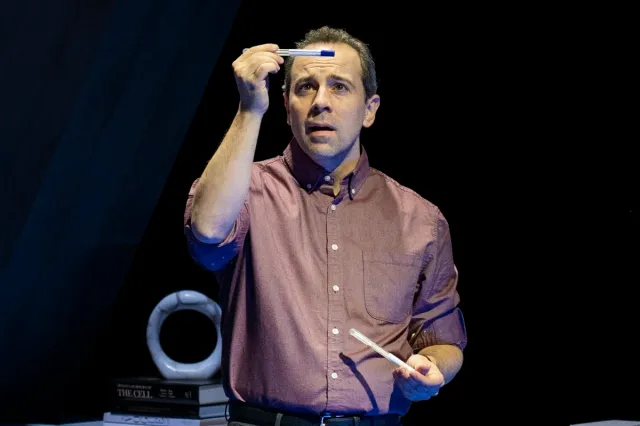
(© Russ Rowland)
Rob McClure first attracted theatergoers’ attention when he stepped into the hit musical Avenue Q in 2006 and has since delighted audiences as the star of Broadway shows such as Chaplin, Something Rotten, and Mrs. Doubtfire.
For now, though, McClure is resting his singing voice by playing the longevity scientist Professor Coffey in David J. Glass’s compelling off-Broadway drama Spare Parts, about a billionaire who chooses to go to extraordinary lengths to try to live longer (maybe forever).
TheaterMania recently spoke to McClure about what attracted him to the project, his own take on ethical dilemmas, how it feels not to have to sing onstage every night, and the future of the revised Damn Yankees, in which he starred last year at Arena Stage in Washington, DC.
This conversation has been condensed and edited for clarity.
What attracted you to the project?
They reached out to me to do a table read about a year and half ago. They sent me the script, and I was taken with the science. And then I read up on David J. Glass, and in learning about how legit he is as a scientist [Glass is vice president of research at a biotech company and a lecturer at Harvard Medical School], that really made the play feel imminent, not science-fiction. We have seen this sort of cautionary tale as hypothetical, but this no longer hypothetical. Plus, it’s a reminder that theater is cyclical: this play is “to be or not to be” all over again.
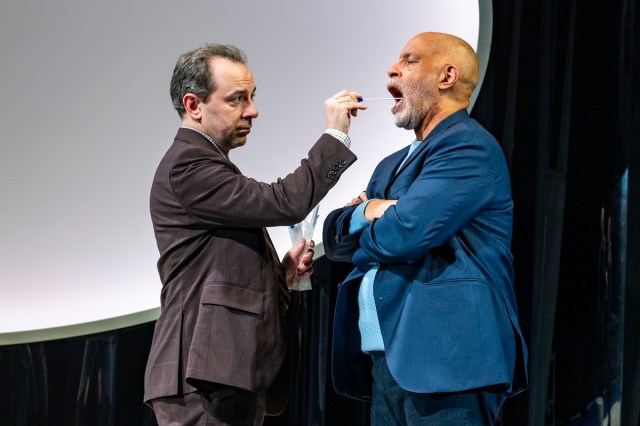
(© Russ Rowland)
Would you want to expand your lifespan for 50 years?
I expect that answer will change as I get older. Is it a pill rather than a blood component? What will it cost? The play also is about how a billionaire class is going to make our decisions, and whether the less fortunate can participate. That’s a factor as well.
Your character faces numerous ethical dilemmas throughout the show. Was that interesting to play?
I think what the play does so beautifully is how it shows that everyone has a price tag, and how everyone’s hands are dirty. When each character expresses his POV, he is so righteous. All four characters are tested by this situation. And so much of what my character is up against is the lack of government funding, and the idea that I might have to do the one thing I don’t want to do to achieve the great and noble things that I do want to do. The play backs the characters into corners, and that’s fascinating. In some ways, it reminds me of Sweeney Todd, or Walter White in Breaking Bad. What would I do in those situations?
While you only had to deal with a little medical jargon, did you find any of that hard to learn?
This show is 100 percent different than what I’ve done before. I love that every couple of months I get to dip a toe into an alternate life. I was very lucky to have David in the room. And my co-star Matt Walker has a PhD in genetics. So, I had help when I needed it. I also remember when we were rehearsing this one scene about DNA swapping and Matt actually had the equipment in his bag.
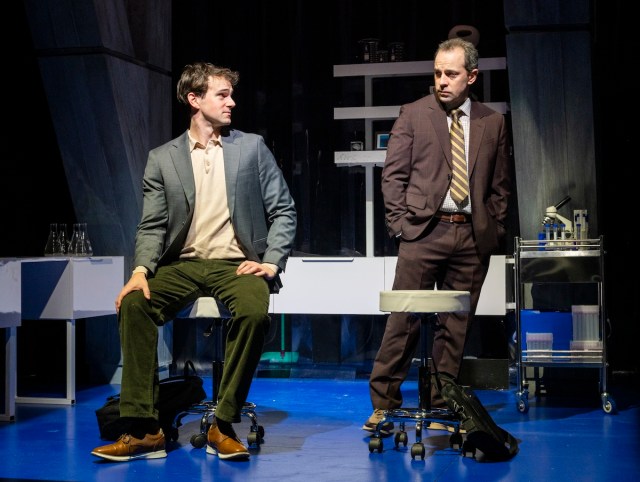
(© Russ Rowland)
One of the most notable aspects of this project is you don’t sing. How does this affect your day-to-day life differently?
I don’t immediately have to test my vocal range. I can wake up and do something different than see how I hit a note. But in the other sense, it’s exactly the same for me whether my part is being sung or spoken. The same things that make me tap-dance in a musical is what makes Coffey go into his spiel about genetic findings; it’s about being passionate. And like with all great shows, in Spare Parts, we meet Coffey at the moment when everything changes for him.
Another difference for you is that this is an off-Broadway theater, rather than the Sondheim, where you starred in Mrs. Doubtfire, or the MUNY in St. Louis. How does that affect you?
For me, whether I’m playing the 11,000 seats of the MUNY or the 100-something seats of Theatre Three for Spare Parts, it feels surprisingly similar. I think any show can feel intimate when done correctly. As an actor, all you have to do is play the reality of the situation.
Finally, we have to discuss the production of Damn Yankees you did at Arena Stage? How fun was it to play Applegate? And is it coming to Broadway?
I wish I knew the answer to the latter. I had the time of my life with that company. Applegate was delicious to explore, and since so many actors have played him before, I wanted to give the part my own take. I wanted to make him scary. Sure, he is funny and provides the show’s comedy, but he has to be dangerous foe for Joe. He really has to seem like he is the devil. Of course, I would like it to come to Broadway, but in this business, you have to take things one day at a time.




Featured In This Story
Related Articles
See all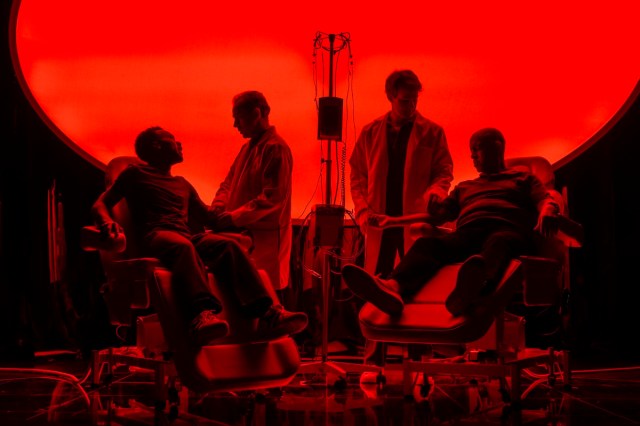
Latest Reviews
See all


Latest Videos
West End vs Broadway: Oh, Mary!—From an Angry Inch to an Angry First Lady, With John Cameron Mitchell and Mason Alexander Park
Mitchell and Park celebrate a decade-long friendship in our latest installment.