
Interviews
Interview: Oedipus Tony Nominee Mark Strong Finds Theatrical Alchemy on Broadway
The versatile actor breaks down the physical intensity and “jazz energy” behind his latest acclaimed performance.
 |
Broadway
|
|
Broadway
|
May 29, 2026
(© Tricia Baron)
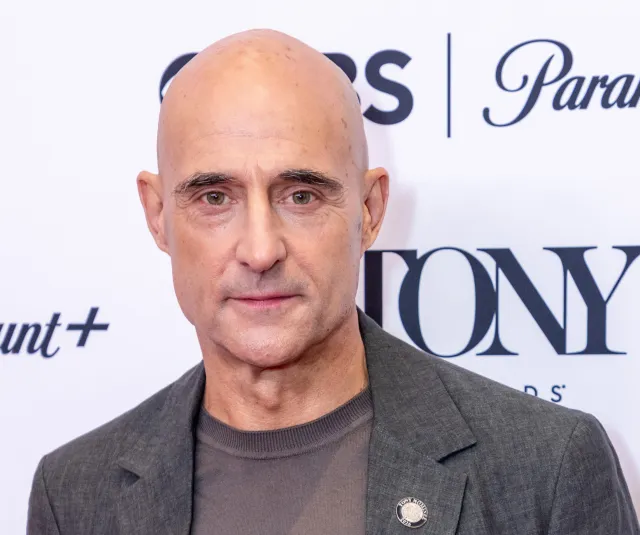
“We’re always chasing the alchemy in this business,” Mark Strong says. “Nobody starts a play without hoping it’s going to be amazing. Occasionally, everything comes together, and the alchemy works.”
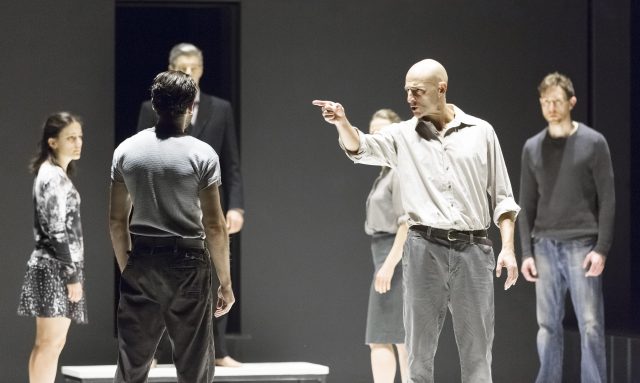
Strong, one of the silver screen’s most reliable villains, has achieved that alchemy twice on the New York stage: 10 years ago in Ivo van Hove’s revival of Arthur Miller’s A View from the Bridge, and last fall in Robert Icke’s adaptation of Oedipus. It was Strong’s second Broadway show, the second production he’s been part of that left audiences too stunned to speak, and it now marks his second Tony nomination.
“This isn’t me showing off or anything,” Strong says with a laugh as he explains his entrance into an exclusive club. “I think there are only three people in the history of the Tonys who have a 100 percent record of being nominated for shows that they’ve done. Now, I’ve only done two, right? Nevertheless, that’s a 100 percent record.”
Strong wasn’t sold on the idea of Oedipus when Icke pitched it. Then again, he wasn’t sold on the idea of A View from the Bridge, either. Ultimately, both productions “had a great way of delivering what had sort of drifted into becoming a ‘heritage play’ and brought it right up to date. When I think of Oedipus, when I think of Greek tragedy, I imagine robes and wailing. There was something about the way that we’d modernized it that allowed young people to come in. With both plays, we found a younger audience, an audience who might not have gone to see those plays originally. And that’s incredibly important.”
(© Julieta Cervantes)
The idea of casting Strong as Oedipus came around when Icke directed him in David Hare’s The Red Barn at the National Theatre in 2016, shortly after View closed on Broadway. “I really enjoyed working with Rob. He’d was working on a Dutch incarnation of Oedipus, and I thought his adaptation was genius.”
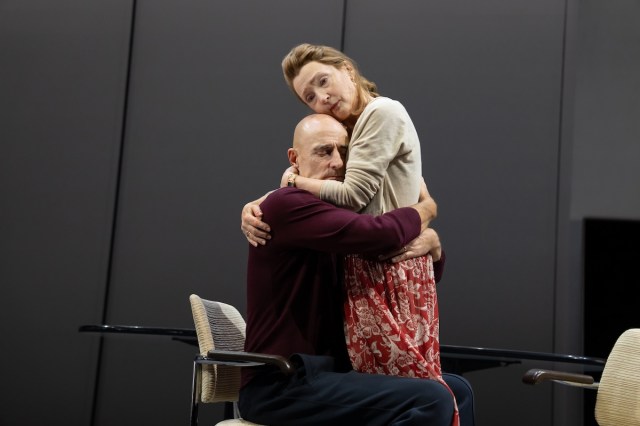
Icke’s sets the tragedy against the backdrop of a modern election, with Oedipus (Strong) discovering the truth about his relationship with Jocasta (Lesley Manville) just as the results are called in his favor. This creative choice reflects Strong’s broader philosophy about theater itself.
“What’s the point of doing stuff in traditional versions if people are going to feel like they’ve seen them before, or not going to see them [at all] because they feel they know what they are?” Strong muses. “It doesn’t matter whether it’s Shakespeare or Greek tragedy. If you can make something relevant and give it the strength that his productions all seem to have, so that people really do feel that they’ve witnessed something special, I totally see no harm in that.”
That philosophy is imbued within every moment of Oedipus, from the primal love scenes between Strong and Manville (“Rob Icke productions give you no room to hide,” Strong says) to a terrifying sequence in which Strong’s Oedipus violently throws his grown children across the room after learning that they are, in fact, his half-siblings. The performers landed with a horrifying thud—”They wanted me to be as physical with them as I possibly could and I was constantly asking them if it was too much,” Strong remembers, noting that a stunt coordinator helped keep everyone safe—and the moment landed with an equally scary realism.
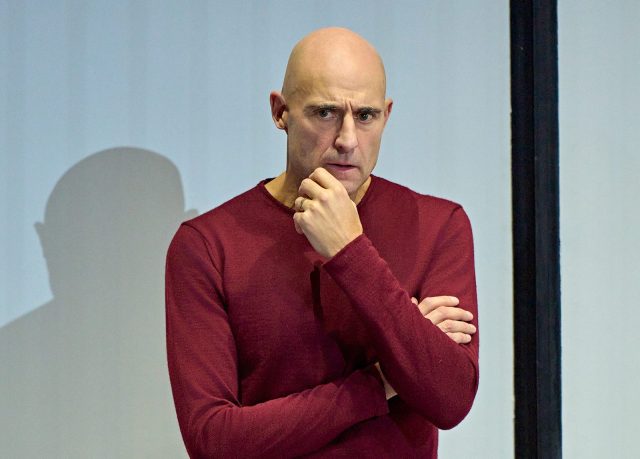
“Everything he’s believed in, and all the love that he’s had for his family and the world that he thinks that he’s in just crumbles,” Strong notes. “It says in the script that he roars from the depth of himself, and there was a way that it could have been done as a big show. By facing upstage, it made it much more devastating. Throwing his kids away from him with the force that he does, he realizes it’s all over.”
Naturally, Strong’s interpretation of the role grew over the course of his time playing Oedipus, but he was admittedly surprised when Icke wasn’t contented with the early days of the Broadway transfer, having already completed a very successful West End run several months earlier. “We were not complacent, but we thought we had it. Rob played us a piece of classical music at normal speed, and then he played a jazzier, sped-up version. The first piece of music, we went ‘Oh, that’s beautiful.’ Second piece of music was the same, but sharper. More modern. He went ‘Which do you prefer?’ And we all said, “The second one, because you can hear the refrain of the first, but there’s some energy to it.’ He said, ‘That’s what you need to be doing with the production. You’ve all settled too much.”
The reset worked: months after the run ended, they were honored with seven Tony nominations. Strong speaks of the nod less as a prize to be attained and more as a recognition of a singular moment. “The nomination, I think, is the thing that I take great gratitude in. It means something that I was doing was recognized by my peers.” For him, nothing means more than that.
Eventually, Strong could go three-for-three, as he and Icke are trying to figure out a production of Macbeth. “When he asked me, my initial reaction was, it’s done so much,” Strong says. “But as an actor, if you get the opportunity to play the part, you’ve got to play it. He took me through all the things I worried about, and one-by-one, he managed to settle my nerves.”
When shall we two meet again? Hopefully, in less than a decade.
(© Jan Versweyveld)




source on Google
Latest Reviews
See all






Latest Videos
Watch the Trailer for Elsinore Starring Andrew Scott
The film is based on the true story of Ian Charleson, who played Hamlet at London’s National Theatre after being diagnosed with AIDS.