
Interview: John Kani Revisits Master Harold as a Tribute to Playwright Athol Fugard
The legendary South African actor stars in the Geffen Playhouse production of Fugard’s seminal drama.
 |
Los Angeles
|
|
Los Angeles
|
April 7, 2026

(© Jeff Lorch)
Johannesburg, March 1983. Only three months earlier, a five-day ban on Athol Fugard’s new play, “Master Harold”…and the boys, had been lifted, the work having been previously condemned by the Publication Control Board as “indecent, obscene, immoral, and offensive to public morals.” Now, as the drama edged toward its South African premiere at the Market Theatre, the playwright, who was in New York, sent word to his trusted friend, the eminent actor John Kani, who was preparing to take the stage: seek out, if he could, Sam Semela, the real-life inspiration for the character he was about to play.
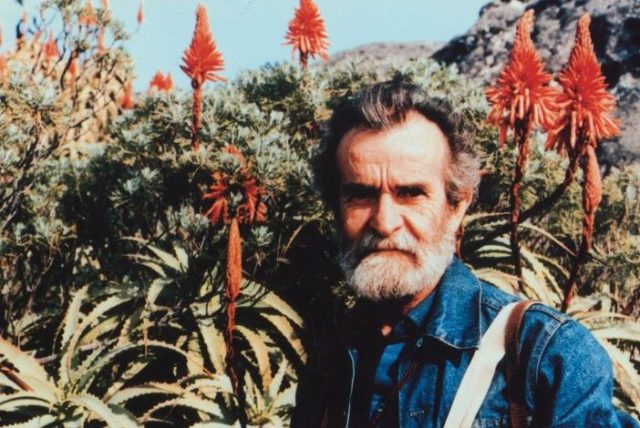
Los Angeles, April 2026. Kani, now 82, tells the story as if it happened yesterday. He had been tasked with flying the real Sam from the Black township of Port Elizabeth, where he, Semela, and Fugard all once lived, to Johannesburg for opening night, as Fugard intended to publicly apologize for an incident at the heart of the play. Sam had worked in the Fugard family teahouse and, in many ways, taught the boy who would become the celebrated dramatist how to be a man. In the play, as in life, the young Fugard spat in Sam’s face in a burst of adolescent rage, a gesture that irrevocably altered their relationship.
“I spent four days looking for Sam,” Kani recalls. “When I arrived, I knew something had happened because there were a lot of people outside. I said, ‘I’m looking for Sam,’ and they said, ‘He died last night.’” The furniture was piled outside the Semela home, a Xhosa tradition marking the death of the head of a household. Fugard never had the chance to apologize in person. “I was that little boy who abused him at a moment of terrible confusion and pain in my life,” the author told me in 2016. “The shame of that moment—the climactic moment in the play—I will take with me to my grave. You can’t wash away something like that.”
(© Billy Rose Theatre Division, the New York Public Library)
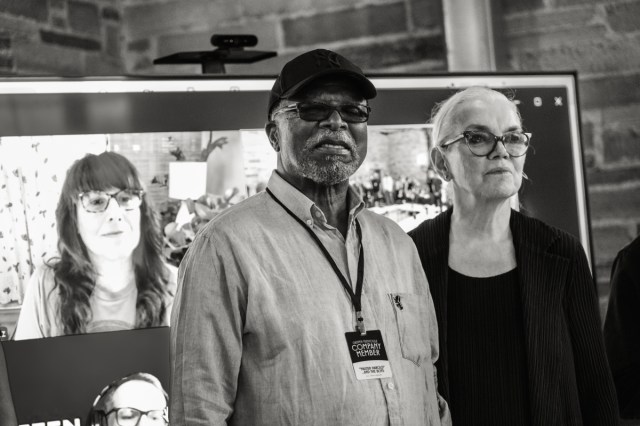
It’s with those memories in mind that Kani returns to the role of Sam in the new Geffen Playhouse production of “Master Harold”…and the boys, co-directed by Emily Mann and Tarell Alvin McCraney. Mann, a longtime colleague of both Fugard and Kani, pitched Kani the idea after Fugard’s death, at the age of 92, in 2025, and beyond needing to adjust the character’s age in the script, Kani couldn’t say no. “It’s for him,” Kani says. “It’s for the memory that I continue to hold dear in my mind of all the things we went through together. It’s for a great writer, a great human being, and a dear friend.”
The experience has provided Kani with the ability to “not remember, but rediscover” the play, while sharing his lived experiences with the two other actors in his cast, Nyasha Hatendi, who plays the other server, Willie, and Ben Beatty, who plays Fugard’s stand-in, Master Harold. “I’m celebrating a democratic, non-sexist, non-racist South Africa, and now I go back to 1950 [when the play is set], just two years after the regime got into power. They got into power in 1948, and by 1950, they had implemented over 300 racist laws.”
There was much discussion about the history of apartheid during rehearsal, of course, but thanks to Mann, says Kani, “I’ve been able to create a distance from all I know,” which has enabled him to see the play in 2026 through the eyes of his castmates. “It’s almost like it’s an intergenerational conversation,” he says.
(© Jeff Lorch)
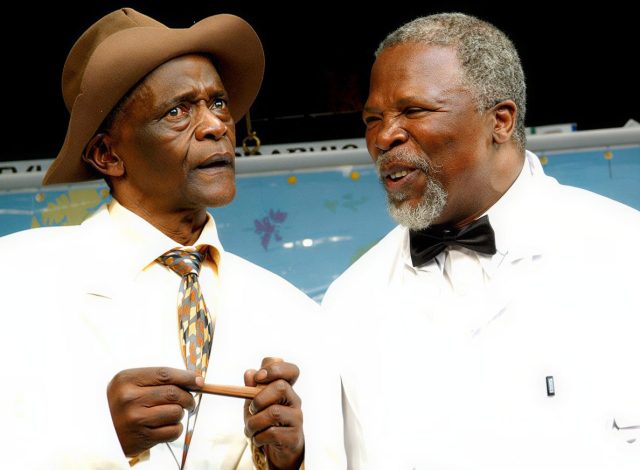
Of course, Kani’s personal history with Fugard, and with Winston Ntshona, who was the third in their theatrical triad and died in 2018, looms largest. Together, they authored the anti-apartheid plays Sizwe Bansi Is Dead and The Island, the latter of which earned Kani and Ntshona a rare joint Tony Award for Best Actor in 1975and, when they performed it back home, led to an imprisonment that made international headlines.
Kani says that government officials justified their arrest by citing Clive Barnes’s review in the New York Times, accusing the actors of feeding Barnes information about South Africa’s repression. “The security police read the review as if I said those things, but it was not me. He was white, he was in America, and he wrote this review. They didn’t want to listen to me; they said, ‘You made him say these things.'” Kani and Ntshona were interrogated, tortured, and held in solitary confinement for 23 days before being released amid protests across New York, London, and South Africa. “They opened the cell door and said, ‘You can go home. Seems like these people from overseas like you.'”
That was just a few years before the assassination attempt that led to the loss of his left eye (he has worn a prosthetic ever since). “There are 10 people that will be eliminated by the 16th of June 1982,” Kani was told. He was on a list with the likes of Winnie Mandela and Bishop Desmond Tutu. “What am I doing here? I’m not an activist, I’m an actor,” he says now. “Eleven stab wounds. I was left for dead. I even heard them saying, ‘Let’s go, he’s dead.'” It was a young white doctor at the trauma center who saved him.
(© Harold Gess)
“They had just had bad press for something, and the young white doctor didn’t want any news press to come in, so they decided to move me and hide me.” His would-be assassins couldn’t find him to finish the job. “I went back to the hospital to find the young white boy who didn’t want any press, and nobody could remember who was in charge that night. I owe that gentleman my life.”
How does one get the courage to not just go on after that, but to do it with your head held high? “I believe in human decency,” Kani says. “I believe that I’m not just here to make Black Panther films,” he says of the Marvel movie series that made him internationally famous as King T’Chaka. “There must be a purpose of my life, and I find that purpose fulfilled within my work onstage as a writer and actor.”
Part of that purpose now includes furthering Fugard’s legacy through productions like “Master Harold,” which Kani calls “a gift I got from the Geffen Playhouse, from Emily, and from Tarell.” Fugard may be gone, but he remains ever-present. “When I step back as an elderly 82-year-old man, I can hear him. I see him behind me all the time. I can hear him all the time.”
(handout image)




Featured In This Story

Latest Reviews
See all
Latest Videos

Get a First Look at Megan Thee Stallion as Zidler in Moulin Rouge! on Broadway
Megan Thee Stallion starts performances on Tuesday, March 24.