
Interview: Gina Torres Talks About Returning to Broadway in Buena Vista Social Club
The Suits star embraces her Cuban heritage in a long-awaited Broadway homecoming.
 |
Broadway
|
|
Broadway
|
October 16, 2026
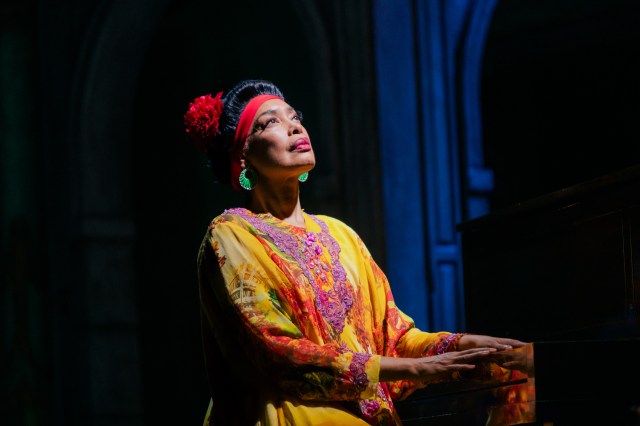
(© Andy Henderson)
It’s been 32 years since Gina Torres last trod the boards of Broadway, and her current seven-week stint, in the acclaimed musical Buena Vista Social Club, will be longer than her last one—in The Best Little Whorehouse Goes Public, which closed after 28 previews and 16 performances in 1994. That was after she made her Broadway debut a year earlier in another flop, David Henry Hwang’s Face Value, which closed before it officially opened.
“I think I had two posters up at Joe Allen at the same time!” Torres says with a laugh, referring to the famed eatery lined with window cards of theatrical bombs, and relishing her new gig. “Hopping onto this bullet train that is Buena Vista Social Club is really lovely.”
For Torres, who spent seven seasons as law firm honcho Jessica Pearson on the TV show Suits and recently appeared as Gertrude to Patrick Ball’s Hamlet in Los Angeles, playing the leading role of Omara Portuondo in Buena Vista during Tony winner Natalie Venetia Belcon’s absence (through November 29) is a welcome change, both a homecoming for the Bronx native and a way to connect with her heritage.
The daughter of Cuban immigrants, Torres grew up listening to the music of their homeland, and had a chance to visit the Caribbean country when she was in her teens, “just before and after the Soviet Union had pulled out,” she says. “A lot of my family was still there.”
So Torres was thrilled when she was offered the chance to join the Broadway production, having been swept away by the musical when she saw it a year earlier. “I just absolutely fell in love with the show and told everybody that I knew that they had to go and see it. I was in the audience with a whole lot of Cubans, and we all got extremely emotional watching this story play out in such a beautiful and intimate and ultimately triumphant way. It was a harkening back to a time that for the most part was really very happy.”
Inspired by the 1999 documentary film, the musical unfolds in two timelines, the 1950s, just before the Cuban Revolution, and the 1990s, as the same characters reckon with the past and Omara finds herself reunited with the music and the people she loved as a young woman. The lyrics are in Spanish, yet the show’s success with audiences who don’t speak the language doesn’t surprise Torres.
“The music is infectious, regardless of whether it’s sung in Spanish or not,” she says. “I think that when music speaks to you, it’s in the melody. It’s the actual music that hits your solar plexus and infiltrates your being. And with the characters, there’s something about the emotions that everybody’s going through, whether it’s fulfilling a dream or having a familial rupture. There’s something for everyone to plug into.”
Going into Buena Vista with only two weeks’ rehearsal comes with its share of challenges, especially since Torres is singing some of the show’s signature numbers, such as the romantic bolero “Dos Gardenias.” She’s counting on the training she received as a student at the LaGuardia High School for Music & Art and the Performing Arts to see her through.
“I have to remember to warm up my voice as much as possible and do all those vocalises that I learned when I was studying voice,” she explains. “And stay healthy. I was primarily doing musicals when I was first starting out and living very much like a nun! Getting as much rest as possible. No hanging out at night. No smoky bars when people were still smoking in bars. And as I’ve gotten older, I don’t live that way ’cause I’m doing a play. That’s just how I live my life.”
She’s still in touch with friends from her school days and they, along with other members of her “chosen family,” will be cheering for her in her Broadway return. Torres has found success playing characters whose ethnicity wasn’t central to their stories. Now, she’s glad to have a part that allows her to embrace her background.
“The approach isn’t different because I still have a job to do,” she says, “but the feeling is delicious. It’s wonderful to be able to bring everything that I am, everything that I learned as a child—the pride that I was taught to have in my culture, to have in my language—to a role. After so many years in the industry, to be able to play a Cuban woman is wonderful.”
(© Joan Marcus)




source on Google
Featured In This Story

Latest Reviews
See all








Latest Videos
Watch: Ellen Greene Reflects on the Enduring Legacy of Little Shop of Horrors
Frank Oz’s cult classic movie-musical has gotten a new 4K restoration in celebration of its 40th anniversary.