
Interviews
Interview: Daniel Monks on Chekhov, Shakespeare, and Rewriting the Narrative of Disability Onscreen
Monks starts in Twelfth Night at London’s Barbican, and opposite Sarah Snook in Peacock’s All Her Fault.
 |
London
|
|
London
|
December 10, 2025
In just two years, Australian actor Daniel Monks has tackled Chekhov on two continents, shot major screen projects like Peacock’s All Her Fault and HBO’s Game of Thrones prequel A Knight of the Seven Kingdoms, and now finds himself stepping into Shakespearean romance as Duke Orsino in the Royal Shakespeare Company production of Twelfth Night at the Barbican.
Monks, a survivor of a childhood astrocytoma tumor that grew around his spine, has emerged as one of the more impactful stage performers at the moment, broadening the range of roles made available to disabled actors simply by playing them as written. Here, he reflects on what true inclusion looks like on stage and screen.
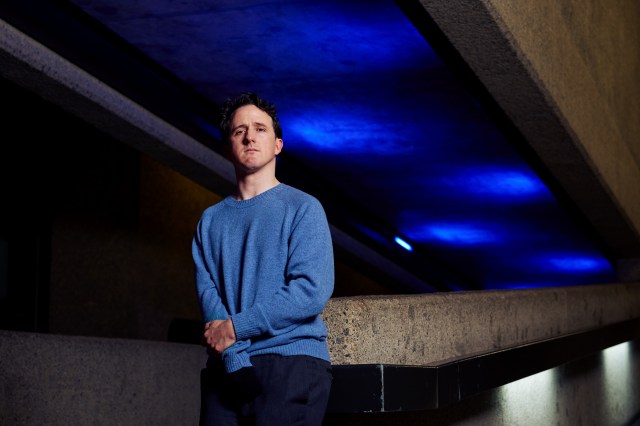
(© Helen Murray)
This conversation has been condensed and edited for clarity.
What a crazy couple of years this must have been for you.
Totally. I did Cherry Orchard at the Donmar in London, and then I went to film All Her Fault and A Knight of the Seven Kingdoms, and then we did Cherry Orchard in New York. It was cool as well, because Sarah was doing Dorian Gray in London when I was doing Cherry Orchard, and then doing Dorian Gray in New York while I was in New York. It was kind of bookended in the same way.
Benedict Andrews’s Cherry Orchard was one of the best Chekhovs I’ve ever seen. It made it feel so vital and alive.
It was one of the best experiences I’ve had in the theater. I love that company so much — I know everyone says that, but I really did. Nina Hoss is an actress who I’d watched for years in German cinema. She was my main pull to want to work on it. Don’t meet your heroes, but if your hero is Nina Hoss, you should, because she exceeded all my expectations both as an actor and a human. It was just the best time ever.
There are far worse ways than to spend springtime in New York than by doing a play on the Brooklyn waterfront.
Absolutely. It was really exciting. It was my first time performing in New York, and New York is where I really fell in love with theater. I started going in my early 20s and would stay on Australian time and see a play every night and stay out all night.
The Aussie theater cohort was out in full force last spring.
Basically, Australians all know each other. When I moved to Sydney, the first play I saw was one of Benedict’s productions for the Sydney Theatre Company. Kip Williams, who did Dorian Gray with Sarah, I did Lord of the Flies at the Sydney Theatre Company with him in 2019. His designer, Marg Horwell, who won the Tony and the Olivier, did my very first play in Melbourne. And it’s just very cool that all of this was happening at the same time in the same city.
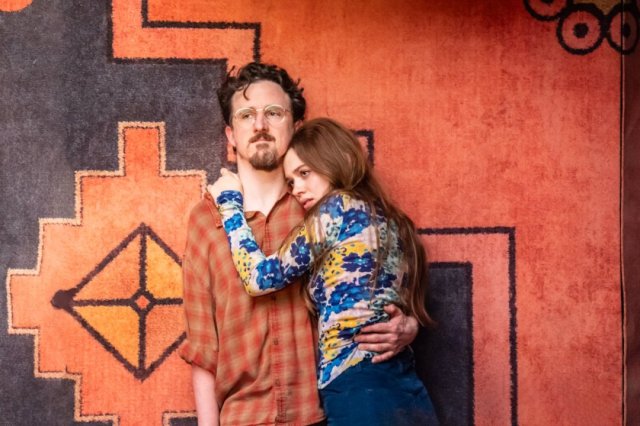
(© Johan Persson)
How did Twelfth Night come about for you? You didn’t do it at the RSC last year because you were shooting.
I had met the director, Prasanna Poonarajah, when I did my first play in London in 2019, which was Teenage Dick. Out of the blue, I got a voice note from him offering me the role of Orsino. It seemed like a dreamy thing. I usually play the angry young man in the Chekhovs. I did Konstantin in The Seagull and Trofimov in The Cherry Orchard. Orsino I never even had on my radar. I’ve played a lot of people who are very burdened with knowledge, and Orsino does not have that problem. He is full of emotions and feelings, but not much thought goes into anything. I just get to be silly and fall in love, which is a nice thing.
In terms of representation, what is it like to play a role like that, where disability isn’t the focus of the character, as opposed to something like All Her Fault, where it is?
My first play in Australia was called The Real Imagined History of the Elephant Man, by Tom Wright. My first play in London was Teenage Dick. Both of those characters are written disabled. For me, it feels important now more than ever to be part of telling authentic stories about disability, because, so often, they’re told from a very abled lens as Oscar bait. We need to have authorship of our own stories.
Having said that, I want to be part of telling all stories. I want a rich, varied, sustainable career. I don’t want to be called upon just when there’s a character that happens to have my disability. What’s great is I went from playing roles that were written as disabled to Konstantin, to Mickey Marcus in The Normal Heart at the National, to Trofimov, to, now, Orsino. For true inclusion, when it comes to representation, we need to be able to play all roles.
Because I am disabled, the lens in which I see the world is invariably shaped by my experience as a disabled person. In playing these roles that aren’t disabled, I don’t need to think much about the disabled component, because I will bring that lens to it in a way that hopefully will be more interesting for audiences.
It’s interesting looking at All Her Fault, in terms of the way your character shifts. He’s disabled from a childhood accident, and he goes from being under the thumb of Jake Lacy’s older brother character to assuming his own bodily autonomy by the end.
My character in the novel is not written as disabled. Megan Gallagher, the writer/showrunner/creator, is the parent of a disabled child, and she really wanted to put that storyline in. Peacock was really supportive of it. Often, the narrative is an able-bodied person’s idea of disability, which is disability equals tragedy, and we overcome the tragedy and win an Oscar. Peter, Jake Lacy’s character, speaks so much about, like, “You’re not going to be confined to that” or “We’re going to overcome this.”
For myself, as a disabled person, and most disabled people I know, true freedom and empowerment comes from embracing our disability, and, in doing so, allowing, without guilt or shame, the supports that we need in order to access the world without it meaning anything lesser about us. This is actually bucking the potential ideas about disability that have been represented in media beforehand. To have that narrative in such a big show on a big platform is really cool.
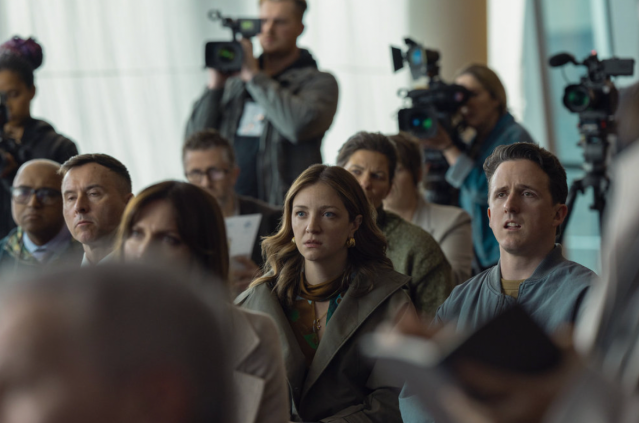
(© Sarah Enticknap/Peacock)




Latest Reviews
See all


Latest Videos
West End vs Broadway: Oh, Mary!—From an Angry Inch to an Angry First Lady, With John Cameron Mitchell and Mason Alexander Park
Mitchell and Park celebrate a decade-long friendship in our latest installment.