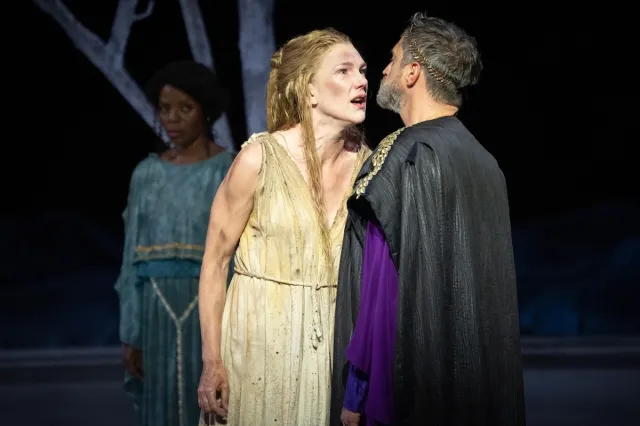
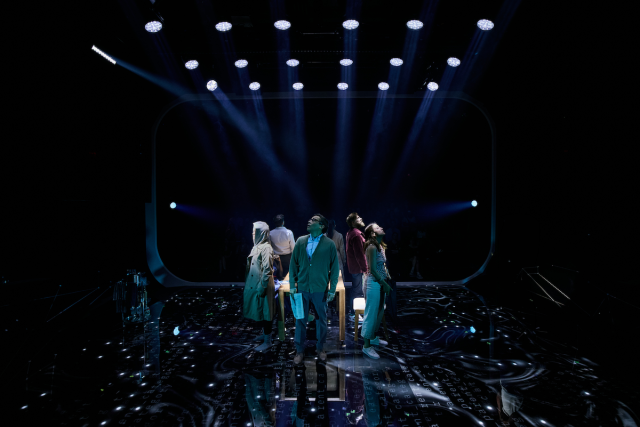
Nicole Lowrance in Engaged
(Photo © Gerry Goodstein)
Did you see the way that Hideki Matsui genuinely created two runs just from the way that he ran the bases against the Kansas City Royals on Sunday? His achievement made me recall the ad-line the Yankees’ used a few years ago to sell their season: “At any moment…a great moment.”
It’s true! Even if your team is down to its last strike and is behind 18-0 in the ninth inning, you might see a tape-measure-distance home run or an astonishing catch by an outfielder who jumps up to catch a fly ball, falls into the bullpen, but still holds onto the ball. At any moment…a great moment.
Of course, that’s true of theater, too. You never know when greatness is going to strike. That occurred to me again the other night while I was watching Engaged, which the Theatre for a New Audience is presenting at the Lucille Lortel Theatre. This 1877 comedy by Sir W.S. Gilbert (yes, the same guy who wrote those musicals with Sir Arthur Sullivan) tells of Cheviot Hill, a young man of property who just might be a distant relative to Harold Hill. Both of them are con-men, but the profound difference is that Cheviot doesn’t realize it. His weakness is the female sex, so whenever he meets a fetching young woman, he proposes marriage to her. Never mind that he just asked for a woman’s hand three minutes ago. He’s already forgot that, because he’s blinded by the new lass’ loveliness. Understand that there isn’t a mean platelet, let alone bone, in Cheviot’s body. It’s just that when he’s not near the girl he loves, he loves the girl he’s near.
Cheviot is being sensationally played by Jeremy Shamos, who shakes subtly but hilariously or writhes in romantic agony when he gets close to a new beauty, crooking his fingers in a strange type of arthritic ardor. He’s uses the same trite line on ever lady, without — here’s the important part — realizing that it’s a line at all. “You are the tree upon which the fruit of my heart is growing” is just what he happens to be feeling in his heart, and each time he says it, he believes it’s the first time he ever has. All these wonderful eccentricities result in Shamos giving one of the best performances of the year.
But that’s not my point. As sensational as Shamos is, he isn’t quite as sensational as Carl Wallnau was when he played Cheviot Hill last fall at Centenary Stage Company in Hackettstown, New Jersey. I know, I know — you’ve never heard of Hackettstown, or if you have, it’s only because you’re a candy freak who knows that’s where M&Ms, Mars, Skittles, and Snickers are made. But if you wanted to see the quintessential Cheviot Hill, that’s where you had to go, 56 miles from New York.
Baseball pundits are fondly of calling their sport “a game of inches,” meaning that the result of a contest can be swayed by a player missing — or hitting or catching — a ball by an inch or two. Actually, as one ex-minor-leaguer told me, baseball is actually a game of quarter-inches, for even that tiny bit can make or break a game. But Wallnau’s facial expressions and vocal insinuations were even more precise than Shamos’s by a hemidemisemi quaver. He offered many great moments at a great many moments.
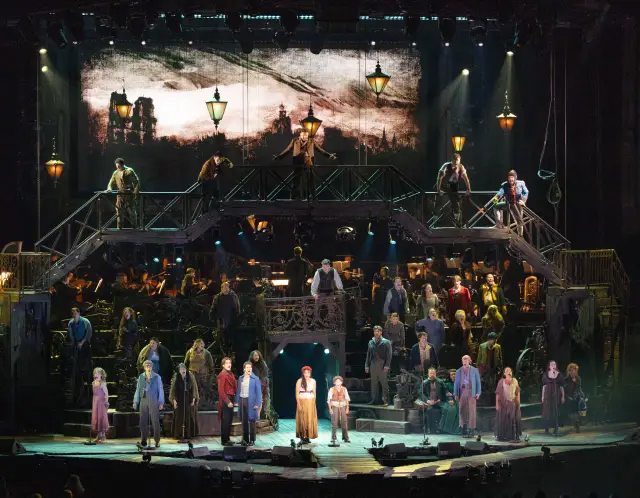
I recently saw Henry IV, Part II at the Shakespeare Theatre in Washington in what turned out to be a very good production. Still, I always judge this play by the “renunciation scene,” as it’s often called, in which Sir John Falstaff shows up in the court of his old pal Hal, who’s just become the newly crowed Henry V. Falstaff expects — literally — a royal welcome, but he sure doesn’t get it. When the new king makes his debut, he lets the knight know in no uncertain terms that it’s all over between them.

in Henry IV, Part 2
(Photo © Richard Termine)
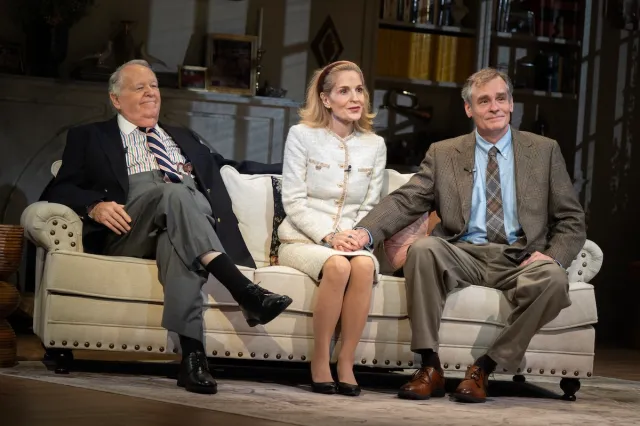
Alas for me, when Ted van Griethuysen’s Falstaff knelt down before his new king, he kept his right hand on the cane he’d been using, so it blocked my view of his face during the entire scene. That’s too bad, because I wanted to see if he’d be as good as the Falstaff who played the best renunciation scene I’ve ever seen. And if you think I’m about to tell you he was Kevin Kline in the much-heralded production he did this season at Lincoln Center, you’re wrong. Kline was certainly amazing, but even better was a young actor named John Kinsman who played the role three-plus years ago for a fledgling company called Ring of Fire Productions in the Clemente Solo Velez Cultural Center on Suffolk Street.
“Who? What? Where?” you say. Oh, how I’d love to take you back in a time machine to see him. When the renunciation scene arrived and Henry gave Falstaff a baleful look, Kinsman was masterful in showing a face that at first said, “Ah, you sly dog, you’re kidding me,” before changing it to, “You know, I’m starting to think you’re not kidding.” Then he switched to “No, of course you’re kidding, we’ll be friends to the end,” to “Oh, my God, you’re really not kidding.” Kinsman’s face then displayed, “All right, let me pretend that I think you’re joking and that I’m actually enjoying your trying to put one over on me, so that you can see I think it’s a joke, which will give you a chance to pretend you have indeed been joking all along — even though I know you haven’t.” Then came the appearance of disappointment that conveyed, “Oh, Hal, how can you do this to me?” followed by an utter look of defeat, before showing us that Falstaff is now facing an uncertain future that he never ever expected to see. Every one of these was done in a second or two before morphing to the next emotion.
At any moment, a great moment.
********************
[To contact Peter Filichia directly, e-mail him at [email protected]]