Long Day’s Journey
into Night
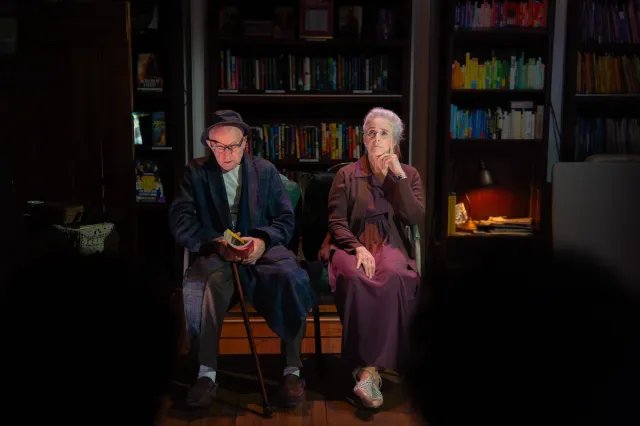
The most ironic aspect of the earnest, generally solid, yet ultimately wearying revival of Eugene O’Neill’s Long Day’s Journey Into Night, running through May 28 at Victory Gardens is that Steppenwolf ensemble member John Mahoney, best known from television’s Frasier and various films, seems utterly miscast in the role of an actor. A meat-and-potatoes performer with a gravelly voice and average-American aura, Mahoney is best-suited playing CIA operatives, politicians, and grumpy not-quite-old men. But when he plays the family patriarch, James Tyrone, in this autobiographical O’Neill classic, imagining the plain-spoken, seemingly humble Mahoney in the role of a classical actor and former matinee idol seems to be quite a reach. It’s hard to imagine this actor treading the stage as King Lear or spending a lifetime performing The Count of Monte Cristo as O’Neill’s father, James O’Neill, did. Willy Loman, perhaps, but James Tyrone? Not quite.
Mahoney gives it a game effort and turns in respectable work, but his performance, which lacks sufficient emotional range, is symptomatic of a production that, under the direction of Sheldon Patinkin, takes a workmanlike approach throughout, dulling the impact of O’Neill’s drama.

into Night
Long Day’s Journey…, completed in the early ’40s but unproduced until three years after O’Neill’s death in 1953, has the capacity to be one of the most emotionally draining experiences that a modern American theater audience can have. To watch the members of the Tyrone family destroy themselves and each other is the dramatic equivalent of watching a deadly automobile accident in deliberate slow motion–slow enough, in this case, that the final collision takes nearly four hours to complete.
Over four lengthy acts, the action takes place over the course of one summer day and night in 1912 at the Tyrone summer home in New London, Connecticut. Since the play’s first production, the closest American theater has gotten in the past 50 years to this kind of unblinking look at self-destruction and family dysfunctionality is, perhaps, Albee’s Who’s Afraid of Virginia Woolf? or, on the big screen, the John Cassavettes film A Woman Under The Influence. Yet O’Neill’s work offers little of the sense of justice and gallows wit of the former or the small sense of hope presented by the latter.
The production, presented by the Irish Repertory of Chicago, also has some particularly high standards to meet, since this mounting closely follows the sizzling Court Theatre production of O’Neill’s Desire Under The Elms and the Goodman Theatre’s sublime revival of A Moon For The Misbegotten which is now on Broadway with a handful of Tony Award nominations in its pocket. In this respect, all of the performers here have their moments. Annabel Armour, despite an unconvincing silver wig, haunts the stage in a morphine-addicted haze of denial, desperation, and utter loneliness as the mother, Mary Tyrone. John Judd, spewing forth rage and self-loathing, skulks about in his father’s shadow as the Tyrones’ alcoholic son, Jamie. David Cromer coughs up poetry and blood as consumptive younger brother Edmund. Rengin Altay is both puckish and knowing as the Tyrones’ tippling maid Cathleen. As for Mahoney, he is particularly effective in a long scene with Edmund in which he essentially admits that he is willing to shortchange his son’s health in exchange for a more affordable tuberculosis sanitorium.
But because the production feels under-rehearsed, with its pacing and blocking more scripted than organic, the performances never really coalesce. Mahoney rarely conveys the gravity or tragedy of his role, and there are more than a few moments when each actor seems to be performing a scene in an entirely different theater from the others. This leaves the tragic journey of the Tyrones, while bleak and heart-wrenching from any perspective, to be far less affecting in the end than it should be. There is misery here, but the production skirts its borders than diving into it–and that, after having traveled a very long journey into blight.