
Review: Wayne Brady and Billy Porter in a La Cage aux Folles That's Still Finding the Best of Times
Robert O’Hara directs the Jerry Herman-Harvey Fierstein classic for Encores!
 |
New York City
|
|
New York City
|
June 18, 2026
(© Joan Marcus)
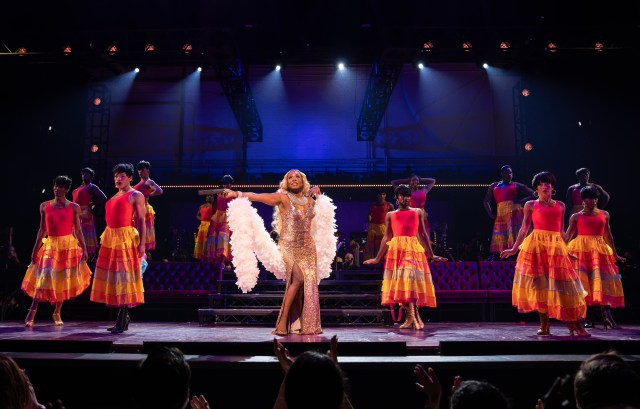
Is there a greater rush of euphoria than “The Best of Times Is Now”? One of the of the all-time great showstoppers, it exemplifies what composer Jerry Herman described as the “simple, hummable showtune,” one of his buoyant, life-affirming anthems that live in your head for weeks. When it arrives in the second act of La Cage aux Folles, it’s a full-scale volcanic eruption of musical-theater joy.
It’s the one moment where the joy finally comes out in Robert O’Hara’s New York City Center Encores! revival, a contemporary reimagining of Herman and Harvey Fierstein’s musical comedy. But O’Hara’s typically ambitious vision and Encores’ typically compressed 10-day rehearsal process don’t jibe. You can see the seeds of O’Hara’s point of view being planted, but they haven’t been given enough time to take root.
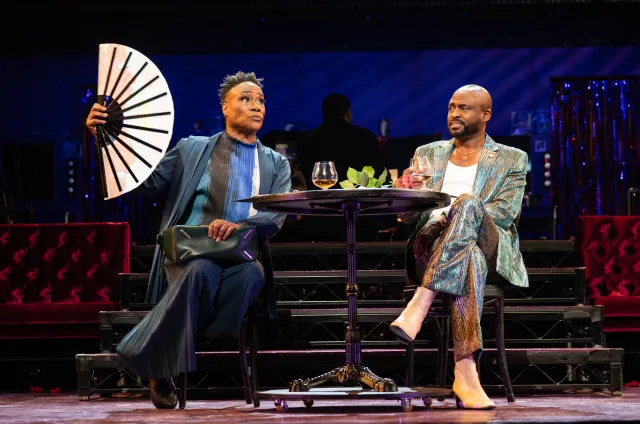
At its most basic level, the Tony-winning musical, based on Jean Poiret’s 1973 French farce, was a barrier-breaking work of the early AIDS crisis, introducing Broadway audiences to a loving gay relationship amid rampant political misinformation (even the original Arthur Laurents production and revivals as recently as 2010 cast heterosexual actors in the central roles). O’Hara takes the premise a step further, transforming this birdcage into a broadly queer, Black nightclub, presided over by the suave Georges (Wayne Brady), but really ruled by his volatile partner Albin (Billy Porter), who channels his energy into his performances as the glamorous drag queen Zaza.
(© Joan Marcus)
Offstage, Georges and Albin are parents to Georges’s 24-year-old son Jean-Michel (Alaman Diadhiou), who arrives home with news that he’s getting married to Anne (Rachel Webb), the daughter of a homophobic politician and his wife (Peter Francis James and Sharon Washington). Jean-Michel, unwilling to reveal that his “mother” is a man, instead opts to de-gay the household and banishes Albin for one night. It’s a farce, so naturally, things go haywire.
Fierstein’s book is sturdy enough to support a post-Obergefell reimagining, and at a moment where queer rights remain distressingly under threat, the premise of a homophobic politician trying to strip people of their rights in the name of “family values” feels even more urgent in 2026 than it did in 1983. AIDS may not be the same death sentence it was 40 years ago, but as this production reminds us, a spectrum of queer lives are still in grave danger at the hands of close-minded bigots.
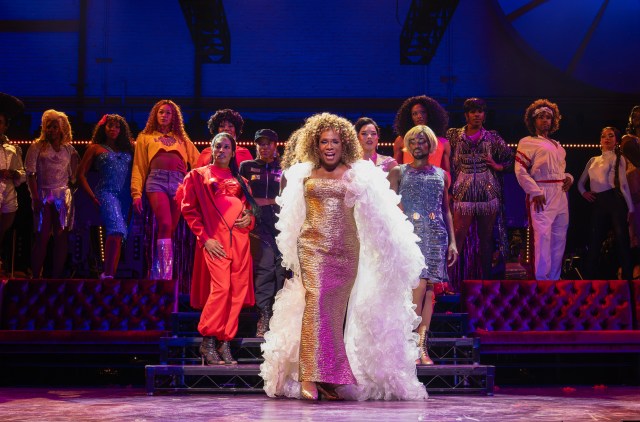
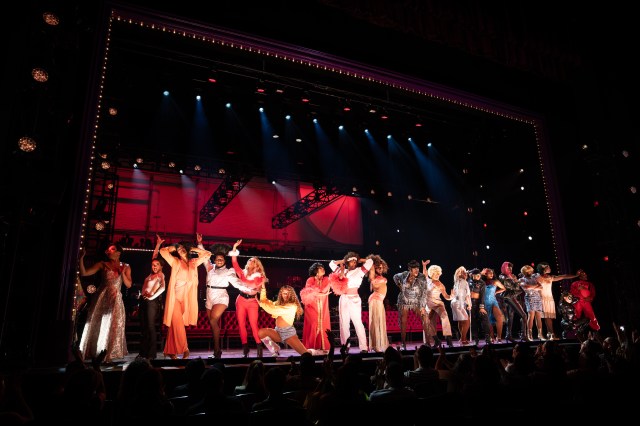
But many of O’Hara’s additions feel more like accoutrements than anything else. The Cagelles are expanded into a wide array of gay, trans, and genderqueer performers (as opposed to simply being men in drag), executing contemporary choreography by Edgar Godineaux and costumed by Clint Ramos and Michelle Ridley as a kaleidoscope of homages to Beyoncé, Mariah, Rihanna, Whitney, Tina, Donna, Janet, and Grace. The concepts are fun but messily executed, especially the dancing. You can’t look at it without thinking that Cats: The Jellicle Ball has already successfully achieved what this production is still trying to work out (in fairness, they’ve had years.)
(© Joan Marcus)
The performances will solidify over the course of the two-week run, but on opening night, both Brady and Porter seemed fatigued; physically, in both cases, and vocally in Porter’s. Of the two, Brady needs the most work: he’s a slick emcee, but he’s locked into a presentational style that reads as discomfort. Once he sheds it, he should be able to find the fuller depth of Georges’s heart—it already exists in his scenes with Diadhiou, a charming tapper who dances up a storm to Dormeshia’s specialty choreography.
Porter meanwhile, has the makings of a fabulously scathing Albin/Zaza, crafting an “I Am What I Am” that feels like an exorcism of the “Billy Porter” media persona that has dogged him for years and accrued as many detractors as admirers. One of the only two performers who know how to land the laughs in Fierstein’s dialogue (the other being James Jackson Jr. as the housemaid Jacob), it’s just a shame that music director Joseph Joubert, leading the great orchestra through Herman’s buoyant score, didn’t find a way to adjust the keys to better suit Porter’s current vocal range. That aside, it’s a tremendous return to form for a performer who, less than a year ago, was in a coma from sepsis and nearly died.
The ultimate takeaway from Robert O’Hara’s La Cage aux Folles is that there are a lot of intriguing thoughts that have been prevented from cohering by the accelerated timeline. That’s why “The Best of Times” lands with such force. It’s not just a second-act showstopper, it’s a reminder of how glorious La Cage aux Folles can be when everything clicks. For five minutes, it truly does, and they really are the best of times.
(© Joan Marcus)




source on Google
Featured In This Story

Latest Reviews
See all






Latest Videos
Watch: Ellen Greene Reflects on the Enduring Legacy of Little Shop of Horrors
Frank Oz’s cult classic movie-musical has gotten a new 4K restoration in celebration of its 40th anniversary.