
Review: The Betrothed, a Pleasing Romp for a Hot Summer Night
Scarlett Grace McCarthy queers the canon in this new comedy.
 |
Off-Broadway
|
|
Off-Broadway
|
July 21, 2026
(© Austin Ruffer)
Ever wondered if works of Jane Austen would be better with bisexual characters? (Yes, I have.) Then consider The Betrothed, a queer reimagining of the Victorian marriage plot at WP Theater. Scarlett Grace McCarthy’s buoyant script is cheerfully rendered by an all-female-identifying cast in a fun and mostly successful absurdist outing.
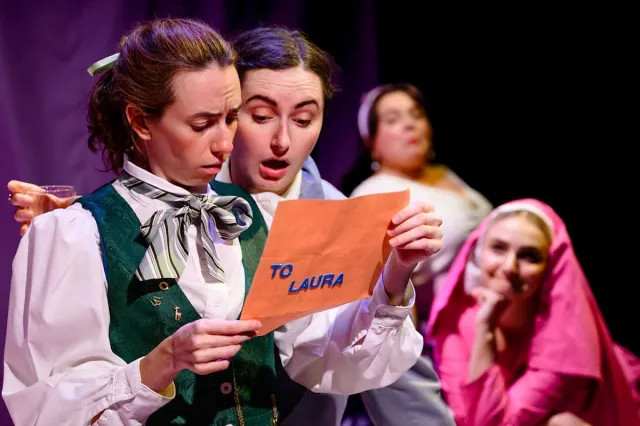
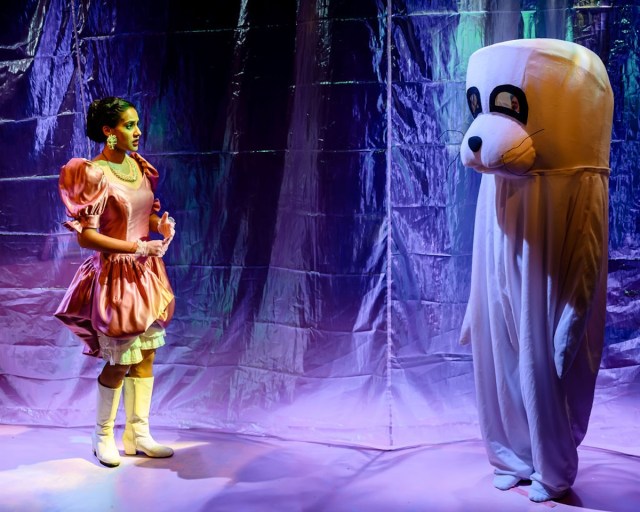
Kitty (Emily Oliveira) has just come of age and is hot-to-go for her childhood best friend Conrad (Enette Fremont), a destitute playboy who’s just returned from a long sea voyage. She’s pretty sure she can entice him to marry her, but according to her father (Caroline Hawthorne), she must wait for her brother Percy (Georgia Kate Cohen) to marry Laura (Annaporva Green) before she’s officially on the market. Unfortunately for Kitty, her sibling’s wedding is called off because of a misunderstanding. Spurred into action to get them back together, her scheme gets more complicated when a nun named Florence (Abby Erff) falls for Percy. Additional wrinkles come from an Arctic Seal (Hawthorne) whose goal is slowly revealed as he gives the characters advice on a rocky beach.
McCarthy’s dialogue crackles, hitting a sweet spot between Victorian vernacular and today’s speech. “Did you know that Eleanor of Aquitaine married Henry II to avoid being kidnapped? Maybe I should get kidnapped,” Kitty swoons while flirting with an imaginary suitor. “These days, a young woman must go to extraordinary means to stand out from the pack and secure a husband.” The plot beats are familiar, lifting elements from everything from Cyrano de Bergerac to Great Expectations, but the skilled articulation makes it feel fresh.
Kitty’s main goal is having someone to kiss, yet she is aware of and frustrated by the male-dominated society around her that cuts her down. Oliveira navigates these character elements believably while getting laughs, winning our hearts easily. Cohen takes a big swing with Percy, doubling down on physical comedy to portray a simpering, fussy rich boy. Not every choice worked for me, but the ones that did hit hard (I’m still laughing about his slow slide out of a chair, under a desk, and out the other side as her character whines about lost love).
(© Austin Ruffer)
Erff is delightfully weird as Florence, and Fremont’s Conrad is a perfect blend of bravado and idiocy. The only disappointment is Hawthorne’s Seal, who is played too straight for a giant talking animal. Using almost no physicality, Hawthorne doesn’t emote enough to hit the beats McCarthy’s has laid out. Hawthorne’s performance as Father is much stronger, so perhaps it’s the mascot costume that’s tripping her up.
While some hallmarks of absurdism are there, The Betrothed is light on social critique, leaving the production without a strong point of view. There are moments where Kitty questions the patriarchal society around her and pushes its limits, but this doesn’t build to a bigger idea, which a queer reimagining of the 19th century would seem to lend itself to. This doesn’t diminish the piece’s pleasures but holds it back from having the deeper themes that the best absurdist comedy can achieve.
Sarah Connolly’s direction is sufficient; the play moves along at a quick pace and scenes with the full cast are easy to follow, even as characters occasionally talk past and over each other, but more could have been done to push the absurdity. The cues were off for some of Lauren Nychelle’s lighting design and Sid Diamond’s sound design, but most worked well. E Morton’s costumes were particularly well-styled. I was very into Conrad’s revealing unbuttoned shirt and Kitty’s Victorian-Lady-by-way-of-80s-Madonna miniskirt and lace stockings.
Despite some shortcomings, it’s hard not to be charmed by The Betrothed’s frivolity. I’m not sure I’ll still be thinking of it come dark winter, but it’s a pleasing romp for a hot summer night.




source on Google
Featured In This Story

Latest Reviews
See all








Latest Videos

Watch Rent Original Cast Members Wilson Jermaine Heredia and Marcus Paul James Perform "I'll Cover You"
The Rent 30th anniversary benefit concert is tonight.