
Review: Seagull: True Story Measures the Distance Between Moscow and Brooklyn
Eli Rarey and Alexander Molochnikov’s play has an encore presentation at the Public Theater.
 |
Off-Broadway
|
|
Off-Broadway
|
March 31, 2026
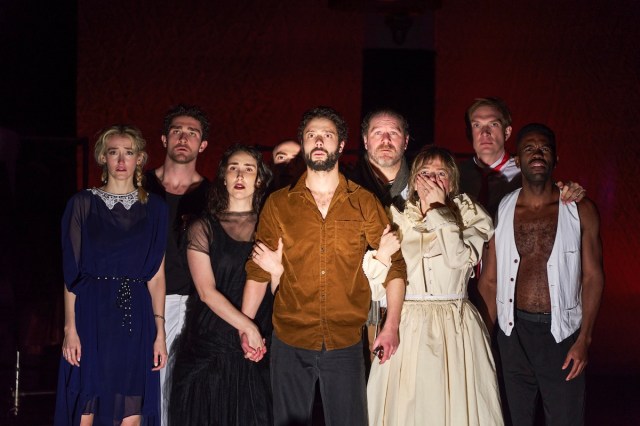
(© Kir Simakov)
The greatest privilege for any theater artist is the ability to create without regard for the political and historical forces marching past the stage door. Kon (Eric Tabach) is under the mistaken impression that he enjoys that privilege. The son of celebrated actor Olga (Zuzanna Szadkowski), he is making his directorial debut at the Moscow Art Theater with a radical staging of Chekhov’s The Seagull. But when theater manager Yuri (Andrey Burkovskiy) balks at some of Kon’s avant-garde choices (a “freedom dance” featuring men in skirts) and asks Kon to make public statements in support of Putin’s war in Ukraine, Kon decides to flee to New York, where he’s sure the freedom-loving people who run our theaters will be eager to produce his Seagull.
That’s the basic plot of Seagull: True Story, the transnational backstager from creator-director Alexander Molochnikov (with a script by Eli Rarey) now playing an encore run at the Public Theater (co-produced by Mart Foundation). It’s the same play I reviewed at La MaMa last year, but its message about the choice most of us face (between bad and worse) feels more urgent in a world spiraling toward catastrophe.
We feel that velocity in Molochnikov’s lively and inventive staging, which creates a grand spectacle on a shoestring budget. Using just a rope attached to a swivel chair, he depicts Kon’s flight to Istanbul, where he will catch a plane to New York City and his new life as a bohemian auteur rooming with his flighty collaborators in a Bushwick warehouse. Outwardly, he’s living the ultimate liberated lifestyle, but Kon quickly discovers the invisible cages American artists willingly inhabit.
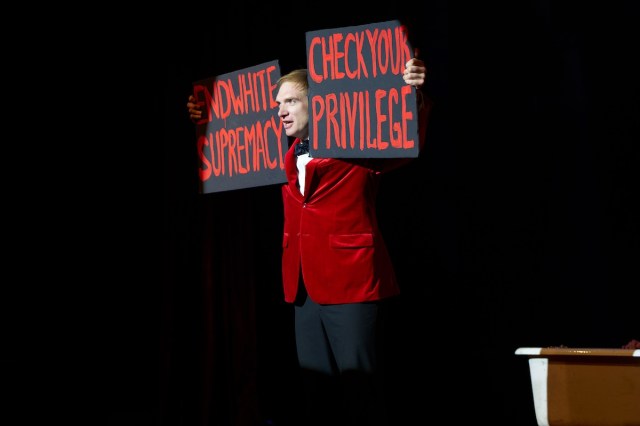
(© Kir Simakov)
Scenic designer Alexander Shishkin successful conveys these different worlds using curtains—deep red for Moscow, graffitied plastic for Brooklyn. Kristina K tells a similar story with her costumes: heavy furs for the Russians, slutty thrift store duds for the Americans. Brian H. Scott and Sam Saliba’s self-consciously theatrical lighting makes good use of spots and practical lights, including an MVP desk lamp. Diego Las Heras shakes us out of our complacency by bringing the sound of war into the theater.
Not everything works. Original songs by Noize MC awkwardly intrude and assault us with (near) rhyming couplets like, “I’m an artist, I express myself like a boss. / But number one priority: stay out of the way of the law.” What seems intended to taste like a full-bodied theatrical experience occasionally leaves us with a grimace.
But that is not for lack of trying from Molochnikov, whose exuberant presence will take him far in a country that adores a character. Arriving onstage in a track suit to deliver a curtain speech (something few off-Broadway directors would be caught dead doing), he joins the cast for an extended curtain call. He may be bowing at the LuEsther, but mentally, he’s onstage at the Bolshoi.
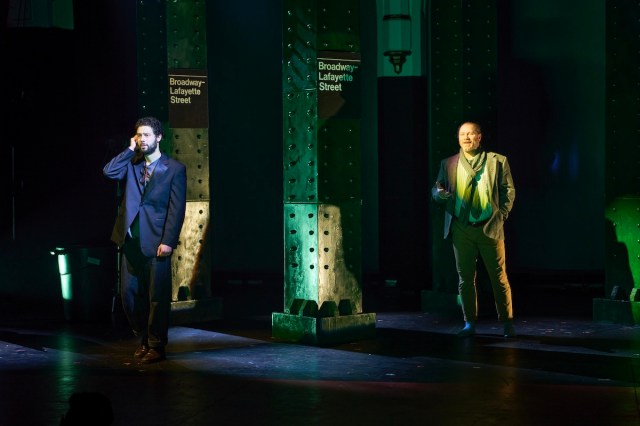
(© Kir Simakov)
The actors match Molochnikov’s big Brecht energy in their performances, with Burkovskiy leading the way as a manically disingenuous MC, his broad smile masking the brutality of raw power. Tabach’s Kon is appropriately youthful and naïve—the kind of idealist who only learns the hard way. Elan Zafir is quietly heartbreaking as his Russian dramaturg Anton, who is more clear-eyed about the consequences of his principles but still holds fast to them. Szadkowski always brings a bracing level of intensity to every role she inhabits, and her Olga is no different. She knows exactly what she wants (keep her son in Russia, but out of prison) and she’s willing to bully, threaten, and emotionally blackmail to get it.
Gus Birney delivers a memorable performance as Nico, Kon’s Brooklyn lover, who says a lot of high-minded words about art liberated from commerce only to wholeheartedly embrace a commercial career (and a wealthier man) when that becomes an option. Despite her loopy cadence, she’s one of the more rational characters in the play. Few among us (at least those who don’t already enjoy a trust fund) would behave differently.
Because money is the lifeblood of the professional theater, whether it is provided by an oppressive state or the fickle rich—pick your poison. Kon does in the play, just as Dmitry Krymov (once the most in-demand stage director in Russia, now straining to produce one play a year at La MaMa) has in real life. This is not just a dilemma for dissident artists. Eventually, we all must choose between our ideals and survival. That’s what makes this Seagull a particularly harrowing true story.




Featured In This Story

Latest Reviews
See all
Latest Videos

Get a First Look at Megan Thee Stallion as Zidler in Moulin Rouge! on Broadway
Megan Thee Stallion starts performances on Tuesday, March 24.