
Review: Olivia Washington Ignites Geffen Playhouse in Angry, Raucous, and Shamelessly Gorgeous
Pearl Cleage’s comedy finds power when Washington seizes the stage.
 |
Los Angeles
|
|
Los Angeles
|
June 22, 2026

(© Jeff Lorch)
Angry, Raucous, and Shamelessly Gorgeous, now running at the Geffen Playhouse, has an intriguing premise and a talented cast. A comedy about women’s place in the African American movement , Pearl Cleage’s play misses its targets for much of its 100-minute runtime—until it’s jolted to life by a tantalizing performance from Olivia Washington. When Washington’s character, Pete, takes center stage, she revitalizes the entire ensemble and finally gives the evening grit and substance.
Former Atlanta theater provocateur Anna Campbell (Tony nominee Charlayne Woodard) returns after 30 years in Europe, imagining her homecoming as triumphant. In the 1990s, Anna had caused a stir with Naked Wilson, a performance art piece in which she recited male monologues from August Wilson plays while naked, critiquing the subjugation of female roles in his work. Festival director and old friend Kate (Deborah Joy Winans) has invited Anna back to receive a special award—not to perform the piece. Instead, a novice actress has been hired to revive it. Betty (Denise Burse)—Anna’s best friend, manager, and general caretaker—tries to keep her now-sober boss from unraveling at the news.
Farcical elements abound until the new actress, Pete (Washington), arrives. A former stripper and adult-film star, Pete has never been onstage and hasn’t even read an August Wilson play. Anna spirals as she’s forced to confront her age, her perceived obsolescence, and the possibility that her life’s work may be reduced to a gimmick in someone else’s hands.
Though the subject matter is often sharp and stinging, the play treats it lightly—more like a drawing room comedy than something to sit with and process. Only when Pete enters, bringing a lived-in authority and a vastly different perspective shaped by her own painful history, does the play stop sputtering. Pete is a fully realized character: someone with nothing to lose and everything to gain, demanding to be seen and heard.

(© Jeff Lorch)
The play struggles to articulate why Anna performing Naked Wilson in the present day is such a problem. It seems to suggest that her age—and specifically her nudity at that age—is the central obstacle. But why? Is a 70-year-old, fully accepting of her body, inherently distasteful? Anna is not a victim of exploitation; she is in control. If her original work was truly provocative, audiences should be able to engage with the beauty and complexity of a body at any age. This question is made even more puzzling by the fact that Woodard looks stunning. If Anna chooses to shed both inhibition and clothing, more power to her.
The play also gestures toward the limitations of women’s roles in August Wilson’s work but never fully explores the idea, beyond noting that Anna was driven out of Atlanta by purists in the ’90s. There is a wealth of nuance embedded in this premise that remains largely untapped.
Director LaTanya Richardson Jackson, who directed the 2022 Broadway revival of The Piano Lesson, clearly has deep roots in August Wilson’s world. She has assembled a cast with ties to his work, and that familiarity brings an added layer of subtext—even when the script leaves too much unsaid.
Washington ultimately steals the show with a striking combination of self-assurance and vulnerability. She carries pride in both her past and her ambitions, and she possesses an intensity reminiscent of her father, Denzel Washington, even in lighter moments. Though the audience never fully hears her perform Naked Wilson—we instead see it via a silent video—her presence is so commanding that it hardly matters.

(© Jeff Lorch)
Woodard, who has gifted Los Angeles audiences with memorable solo performances over the years, is constrained here by a role that never quite deepens beyond its surface similarities to Margo Channing. She brings bluster and resilience, but the script offers limited support. Burse feels oddly disconnected at times, hindered by both uneven material and line stumbles, while Winans delivers sharp comic timing but is likewise underutilized.
Richardson Jackson stages the production with visual opulence. Beowulf Boritt’s set captures a lavish hotel suite, complete with a patio, tasteful furnishings, and a blooming trellis. Emilio Sosa’s costumes are couture-level—flowing sundresses, caftans, and sharply pleated shirts evoke a modern take on the excess of Dynasty-era glamour. In contrast, Pete’s wardrobe is equally striking, shifting from distressed denim and plaid to an elegant red dress in her final appearance, underscoring her transformation.
Angry, Raucous, and Shamelessly Gorgeous is frustrating because of its undeniable potential. It has something urgent to say—but in its current form, it feels uneven, too committed to a comfortable comedic structure that ultimately dulls its sharper edges.




source on Google
Featured In This Story

Latest Reviews
See all






Latest Videos
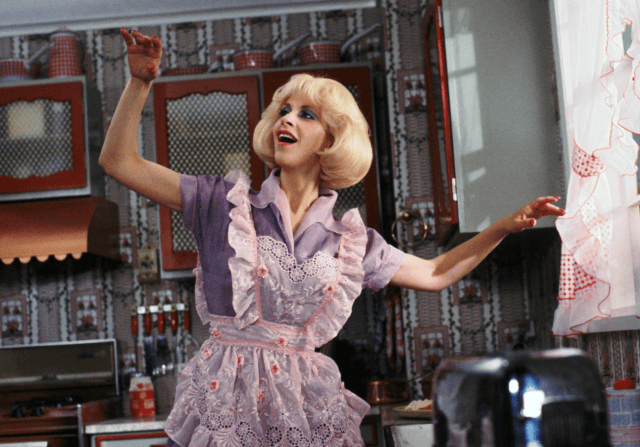
Watch: Ellen Greene Reflects on the Enduring Legacy of Little Shop of Horrors
Frank Oz’s cult classic movie-musical has gotten a new 4K restoration in celebration of its 40th anniversary.