
Review: Garry Starr: Classic Penguins, a Naked Clown Show About Great Literature
The Fringe Festival hit comes to Studio Seaview.
 |
Off-Broadway
|
|
Off-Broadway
|
September 8, 2026

(© Austin Ruffer)
“It is not possible to be a clown for an audience, you play with your audience,” wrote Jacques Lecoq, the famed acting coach who revolutionized physical theater, adding that if a clown does not engage with the audience, he might become trapped in his performance and “would end up in a psychiatric ward.”
It seems apropos, given the phallic humor and oft-alarming wordplay central to Garry Starr: Classic Penguins, to blame a guy named Lecoq (who, it so happens, taught Garry’s own teacher Philippe Gaulier) for what’s going down at Studio Seaview. Garry sure plays with his audience, though I’m not so confident that’ll spare him from institutionalization.
You see, Garry Starr (the stage name of Australian writer-performer Damien Warren-Smith) is working his way through the Penguin Classics, and he needs our help. As he plows through a bookshelf of paperbacks, he aggressively misinterprets each title, recruiting audience members to pitch in with each shenanigan. Oh, and he’s butt naked, save for Elizabethan ruff, a tailcoat, and flippers. He’s a daftly erudite penguin, get it?
Some of Garry’s interpretations of the titles are innocuous enough, like some rather literal takes on The Grapes of Wrath and A Clockwork Orange. Some are rather snoozy, as when he spins around holding a globe while the audience counts all the way up for Around the World in 80 Days. His cleverest gimmicks involve the juxtaposition of titles. When he comes to The Collector, John Fowles’ 1963 thriller, he passes around a hat for cash. The following book is Karl Marx’s Communist Manifesto, so he redistributes it.
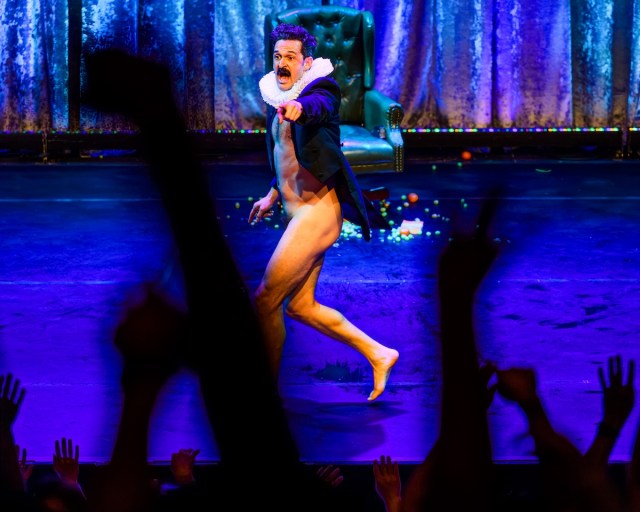
(© Austin Ruffer)
But the nuttiest moments, so to speak, involve his private bits hovering inches from audience members’ faces (as when he ties one person down, Lilliputian style), or, horrifyingly, when he reveals that there is a Penguin Classic entitled The Bodysurfers.
And in one of the grossest moments of audience participation I have ever witnessed, he feeds a grape to a volunteer, mama bird-style, then has her transfer the grape back into his mouth before passing it through a rotation of audience members gob-to-gob. How far we’ve come from Covid restrictions.
And how far also from those pesky little conversations about consent? Garry asserts that audience members can opt out of certain experiences. But in a show like this, where what is being asked of volunteers far exceeds any boundaries of politeness, the social pressure to be agreeable may make it difficult for audience members to comfortably depart an interaction midway through (especially if they’ve been literally taped down to the stage).
For audiences who are squeamish about the interactions, the show’s well-hewn structure may be more appealing than its performance. There are some expertly-constructed setups and callbacks. You won’t see the rather clever Brideshead Revisited joke coming.

(© Austin Ruffer)
Clowns, however, make for slippery critical subjects. They have a tendency to reflect the audience’s fears and fantasies—the unashamed id fully expressed and exposed—so their reception, if they’re good at their craft, is purely a matter of individual taste and psychological susceptibility. Part of what makes some of us find certain clowns funny is the possibility that other audience members might feel more discomfort than amusement. You laugh at how narrowly you’ve averted embarrassment. Or, if you’re hard-wired to be put off by a vision of what we might look like without any inhibitions, you don’t.
Garry Starr: Classic Penguins, directed with wicked nonchalance by Cal McCrystal, works on two different levels: the planting of the seed of something outlandish on the horizon and then the actual flowering of each shocking scenario. For some audiences, the latter is the payoff worth admission: you probably know who you are, and this show is definitely for you. But if theater is about the power of the imagination, Garry Starr: Classic Penguins leaves nothing to the mind’s eye. It’s pretty obvious, for example, where we’re meant to think “The Little Prince,” who’s gone missing in the opening minutes of the show, has got to; there are only so many hidey holes onstage. I found the setup of the joke sufficient without the graphically-staged punchline in which “The Little Prince” is retrieved. Ironically, for a show that asks so much of its audience, very little imaginative work is required.
But there is something unquestionably compelling, whether you’re consistently laughing or not, about the ease with which Garry Starr presents his naked body, every crevice of it, to us. It’s not that we stop noticing that he’s in the buff, but we might forget, at least when he keeps his distance, that he’s not supposed to be. An invitation, perhaps, to rethink the caution-tape boundary between the versions of ourselves we present in public and our own inner clowns.




source on Google
Featured In This Story
Latest Reviews
See all








Latest Videos
Watch: Ellen Greene Reflects on the Enduring Legacy of Little Shop of Horrors
Frank Oz’s cult classic movie-musical has gotten a new 4K restoration in celebration of its 40th anniversary.