
Review: Fanny: A Fantasy in G Reveals the Other Mendelssohn
Tim McGillicuddy’s bio-drama bows at A.R.T./New York Theatres.
 |
Off-Broadway
|
|
Off-Broadway
|
March 31, 2026
(© Chase Randall)
A warm, affectionate portrait of a forgotten artist, Tim McGillicuddy’s new play Fanny: A Fantasy in G steers admirably clear of cliché. Regrettably, this world premiere from Off-Brand Opera at A.R.T./New York Theatres also frequently avoids drama.
Scholarly in style, McGillicuddy’s work honors the life and work of 19th-century composer Fanny Mendelssohn, the older sister of famed German master Felix Mendelssohn. Mostly unpublished in her lifetime, Fanny is today recognized as a talent at least equal to her brother; works misattributed to Felix have since been properly credited to her, including “Easter Sonata.”
A wealth of research is evident in A Fantasy in G, an expansive chronicle of Fanny’s adult life up to her death, at 41, of a stroke. McGillicuddy and director George Abud (who adapted, helmed and starred in 3Penny Opera for Off-Brand Opera in January) take laudable care to neither sensationalize Fanny’s life nor force any unnatural modern resonances. But they never find another route to getting under their subject’s skin.
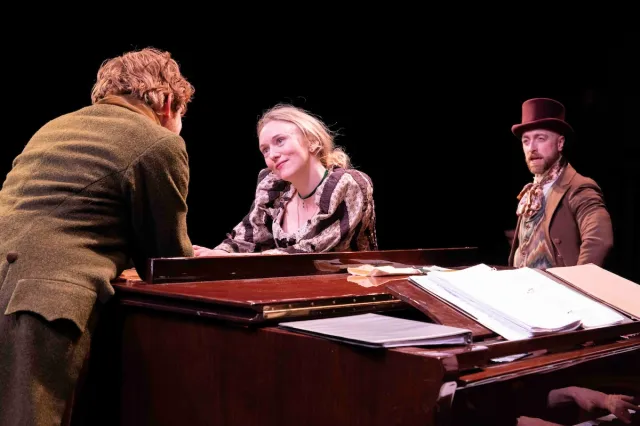
We first encounter young Fanny (a fervent Annalisa Chamberlin) in 1820s Berlin, bouncing off the parlor walls of the expansive Mendelssohn home. Her brother Felix (Zaq Latino, looking like a Madame Taussauds replica of the composer) is rising in the German musical scene—but Fanny is stuck. The two’s parents Abraham (a kindly Rufus Collins) and Lea (Úna Clancy, wise and imposing) have indulged their daughter’s musical interests, up to a point. But the question of marriage now rears its head.
(© Chase Randall)
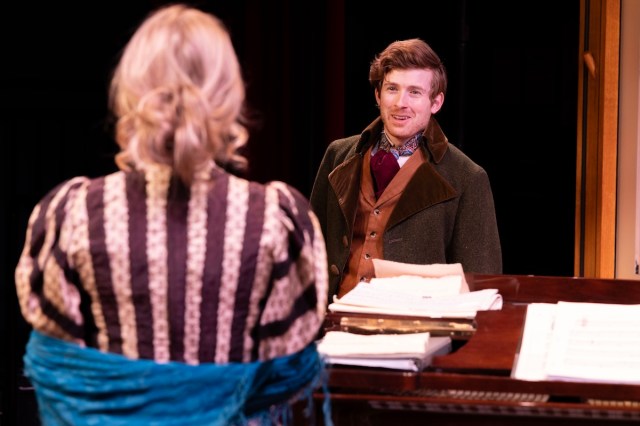
Not that marriage is imminent. When Fanny humiliates two suitors, Landstreiker (Adam LaSalle) and the conniving Lamond (Kelsey McClarnon), her mother seems only mildly perturbed. And while the parents disapprove of Fanny’s preferred choice, the painter Wilhelm Hensel (a bubbly Daniel David Stewart), they acquiesce without a fight. Wilhelm supports Fanny’s composing and seems devoted to her.
Fanny’s house is a loving one, and above all, a bastion of artistic creation. She floats freely through this, “greenhouse, a place of seedlings and new life cultivating wonderful human talent,” as she describes it to Wilhelm. (McGillicuddy is chiefly a poet, and his dialogue is filled with pleasant little reveries.) The problem, for Fanny, is not within these walls. It is the world outside.
That’s where the drama lies, but McGillicuddy’s efforts at injecting tension tend to falter. At one point Fanny and her sister Becka (Ava Delaney) investigate their father’s quiet aid for refugees in the Jewish ghetto. In a confusing sequence, the two wind up drawing undue attention that leads to an underground activist being killed (or perhaps just injured—the staging is unclear).
Equally contrived are the villainous machinations of Lamond, whose offer to publish Fanny’s works is an obvious deceit. In trusting Lamond with her compositions, Fanny apparently forgets that she greeted his marriage proposal by calling him a homosexual. A lot of narrative real estate gets eaten up by Lamond, portrayed hammily by McClaron, and much of it strains credulity.
But in terms of Fanny’s own journey, McGillicuddy sticks to quiet tragedy. Her musical dreams are not quashed overnight, but fade away gradually as the years pass. An existential ennui gradually sets in as Fanny drifts from her purpose. It’s a moving notion, and likely a truthful one. Amid lots of other business, it also feels like a secondary plot.
(© Chase Randall)
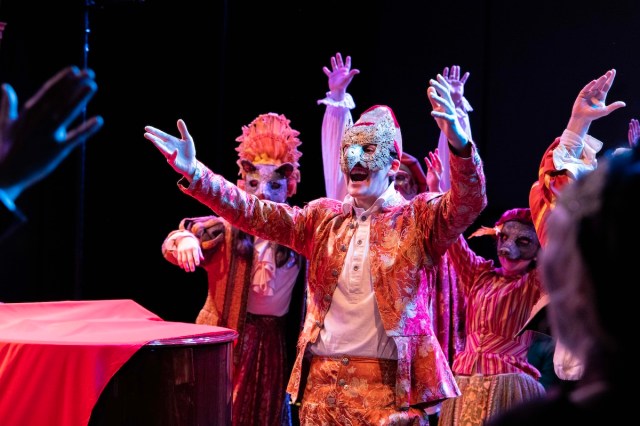
Chamberlin is most alive opposite the excellent Stewart, who lights up the stage as Wilhelm. Their initial courtship is adorable, and jolts the play to life, though their partnership is sadly backgrounded in the second act. A bacchanalian interlude in Rome enlivens the proceedings, and is crisply staged by Abud.
Chiefly known as an actor (in Lempicka and The Band’s Visit on Broadway), Abud here demonstrates a steady hand as a director. Stage action moves at a quick clip, and the performances are sharp. Abud also seamlessly incorporates a potentially tricky narrative device: the “Muse” (Melody Fader), an unacknowledged presence at the family piano playing soft underscoring for most scenes. Dressed all in black, the Muse also exists as a quiet portent of doom; in Abud’s careful blocking, her presence is unobtrusive yet always felt.
Even with a low budget, Henry Pedersen’s set feels disappointingly barren (certain props look carted in directly from IKEA). But credit is due to Raul Luna’s tremendous costumes, which are plentiful and carefully detailed.
While McGillicuddy’s gentle play never comes alive as drama, it remains an agreeable tour through a long-neglected artist’s legacy.




Featured In This Story

Latest Reviews
See all
Latest Videos

Get a First Look at Megan Thee Stallion as Zidler in Moulin Rouge! on Broadway
Megan Thee Stallion starts performances on Tuesday, March 24.