
Review: Dealing With Jewish Grief in Matthew Leavitt's Sukkot
This new play is directed by Joel Zwick (My Big Fat Greek Wedding).
 |
Off-Broadway
|
|
Off-Broadway
|
July 21, 2026

(© Carol Rosegg)
A year after his wife’s passing, Patrick (Andy Robinson) is at a loss. How can he make the unveiling of her headstone a meaningful turning point when his grief has stagnated before he can reach acceptance?
He lands on an unexpected answer for an Irish Catholic: go all out celebrating Sukkot, the one Jewish holiday on which God commands worshipers to be joyful. Patrick’s wife was a secular Jew, and though his three miserable, squabbling grown children know diddly-squat about Judaism, he’s going to make them sleep in the wooden sukkah—the hut in his yard he’s constructed himself—and compel them to rejoice.
It sounds like a thin premise for a play, but Matthew Leavitt’s script sheds some initial sentimentality (“I have a hole in my soul,” Patrick keens in his first monologue) for Sukkot at 59E59 to emerge as that rare, lovely beast, a dysfunctional family dramedy that feels both fresh and believable. Patrick’s sudden obsession with the Jewish holiday, which includes chanting in Hebrew and desperately trying to learn the ritual for shaking the ceremonial lemon-like etrog and the lulav frond without poking anyone’s eye out, might strain credulity every so often. But the cross-cultural trial and error that takes place in set designer Mark Mendelson’s impressive sukkah adorned with Christmas lights is ultimately a touchingly persuasive depiction of how far the grieving will journey to reclaim lost joy.
Sukkot gets a lot of help from director Joel Zwick, best known for his helming of My Big Fat Greek Wedding. He still knows his way around a quirky family, and he coaxes the cast toward performances that simultaneously make the tensely tender relationships seem universal and wickedly specific.
Yes, each of Patrick’s three children is an archetype. There’s Asher (Jonathan Slavin), the sardonic gay brother, depressed and unemployed, who has an “incurable hatred of sleeping anywhere insects can lay eggs in my ears.” There’s Maraide (Liza Seneca, also Leavitt’s co-artistic director of the L.A.-based company the 6th Act), the squeezed-thin gynecologist mother of two who responds to Asher’s accusation that she uses her children as a “get-out-of-jail-free card” with self-loathing fury: “It IS the jail!” And there’s Eden (Natalie Lander), the devil-may-care youngest sister who hitchhikes home on the back of a motorcycle with a guy named Tank and who wants to make an app that would tell you which songs in your music library are “recorded by morally reprehensible people.”
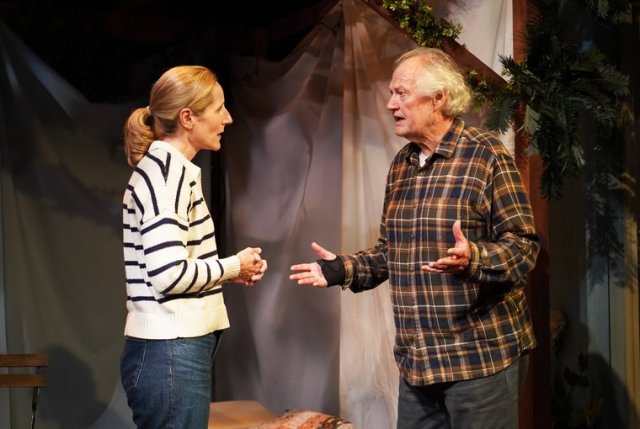
(© Carol Rosegg)
But those conventions aren’t just shorthand for the audience to recognize each sibling as distinct. They’re also the oversimplifying categories that the siblings use themselves to box each other in, and Leavitt’s play gets smarter and more interesting as his characters are forced to reckon with the adults they’ve each grown up to be. Leavitt smartly shifts around the constellation of characters onstage so we see how the family dynamic shifts depending on who’s in the sukkah: Robinson and Seneca have an especially affecting father-daughter chemistry.
Leavitt’s an adroit observer of the online lives of older millennials and how crudely technology opposes spiritual contemplation. Patrick instructs his kids to bow their heads in prayer, and they immediately start scrolling as soon as his eyes are closed. And they literally can’t get through the blessings because YouTube ads pop up in the middle of the instructional video.
That light touch and breezy pace from Leavitt and Zwick keep things from tipping over into saccharine, except for the occasional weepy closing lines of otherwise fun scenes and the maudlin piano music that ties scenes together.
“There is nothing more horrible than seeing your parents as actual people,” Asher moans after a shocking revelation about Patrick’s past comes to light. Sukkot, with clever ease, steers the Sullivan family away from that horror and toward something that might one day approach an etrog’s worth of joy.




source on Google
Featured In This Story

Latest Reviews
See all









Latest Videos
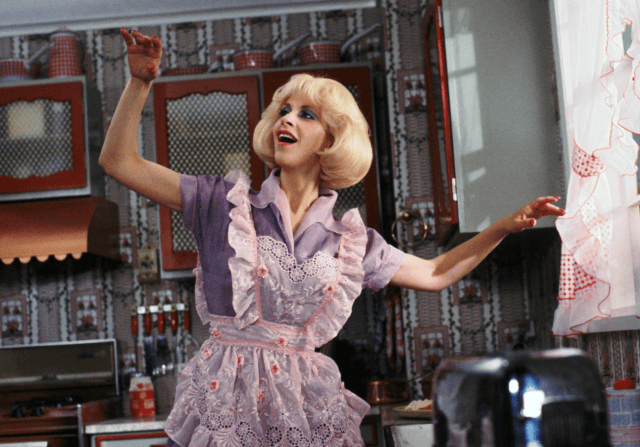
Watch: Ellen Greene Reflects on the Enduring Legacy of Little Shop of Horrors
Frank Oz’s cult classic movie-musical has gotten a new 4K restoration in celebration of its 40th anniversary.