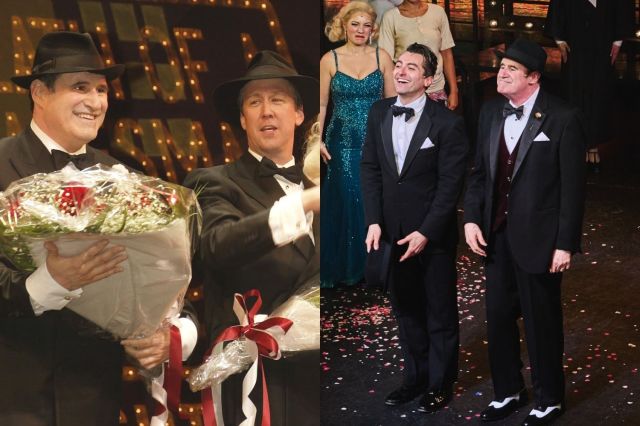
Richard Kind didn’t used to be the King; he simply is the King.
The ubiquitous character actor/George Clooney’s longtime BFF, whose credits stretch from Mad About You and Spin City to Curb Your Enthusiasm, Only Murders in the Building, and Inside Out (and, and, and), is making a rare return to London’s West End this month as Max Bialystock in Patrick Marber’s revival of The Producers.
It’s a role Kind has downpat. He first played Max on Broadway in 2004, later reprising it at the Hollywood Bowl in 2012. But this time, he insists, he’s stepping into an entirely new show. Same lines, different rhythms, a smaller theater, and a wildly different comedic sensibility.
For Kind, that’s part of the thrill. Whether he’s recalibrating a joke based on how quickly an audience laughs (or doesn’t), embracing the production’s gleefully “bad-taste” sensibility, or simply stomping (never gliding) through a role made iconic by Zero Mostel and Nathan Lane, he’s recreating and rediscovering Max in real time, for six more weeks only. And the cardboard belt still fits.
This conversation has been condensed and edited for clarity.
How did you come to do The Producers in the West End?
The music supervisor, a guy named Gareth Valentine, I had worked with him on Guys and Dolls over here, and he and I get along very well. David Babani [artistic director of the Menier Chocolate Factory] asked me if I would do it, and my manager said I couldn’t. I got three kids in college; I can’t afford to do theater. And then Gareth sent me a message saying, “Talk to David.” So, he calls, and he says, “It’s just seven weeks.” And I went, “Wow. Seven weeks, London, The Producers. This is the best.” I told my manager to make it work and we made it work.
Worth it? Let me tell you, it’s the greatest. The best decision. The part is still great, but this production is very different. I’m entering a new show. Same lines, new show, and the cast is very special.
I know what a big fan you are of the original movie.
I am. I loved Zero Mostel. I saw Mel [Brooks] in a restaurant, and you know what I said to him? I said, “Don’t fuck it up.” He didn’t. In fact, he and Tom Meehan transformed it. The movie is still as great as ever, but the musical is a machine. It’s unbelievable how well this works.
When I saw it at the Menier last year, it felt like visiting an old friend. It was perfect on Broadway, and it was just as perfect in this new version with actors who I didn’t know.
I’m going to tell you something. This is nothing against me, nothing against Matthew [Broderick] and Nathan [Lane]. This play works with anybody. They didn’t think it did when Matthew and Nathan left. They were the best. They were great. But the piece still works. It works with me; it works without me. I did it with about eight Leos when I did it on Broadway. The three headliners were Hunter Foster, Alan Ruck, and Roger Bart, and they would throw guys in to see if one guy could be an understudy or could tour with it. And it [always] worked. It’s nuts.
Are there ways in which your Max Bialystock changed over the last 20 years? [On Broadway] I said I was on the Bialystock diet. I lost 30 pounds. I still have the stamina. That’s one reason why I did it. My body hurts more, but I can still do it. It’s great fun. The wonder of theater, of course, is its intimacy. This is what you’re seeing tonight and you’re the only one seeing it. This is the shared bond.
In a 700-seat theater, my delivery is so different. There are certain lines that are iconic and delivered only one way. “The reviews come out a lot faster when the critics leave at intermission” just rolls of the tongue. But there are scenes that are so much more intimate, like “‘Til Him,” which is so sweet. At the beginning of “King of Broadway,” I say “I used to be the king.” But who am I talking to? I’m talking to everybody. It’s so great to confess it to [the audience]. The guy is who he is, but the venue has changed and therefore, my approach to the theatricality has changed.
How would you describe your Max, compared to someone like Nathan Lane or Andy Nyman?
Those guys, they soar. I just plop, plop, plop. I stomp, you know? There’s nothing light on my feet about me.
I loved watching Nathan. He’s so fast and he’s so good. You watch him and your breath is taken aback. He’s masterful. But I don’t do what he does. I knew my Max would be different. So, although it was daunting because the role is daunting, I wasn’t put off.
Andy is very similar to Nathan. He just glides. Nathan glides. I don’t glide. I didn’t want to see Andy do it because I didn’t want to be influenced. There might be laughs that he gets that I don’t get. I talked this over with Andy—we knew each other before, too—and he, in turn said, “I love you, but I can’t [see you either].”
Are there certain things you’ve noticed about the show as a replacement actor that took some getting used to? Here’s an interesting thing. By the time I did it on Broadway, I kept saying that I did it for Asians and Iowans. I’d say, “The reviews come out a lot faster when the critics leave at intermission” and nothing. They didn’t get it. When I did it at the Hollywood Bowl, I got to do it with [original cast member] Gary Beach and I said, “How did Nathan do it?” and Gary said, “You just say it.” I go “No, no, no.”
I used to use that as a bellwether, to see how good the audience is going to be. In London, you get some smart crowds. Yesterday afternoon? No laughs. And I’m like “Oh, my God, I’ve met the audience. They’re not with me.” But the audience turned out to be great. They were wonderful.
There are sight gags in this production where I don’t know anyone on stage can keep a straight face.
Patrick Marber prides himself on having the worst taste in the world. He’s trying to say “Oh, Mel, you think you’re the only one that’s got bad taste?” We have Jesus Christ coming out in “Keep It Gay” as Sabu. Sabu used to be Sabu. The piece starts with me on a toilet, and it still works. There’s stuff here that Mel would say “No, no, no” and instead, we’re just doing it. It’s bad-taste-city, which is what you need.

 |
London
|
|
London
|