
Interview: In Seagull: True Story, Russia Exiles an Artist, but America Clips His Wings
Alexander Molochnikov and Gus Birney reflect on the semibiographical play about political and artistic freedom.
 |
Off-Broadway
|
|
Off-Broadway
|
April 8, 2026
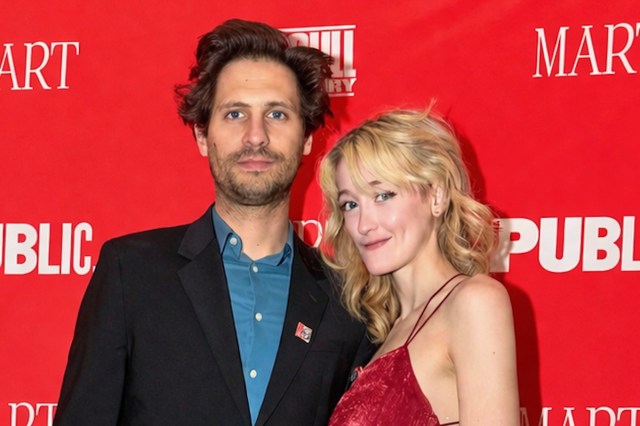
(© Kir Simakov)
Early in Act 1 of Seagull: True Story, now running at the Public Theater, we get glimpses of the play within the play—the Chekhovian Seagull that nests inside the “true story.” It’s 2022 and a clumsy cast of actors at the Moscow Art Theatre are fumbling through a scene. Their director—the conspicuously young and excitable Kon—pounces in a creative fever. Before you know it, winds are blowing, plastic tarps are flying, and our fledgling auteur is jumping around like Tigger in a primal dance party of his own making.
If you’re familiar with The Seagull, you’ve clocked that this modern-day Kon (played by Eric Tabach) is an iteration of Konstantin Treplev, Chekhov’s depressive but ambitious playwright who aches for new artistic forms (and for his ingenue Nina). Even more so, however, he’s an avatar for the show’s creator and director Alexander Molochnikov, who, at 22, became the Moscow Art Theatre’s youngest director in history. By 30, he had fled his home country after speaking out against the invasion of Ukraine.
That’s the story we see play out for Kon, who spends Act 1 tilting at windmills in Moscow and then Act 2 adjusting to a different kind of nonsense in the Brooklyn art scene where he tries again to mount his dream Seagull. “My Seagull was on as a ballet at the Bolshoi Theatre,” says Molochnikov, explaining the true timeline of events that he and writer Eli Rarey wove into their semibiographical play. “The war started in February and already by August, the whole show was shut down because of my support of Ukraine.”
He clarifies dryly, “My support of Ukraine wasn’t setting myself on fire in front of the Russian embassy. Just little posts on Instagram where I was in solidarity with Ukrainian people.” His follower count was and remains at around 100K. “I couldn’t not say that I feel their pain and that I feel shame for my country for bombing them.”

(© Kir Simakov)
Threats of physical harm and imprisonment followed, while all his projects ground to a halt. 19.14, the antiwar play he directed at 22 at the Moscow Art Theatre, has remained in the theater’s repertoire since 2014, but Molochnikov’s name has been scrubbed from it. “The program says, ‘directed by director,’” he shares, cynically delighted at the gem the Russian government handed his current production. “I was really impressed with their creativity, so I thought it should become a part of the play,” he laughs. “This is something you can’t really make up.”
It’s fitting that honesty mixed with dark humor is also Chekhov’s special cocktail. “When Stanislavski and his partner Vladimir Nemirovich-Danchenko started the Moscow Art Theatre, it was the first time the idea of being truthful, bringing actual life onto the stage, was born,” says Molochnikov. The Seagull, the Moscow Art Theatre’s first massive hit, happens to zoom in on the life of an artist—in this case, one who sees truth and freedom as inextricably intertwined.
Freedom of speech is very much at play, but “it’s not government freedom,” says Molochnikov, describing the kind of freedom he, and Kon, and Konstantin are all pursuing in lockstep. “It’s a sort of ability of being free and doing what ‘flies freely from your soul.’” That Chekhov quote pops up several times throughout the play, but the first time we hear it is in that raucous rehearsal scene. Just how parallel are art and life here? Gus Birney, Molochnikov’s Nina figure for both acts, chuckles at the question. “Very parallel.”
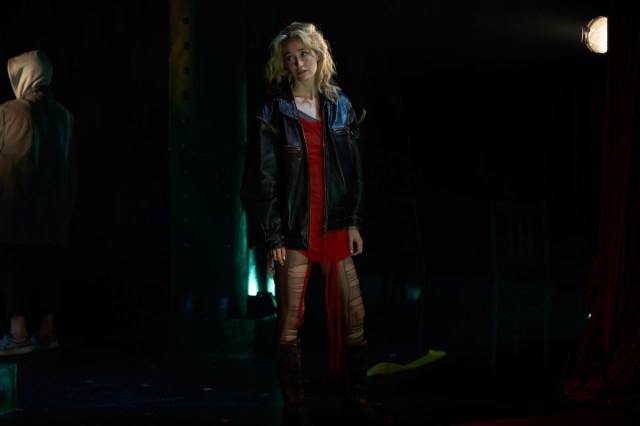
(© Kir Simakov)
Birney first saw Seagull: True Story during its 2025 run at La MaMa, not long after her run in another politically infused ensemble play, Our Class. “When I saw it at La MaMa, it was like, this is truly unlike anything I’ve seen.” Much like the devised theater atmosphere of Our Class, it wasn’t so much the role of her free-spirited actress character, Nico, that appealed to her as it was, “I want to be a part of this group of people and create this crazy circus piece together.” Now having experienced Molochnikov’s rehearsal room, she says, “Sasha is full of so much passion. I don’t think I’ve ever met a man who has a million thoughts going on at once and is able to articulate them all at the same time. He’s truly the definition of an artist.”
But if being an artist requires freedom—the uninhibited kind that allows for thoughts and feelings to take flight—the US isn’t awash in it, much as its branding suggests otherwise. Therein lies the harsh twist of Molochnikov’s play that indicts American culture in the same breath as it condemns Russia’s blatant brutality.
“I wouldn’t exactly call it ‘censorship,’” Molochnikov says, remembering his early days of culture shock navigating a career in New York City. “Censorship is a machine. In the US, none of your restrictions are written on paper.” Breaches of the unwritten rules, however, inevitably become public record. “When somebody tells you everything is fine, but then you get a long report on you, that’s pretty terrifying.” He adds, “It’s very Soviet, I must say.” He qualifies the comparison, acknowledging that not even our most venomous public floggings lead to execution or imprisonment. Still, “in Russia, you know very clearly where the bomb is which will explode your career. In America, it’s a minefield.”
“We’re believed to be this country of freedom of speech,” says Birney, born and raised in New York’s artistic ecosystem (her parents, Tony winner Reed Birney and Constance Shulman, are career actors whom she describes as “primarily theater people”). “This is where you go and your dreams come true. That’s such an old-fashioned idea now. One that’s really the opposite of the truth in current days.”
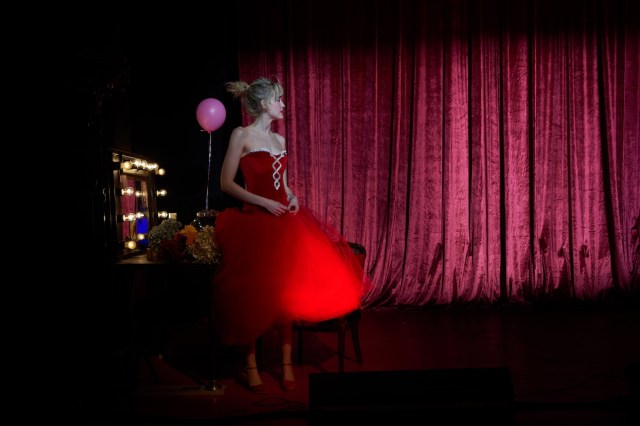
(© Kir Simakov)
In Act 2, Kon rehearses the same scene from The Seagull we saw earlier, now with American actors—hipster Brooklynites who fancy themselves artists with liberal ideals and a healthy disdain for capitalism. The session is a sputtering mess of questions, concerns, and requests for sensitivity. In the play, Kon is visibly frustrated, but Molochnikov, four years assimilated to our diplomatic American ways, allows himself to negotiate a bit. “It’s just very hard for someone who doesn’t grow up in it to figure out all these new … I would say … ‘restrictions.’”
Meanwhile in Russia, the “restrictions” are painfully clear. On March 31, 19.14 marked its 200th performance. Molochnikov’s work, nameless as it may be, continues to have a life back in his home country. He, for the foreseeable future, cannot. “It almost makes me cry,” he says when the topic is broached. “I always ask, do I want it to be performed without my name? My answer is yes because I think that it’s more important that the play is still on.”
The juxtaposition almost sparks hope—like maybe America’s Gordian knot can still be untied. “Yes, of course there are rules,” Molochnikov adds. “And trust me, as it says in our play, Kon learns a lot. I have also learned a lot.” Still, ever the artist who wants to make work that flies freely from his soul, he draws one definitive line in the sand: “There can’t be a policeman in the rehearsal,” he argues. “Whether it’s the government police, the Russian artistic director who is afraid of the Ministry of Culture, or somebody who is constantly making sure every word that’s said in the room doesn’t offend another person.”
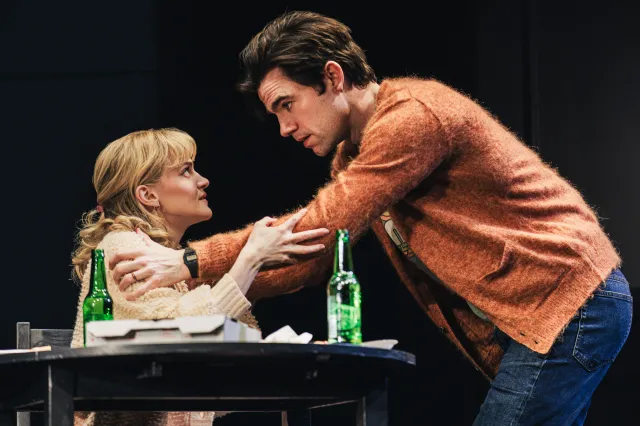
Birney graciously paints a picture of one of these rehearsals whose facsimile is on display at every performance. She talks about working on a scene from Act 2 where she recites one of Nina’s famous monologues. Here, it’s imbued with Kon’s new American vision. “He wanted just an exploration of pure joy and running around,” she says, “so I had to act out all these animals.” Deeper into the monologue, Molochnikov shouted, “Do a runway walk like you’re America’s Next Top Model!” followed by a glut of other random ideas to inspire uninhibited chaos. “It was so fun,” says Birney. “I felt so free.”




Featured In This Story

Related Articles
See all
Latest Reviews
See all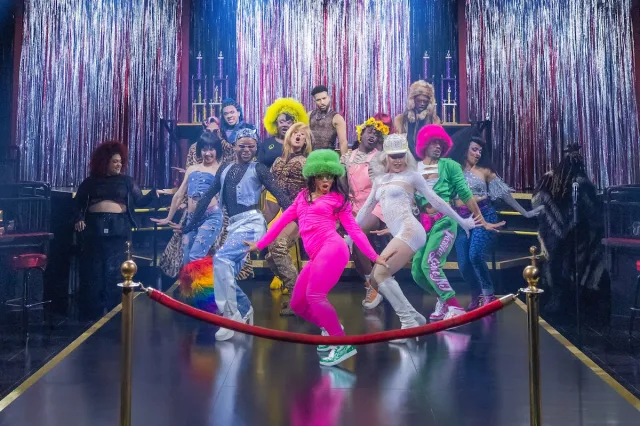
Latest Videos
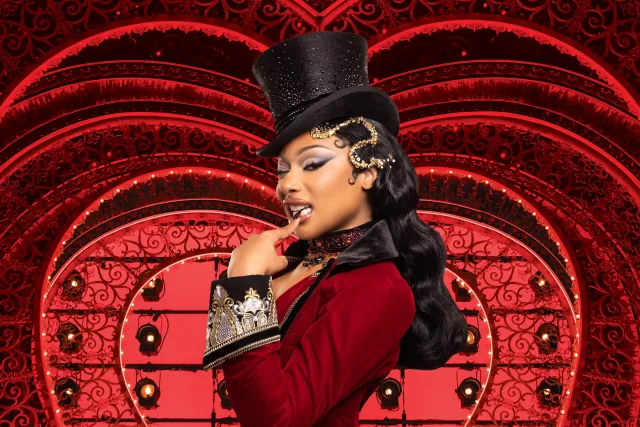
Get a First Look at Megan Thee Stallion as Zidler in Moulin Rouge! on Broadway
Megan Thee Stallion starts performances on Tuesday, March 24.