
Interview: Ayo Edebiri and Don Cheadle on the Mad Genius and Dark Humor of Proof
Edebiri and Cheadle make their Broadway debuts in David Auburn’s Pulitzer Prize-winning drama.
 |
Broadway
|
|
Broadway
|
March 25, 2026
(© Andy Henderson)
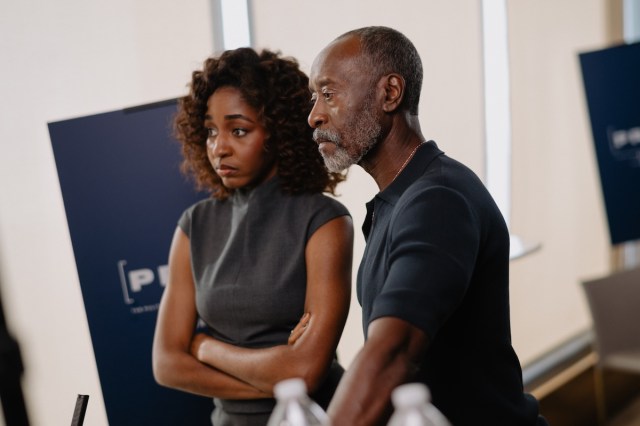
It’s press day for the Broadway revival of David Auburn’s Proof (beginning performances March 31 at the Booth Theatre), and the show’s stars, Emmy Award winner Ayo Edebiri (The Bear) and Academy Award nominee Don Cheadle (Hotel Rwanda), sit down for one of their few off-camera interviews. Still, Cheadle insists on making his fictional daughter’s outfit pristinely lint-free before we begin. “Dad stuff,” he says warmly.
Cheadle—best known for his dramatic roles onscreen, and Edebiri, who began her career as a comedian but has gone on to defy categorization—play Robert and Catherine, a father-daughter pair bound by a shared genius for mathematics and, Catherine fears, a tendency toward madness.
Directed by Tony winner Thomas Kail and co-starring Kara Young and Jin Ha, it’s the family drama’s first Broadway revival since its Tony- and Pulitzer Prize-winning premiere over 25 years ago (a production that also won Mary-Louise Parker a Tony for her performance as Catherine). Onstage, Edebiri and Cheadle are wrestling with the burden of brilliance and the fragility of sanity. Offstage, it’s all care, comfort, and light mockery. Classic dad stuff.
This conversation has been condensed and edited for clarity.
Ayo, Tommy Kail says that when he decided to remount Proof, he immediately thought of you for Catherine. How does it feel as an actor to get that kind of call?
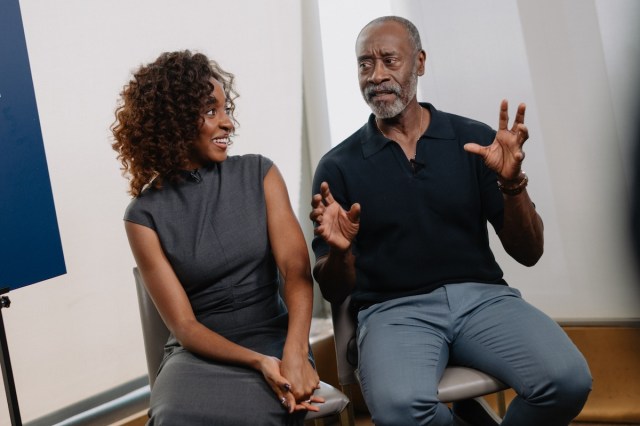
Ayo: Well, I had been outside his house for three years doing a whisper campaign. [Laughs] No, I was really surprised for a lot of reasons. I have wanted to do theater for a very long time, and it was just a matter of like: What’s the project? Who are the people? And then when Tommy called and it was this play, I was surprised, frankly. I was like—I’m Black. That means that the family’s Black. I’ve had experiences of, you try to go after something and the estate is …
Don: Resistant.
Ayo: Resistant. And they try to act like it’s not about anything. They just go, “Well, it won’t make sense dramaturgically.” So, to have this team that is not only into it but about it, we were open to the questions that we had examining the text again. It made me feel really hopeful and excited for what we could all build together.
[Ayo looks to Don for his answer]
Don: She didn’t start the question with, “And Tommy thought of you, Don.”
Ayo: But he did!
Don: It’s fine, I don’t need you to make me feel better.
(© Andy Henderson)
How well did you both know Proof coming into this?
Ayo: Don, talk first.
Don: I had seen it done in class. I’d seen people bring in different parts of it, and for some reason I knew that I knew the surprises in it. When we read it the first time, which was maybe a year and three months ago, we all kind of looked at each other and went, “Ah, maybe this is something we’re gonna come back for.” It was the first time I heard it all the way through, and I was like, “Yeah, it holds up.” Sometimes you read an old play and you’re like, I don’t know why they’d do it now. But there’s every reason to do it now.
Proof is a true actor’s play. Why do you think actors love these roles so much?
Ayo: I mean it’s just incredibly well written.
Don: It didn’t win the Pulitzer for nothing.
Ayo: The words are beautiful, and it all ties together so beautifully. And there are so many things that on a first read you can miss. There’s so much working on so many different levels. I think it’s very deceptively simple.
Both of you, Don especially, has to portray a person whose mind is spiraling out of control. Is that a challenge to play without crossing over into caricature?
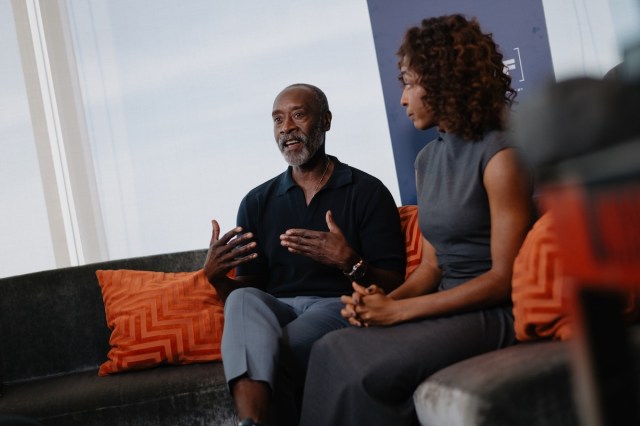
Don: Yeah. And the hyperbolic version of what madness looks like, it actually doesn’t present like that. It presents in a very subtle way, and you’re sometimes having to check and be like, am I seeing what I’m seeing? A lot of times you want to be in denial about it, because you need to not have it be what it’s showing you. The play explores all that stuff.
(© Andy Henderson)
David Auburn writes the madness of these mathematicians like the madness of an artist.
Don: I think math is art. A touchpoint in it for me is music. There’s so much math in music. It really is all math, except expressed in a way that you can hear it and take it in. But I think math, when it’s done at its highest level, they talk about it like music.
Does that relationship between math and art help you relate to these characters?
Ayo: Yeah, definitely. A lot of my friends also aren’t in the arts, and a lot of the language can be the same if your vocation is connected to your passion. The emotions that that can draw out of you, and also the spaces where you can’t control what comes out, is really relatable and interesting to me.
Proof deals with a lot of these big questions and heavy family dynamics, but I think it’s also important to remind people that it’s very funny. How would you both describe David Auburn’s sense of humor in this play?
Both: Dry.
Ayo: Dry and dark. Like a piece of jerky at the bottom of the bag. [Laughs] Then if you do speak with him, it’s like … that tracks. His jokes—they sneak up on you. Because his face is very straight when he delivers them, and it’s a very dulcet sort of tone. And then you’re like, “Oh, you just said something deeply funny and strange, you weird man.”




Featured In This Story
Latest Reviews
See all

Latest Videos
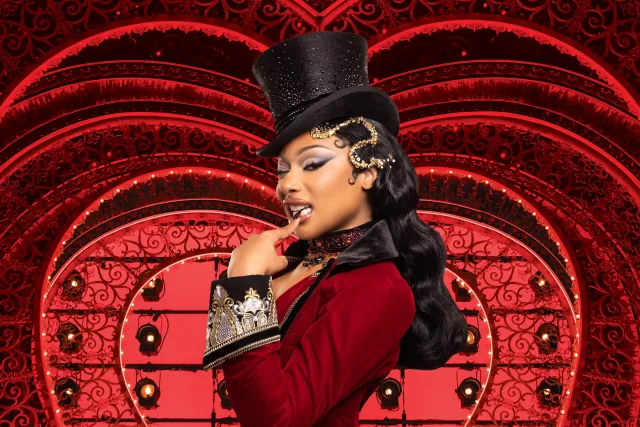
Get a First Look at Megan Thee Stallion as Zidler in Moulin Rouge! on Broadway
Megan Thee Stallion starts performances on Tuesday, March 24.