
Elliot Levey on the Giant Gulf Between London and New York When It Comes to Being a Jewish Actor
Levey, who won an Olivier Award for his portrayal of publisher Tom Maschler in Mark Rosenblatt’s Giant, is now reprising the role on Broadway.
 |
Broadway
|
|
Broadway
|
April 3, 2026
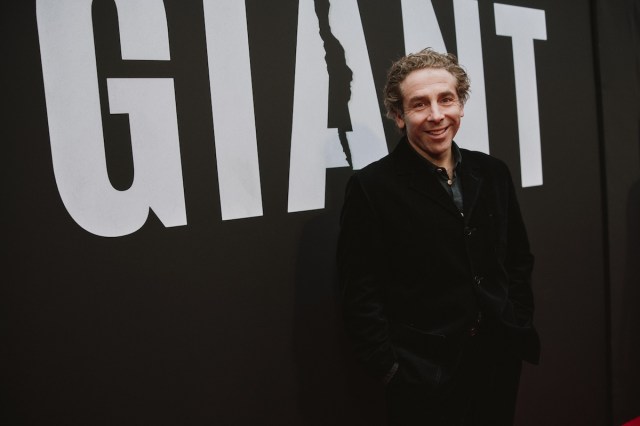
(© Emilio Madrid)
Elliot Levey is fascinated by the contrast between London and New York, and the way each city sees him. Back home in the UK, Levey says he’s most often viewed, first and foremost, as a Jewish actor. In New York, however, where he is making his Broadway debut in Giant at the Music Box Theatre, he’s struck to find himself seen simply as an actor.
That distinction marks an unexpected turning point for Levey, who has won two Oliver Awards for playing Jewish men in vastly different circumstances but who are united by the way the world responds to them. In Rebecca Frecknall’s revival of Cabaret, he played the fictional Herr Schultz, the German-Jewish fruit vendor whose faith in assimilation ultimately leads to his doom. In Mark Rosenblatt’s Giant, Levey plays Tom Maschler, the real-life literary titan tasked with keeping the peace during a contentious meeting with his anti-Zionist, allegedly antisemitic client, Roald Dahl. Through these roles, Levey has theatrically explored how Jewish identity is perceived, understood, and misconstrued, both onstage and off.
Levey says the otherness he experiences in New York is a lot less prevalent than it is in the UK, where the Jewish community is small enough (0.5 percent of the population) to seem almost exotic. Levey recalls being in a play called Monkey at the Young Vic in 2001, “and most of the reviews referred to my Judaism,” he says. “I was the monkey, and they’d say things like ‘the Semitic Simeon.’ As a young actor, when you think you can play anything, I thought, ‘Oh, my God, I’m the Jew.’ And I’ve embraced it. It’s paying for my electricity and my food.”
Here in the Big Apple, it has proved to be another story. “After the show last night, I was signing something and somebody said, ‘Are you Jewish?’ and I burst out laughing. I’ve never been asked this question, I think, in my life. It’s so—I don’t want to say thrilling because I don’t want to sound like I’m some self-hating bastard—but this is a Jewish town.”
![[L to R] Aya Cash, John Lithgow, Elliott Levey, and Rachael Stirling Photo by Joan Marcus](https://www.theatermania.com/wp-content/uploads/sites/4/2026/04/L-to-R-Aya-Cash-John-Lithgow-Elliott-Levey-and-Rachael-Stirling-Photo-by-Joan-Marcus.jpg?w=640 "[L to R] Aya Cash, John Lithgow, Elliott Levey, and Rachael Stirling Photo by Joan Marcus")
(© Joan Marcus)
During those years, Levey encountered what Americans might be tempted to call a wave of antisemitism but what was merely a product of the culture. “I had an English master that would openly call me the Jew when we were studying Oliver Twist. At Oxford, in my first week, I was in a three-person tutorial, and the professor said, “Ah, you must be Levey, judging by your facial features.’ I’m embarrassed to say it, but at the time, it was sort of affectionate. I know that Americans just think that’s crazy, that it’s some form of self-hatred, and it really wasn’t. But I’m not sure New York Jews would take those bantery comments on the chin without a fight.”
His lived experiences echo through the roles that Levey has taken on in recent years. Between Cabaret and Giant, he appeared in the West End revival of C.P. Taylor’s Good as Maurice, the Jewish best pal of a German literature professor who becomes an SS officer and ignores his friend’s plea for help to leave the country.
Thematically, you can connect these three characters, though the real-life Tom Maschler is perhaps the luckiest: he survived. Born in Berlin in 1933 to Austrian-Jewish parents, the Maschlers fled from Vienna to the United Kingdom after the Anschluss. As an adult, he would go on to acquire and publish works like A Movable Feast, Catch-22, and One Hundred Years of Solitude as head of the publishing house Jonathan Cape.
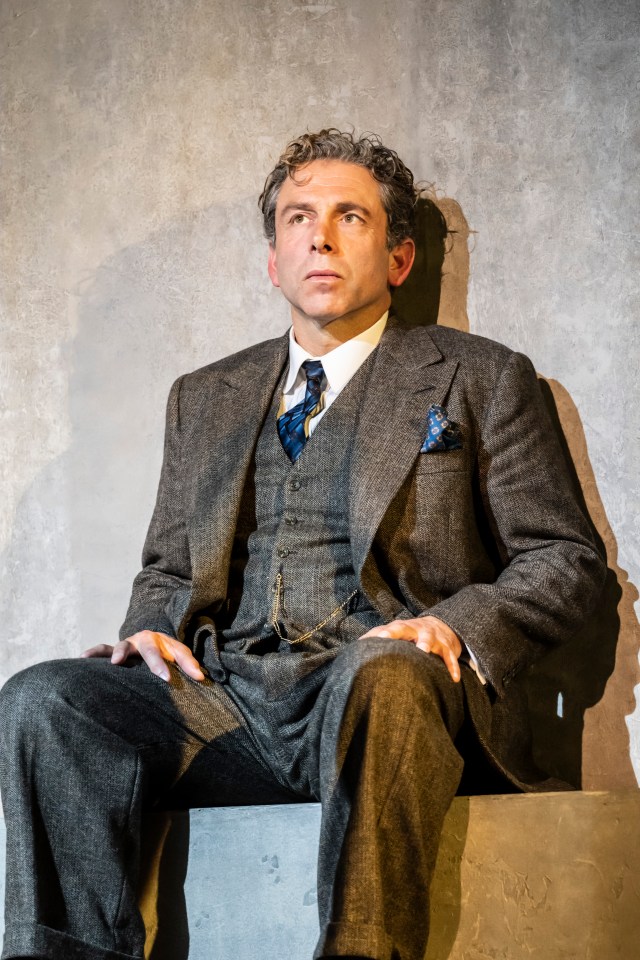
(© Johan Persson)
In Giant, Maschler finds himself navigating a volatile confrontation between client Roald Dahl and Jessie Stone, a fictional Jewish-American book sales rep played by Aya Cash, over comments Dahl made about Israel after it bombed Beirut in 1982. While Stone confronts Dahl directly, Maschler opts to sidestep the bigotry he has historically encountered to avoid the consequences of challenging it. “You just ignore it,” say Levey’s Maschler. “I wouldn’t be friends with someone who … Fundamentally hates me.” John Lithgow’s fire-breathing Dahl snarls, “If I’m an anti-Semite, then what are you, Tom? A house Jew, I suppose.”
For Levey, his characters are echoes of people he knows in real life, the “fellow kvetching Jews” who make up his WhatsApp chat groups. “Maschler is there. Herr Schultz is certainly there on some of them. At the moment in England, Maurice from Good is the one saying, ‘I’m not mad here. This is going very, very wrong.'”
But his conversations in other groups evoke the tensions that Rosenblatt explores in the play: if you’re against the existence of a Jewish state, does that automatically make you an antisemite? And if not, why have the two become inextricably linked, especially in 2026? Levey notices that several of his relationships are deteriorating because of it. These are “fellow left-leaning, liberal people whose despair and, let’s face it, hatred of Israel is becoming incredibly compromising for friendships. You and I both know of many people who have just gone down the rabbit hole with a fixed idea: there’s some goodies and there’s some baddies, and goodbye, Elliot. It’s hugely depressing. I’m not asking you to defend Israel. Pursue your views. Let’s all just be more rigorous in checking our facts than we ever have been in our lives.”
That’s why the glowing reception of Giant in New York, and especially the lack of descriptive anthropology about his performance, are deeply personal for Levey. “Look, I was very happy at school to have my special ghetto tie, but it’s really nice when the ghetto is the greatest city on earth. I’m getting handshakes like I’ve just done my Bar Mitzvah piece and I’m walking off the bima. I feel…well, I could cry. There’s no other way of saying it.” In New York, he’s seen not as a Jewish actor, but an actor who is Jewish—a giant distinction.

(© Marc Brenner)




Featured In This Story
Latest Reviews
See all


Latest Videos
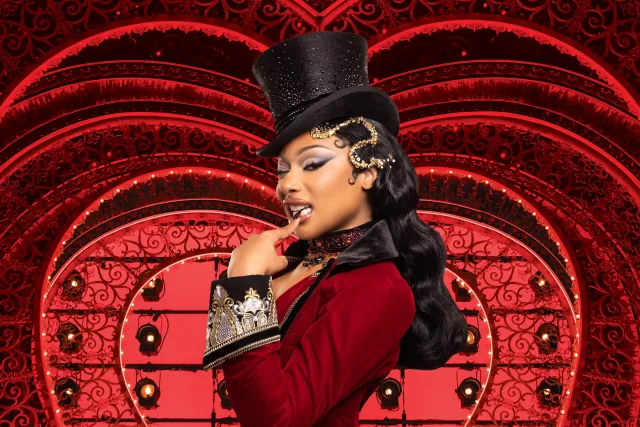
Get a First Look at Megan Thee Stallion as Zidler in Moulin Rouge! on Broadway
Megan Thee Stallion starts performances on Tuesday, March 24.