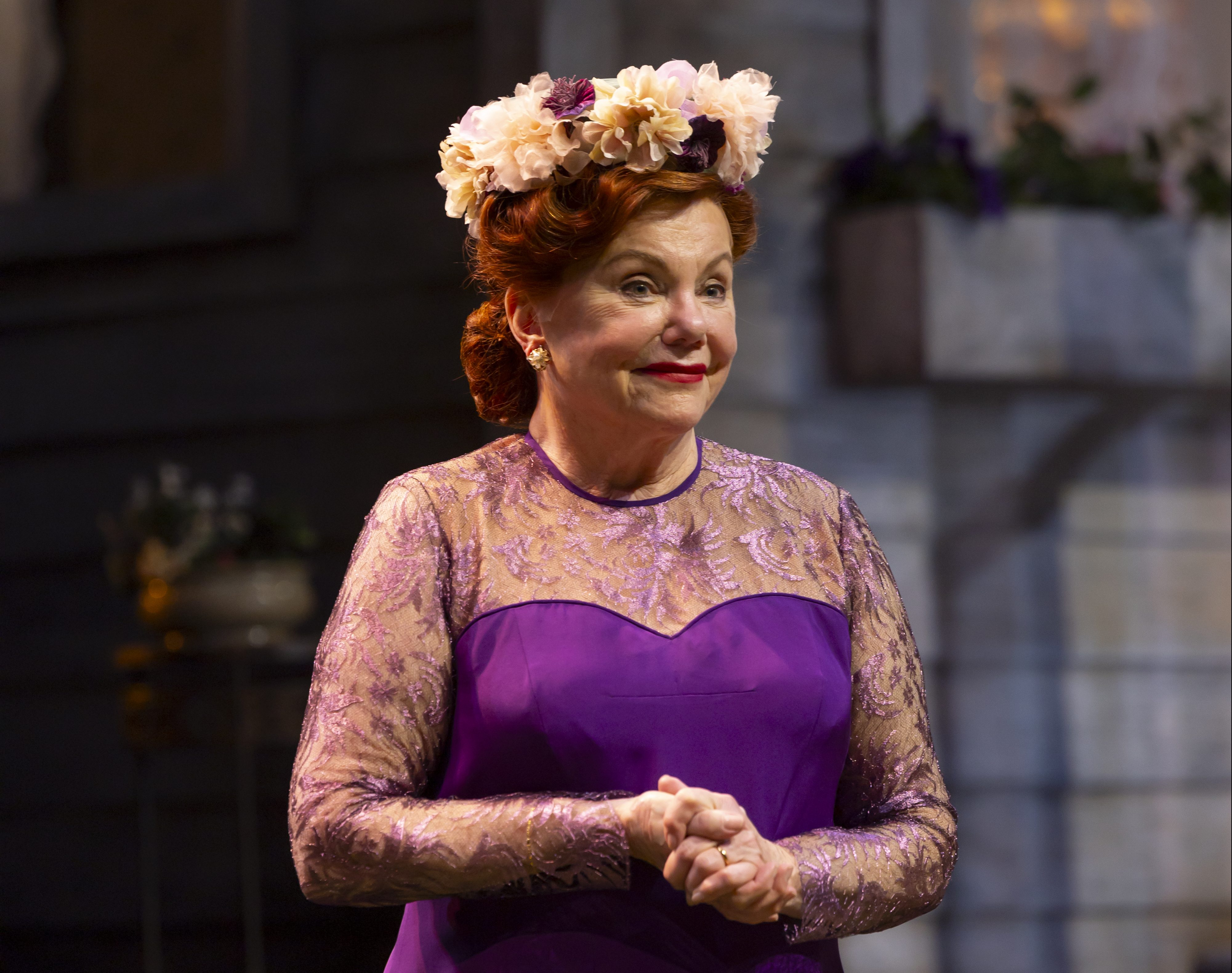

Gem of the Ocean

(Photo © Carol Rosegg)
Waiting for Gem of the Ocean to begin and taking in David Gallo’s not-yet illuminated version of a large parlor at 1839 Wylie Avenue in Pittsburgh’s Hill district circa 1904, I realized something that I habitually do in anticipation of whatever is the newest addition to August Wilson’s decade-by-decade cycle of plays about the 20th-century African American experience: I prime myself to relish the collection of full-bodied speeches that I have every reason to believe some or all of the play’s characters will be given. It’s a similar feeling to the one I’ve had in the past at new Richard Rodgers-Oscar Hammerstein II or Alan Jay Lerner-Frederick Loewe musicals — or, more recently, at a new Stephen Sondheim or William Finn musical. I assure myself that even if the show as a whole doesn’t entirely pass muster, it will contain moments to astonish and excite me.
Rest assured that with this ninth entry in his soon-to-be completed decalogy, Wilson doesn’t disappoint in terms of monologues: There are at least a dozen speeches so carefully wrought that they had me silently expressing thanks for their harsh poetry. The first is given by Aunt Ester (Phylicia Rashad), the supposed 285-year-old woman in whose home all the incendiary action occurs. (The actual fires in the plot happen elsewhere.) This initial beauty is about rope and, without mentioning lynching, goes in part: “God made the rope. It’s man who sometimes gets in the way of God’s creation and turns it over to the devil.” Among the many other sparkling remarks that Aunt Ester makes in line with her conviction that people should ask questions but make certain they’re the right questions is one about legal papers. During this touching disquisition, she says: “The law say I needed a piece of paper to say I was a free woman. But I didn’t need no piece of paper to tell me that.”
Not all of Wilson’s juicy-to-bursting monologues are handed to the play’s most sympathetic figures. Solly (Anthony Chisholm), who also calls himself Two Kings, is a Solomonic activist who literally carries a big stick and, along with Aunt Ester, serves as a reluctant hero and role model. In response to the still-new freedom that American blacks are supposedly enjoying, he exclaims, “They never made Emancipation what they say it was…They wave the law on one end and hit you with a billy club with the other.” In opposition to Solly is Caesar (Ruben Santiago-Hudson), a local mill executive with a carpetbagger mentality, whose comments: “It’s Abraham Lincoln’s fault. He ain’t had no idea what he was doing. He didn’t know like I know. Some of these niggers was better off in slavery. They don’t know how to act otherwise.”
The wonderful thing about these speeches is that unlike, say, Wilson’s King Hedley II, in which brilliant outbursts blossom like flowers in an untended garden, they appear in one of Wilson’s most tightly structured plays. (Todd Kreidler is billed as the dramaturg.) In each entry of his important series, he’s scrutinized the forces at play on African-Americans and how these besieged folks rise to maximize positive influences and minimize negative ones. The Gem of the Ocean characters are still grappling with the aftermath of emancipation — with, for instance, their tenuous hold on freedom in contrast to Alabama blacks who are still denied exit from the state. Living with Aunt Ester at her home and benefiting from her breadth of spirit are Black Mary (LisaGay Hamilton) and Eli (Eugene Lee). Dropping in on her are Solly, the white trader Rutherford Selig (Raynor Scheine), and the meaningfully called Citizen Barlow (John Earl Jelks), who arrives through an upstairs window because he needs to have his “soul washed” for a crime that he believes he’s committed.

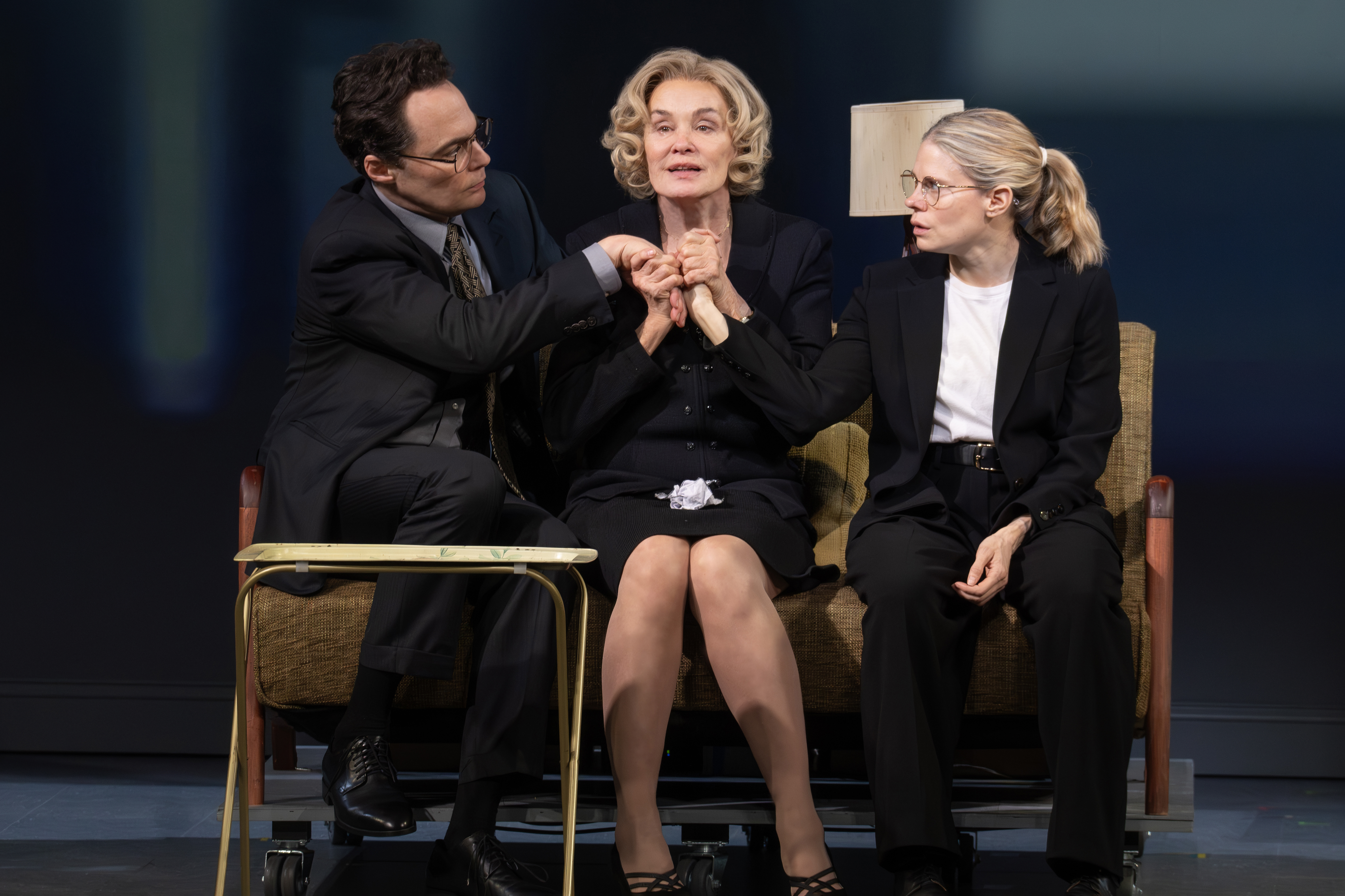
Eugene Lee, and John Earl Jelks in Gem of the Ocean
(Photo © Carol Rosegg)
How Aunt Ester accomplishes this feat — by sending him across the water in a paper boat called “Gem of the Ocean” to the replenishing place she identifies as the City of Bones — is the main action in Wilson’s second act. (Ester is helped immeasurably by lighting designer Donald Holder and sound designer Dan Moses Schreier.) Furthermore, how Citizen Barlow recovers his self-esteem to take up Solly’s crusading mission and so realizes one of Aunt Ester prescient dreams is the play’s major thrust. Compared to earlier Wilson plays, which to some extent echo prevalent styles of plays written in their specific decades, Gem of the Ocean may not qualify as “well-made,” but it has dark charm and weaves its own irresistible spell.
So does the acting. Director Kenny Leon is here reunited with his Raisin in the Sun leading lady Phylicia Rashad, and the results are similarly revelatory. Rashad plays age with a hobbled walk and the fingers of her left hand palsied. Delivering Aunt Ester’s words of unfrilled wisdom in crisp but forgiving tones, Rashad is a beacon around which a fine ensemble navigates. Throughout Gem of the Ocean, there are references to water as well as to earth, air, and fire, but the most significant word here is in the title: “gem.”
Featured In This Story