At Musical Theatre Works on Monday night, I once again enjoyed myself, this time moderating a panel with a foursome who helped Rent become the sensation that it has been since 1996. Director Michael Greif, musical director Tim Weil, and stars Anthony Rapp and Daphne Rubin-Vega were on hand to tell about the evolution of the landmark musical. And though Greif left early to attend the Obies (“I’m a nominator,” he explained) and Rubin-Vega arrived late because she’s shooting a movie in which a butcher makes a sculpture of her in meat (“I didn’t recognize you without the handcuffs,” I quipped), a good time was had by all.
Alas, how much happier we all would have been had Rent’s bookwriter-composer-lyricist, Jonathan Larson, been on hand to participate. But, of course, he died more than six years ago, on the eve of the first preview of the show Off-Broadway at New York Theatre Workshop. Rubin-Vega recalled that he used to hold a wonderful, annual “peasant feast” for his friends but that, for the final one, only the Rent cast was invited–“because we were now his new family.”
I mentioned to the panel that many cynics have alleged that the show garnered its smash-hit status partly because of Larson’s unexpected death and the media circus that ensued. “That’s why they call them cynics,” snapped Weil. Added Rapp, who had done the workshops dating back to 1994: “I can tell you that many times, when there was an audience for any Rent performance, people came up afterwards and swarmed all around Jonathan. That doesn’t often happen with authors but it sure did in his case. And nobody knew then he was going to die. So that’s what would have happened if he had lived: Great success, and people all around him.” (Rapp did the show in London, too, and was still smarting from the critic who said that Larson’s dying was “a good career move.” The audience winced and hissed when they heard what the boor had said.)
Now that we’re living in America at the start of the millennium–and now that three million, two hundred thousand, four hundred minutes have passed since Rent has opened on Broadway–is the show dated? Greif was frank in admitting that such references as AZT to AIDS may make it so–“not that we still don’t have a crisis on our hands,” he cautioned–but he said that he had never ever considered updating the material in any way. If Rent is now suddenly a period piece, so be it. He also said that he has to go back occasionally and admonish certain cast members who tend to incorporate dance moves that hadn’t yet been invented in the long-ago ’90s.

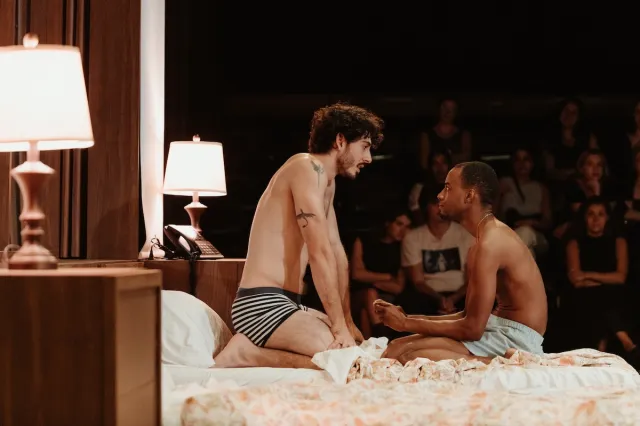
original Broadway production of Rent
I wondered if the group was well-versed in La Bohème before they began work on the show, and I wasn’t surprised to discover none of them was. (I should talk: The only thing I know about opera is The Phantom of the Opera and The Threepenny Opera.) For that matter, did most of the people know anything about Broadway? Greif mentioned that he wanted to try casting kids who didn’t necessarily have much theater experience, and I asked Rapp if he felt there was a big disparity between the theatrically savvy and the newbies. I chose him because I’d been a fan of his ever since I saw him in a much-underrated George Furth play (yes, play; not musical) called Precious Sons. There, he played a child actor who loved the stage but had a parent who scorned his participation. Sure, there have millions of plays with that theme, but here was the difference: The kid was already making a living in a pro production and was now financially out-grossing the father. So the father couldn’t make the oft-heard claim “You’ll never make it” because the kid already was. I still remember the way Rapp wistfully said, “The best days are Wednesdays and Saturdays because I get to do it twice.” (Anyway, Rapp replied that he didn’t see much disparity between Rent’s theatrical veterans and the rock artists who’d never done theater before.)
I also asked whether the powers-that-be felt that, in going to Broadway, they were essentially selling out–much as Mark wonders about selling his videotapes to Alexi Darling. Greif said that Larson was clearly “a Broadway baby” and would have welcomed the chance. Rapp mentioned that, before Rent, he was toiling in a Starbucks and was therefore very grateful to return to Broadway.
I noted that, for all the talk about Rent‘s revolutionizing the musical theater, that didn’t seem to have happened. After all, Thoroughly Modern Millie had just won the Drama Desk Award as Best Musical, The Producers won everything last year, and such recent Tony-winners as The Lion King, Fosse, and Contact, as well as such hits as Ragtime and The Full Monty, were in no way related to
Rent‘s rock score. Greif and Weil urged me to be patient, pointing out that it takes a long time for musicals to get on and saying that possibly, just possibly, quite a few started being written after kids saw Rent. I thought it was a good rebuttal, as was Rubin-Vega’s reminding me of Hedwig and the Angry Inch. When I asked about songs cut from Rent, Weil mentioned one about a door and a wall that he and Rubin-Vega much admired, though Rapp seemed astonished to hear that they liked it. Rapp also recalled a lyric that went something like: “Mr. Negative, you’re HIV-positive.”
I asked if it was tough to play the show with those first two rows of $20 ticket-holders who attended time and time again. Both Rapp and Rubin-Vega rued the incessant attendance of someone they came to call “Lippy”–because “he was lip-synching and contorting himself through each and every lyric,” said Rapp. I also asked Rapp if the character of Mark helped him to become more interested in videocam work, and he replied that he had directed three silent short movies and plans to make some feature-length sound films.

Daphne Rubin-Vega
Finally, I asked the audience for their questions. There was a query about the film version (don’t hold your breath) and a comment from one frequent attendee that “Lippy” is still very much on the scene, lip-synching and gyrating to all the pleasures that Rent has to offer. But the most poignant moment occurred near the end, when someone asked the performers if they’d had much support from their parents when they were younger and pursuing their goals. Rapp mentioned that his mother had encouraged him after he’d shone in some Pennsylvania summer camp productions and that she helped start his career when he was nine–but she discovered that she was dying during the genesis of Rent and she only managed to see the show once, albeit on opening night on Broadway. “Because she was sitting in the first row of the mezzanine,” he said, “I got to see how happy she was all performance long.” Once again, the joy of Rent was tempered by death–but Larson’s message that “It’s not how long you’re here, but what you do while you’re here” continues to live.
********************
[To contact Peter Filichia directly, e-mail him at [email protected]]