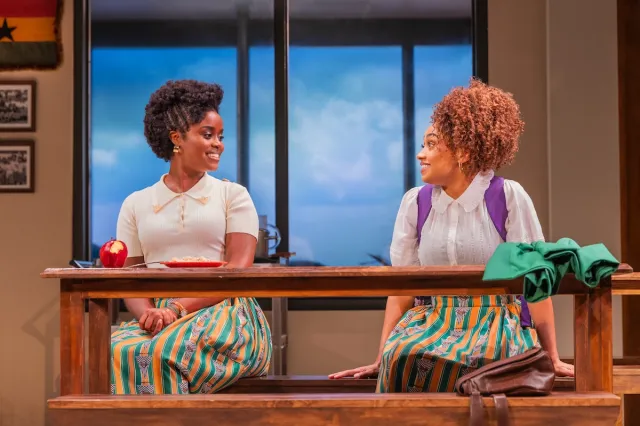
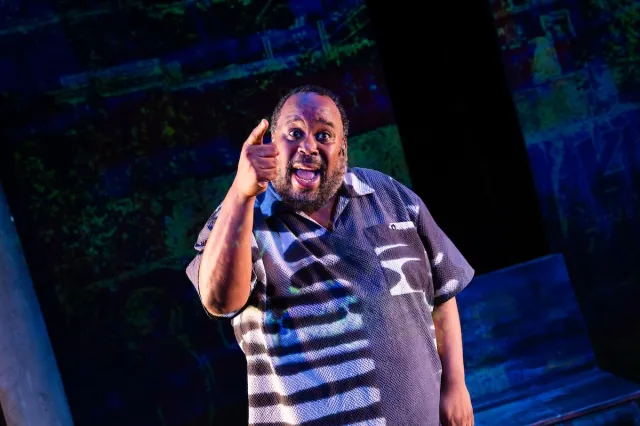
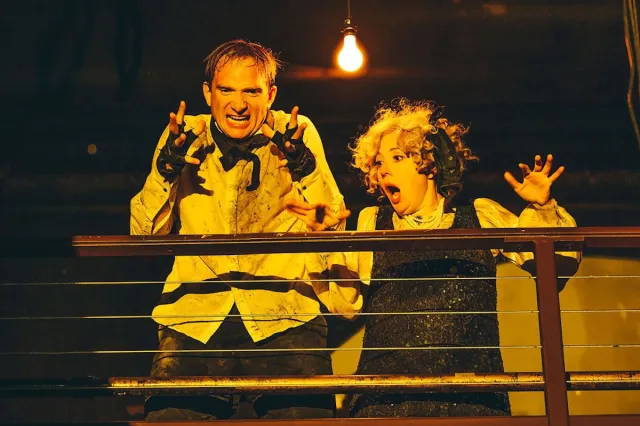
(© Joan Marcus)
Green Bay Packers head coach Vince Lombardi did not coin the phrase “Winning isn’t everything, it’s the only thing.” He likely picked up the quote from a John Wayne movie called Trouble Along the Way. But that doesn’t stop actor Dan Lauria from uttering those words in Eric Simonson’s new play Lombardi, one of the many fact-based productions bowing this fall on Broadway. “Lombardi never did anything to dispel the myth. In fact, he encouraged it and nobody ever challenged him on it and he never corrected anybody,” says Simonson.
The playwright used David Maraniss’ book When Pride Still Mattered: The Life of Vince Lombardi as his primary source material. “Using the book makes it a lot easier to draw facts out from Lombardi’s life if you need them,” he notes. “Maraniss delved into the life of Lombardi, so we get to hear part of the story from Lombardi himself.”
Even the play’s set-up — which concentrates on a single week during the 1965 season when (fictional) Look magazine reporter Michael McCormick (Keith Nobbs) spends a week with Lombardi and his wife Marie (Judith Light) to gather material for an article — is derived from a real-life incident mentioned in the book, when the sports reporter W.C. Heinz spent a week with the coach to see if they could write a book together. “It sounded like a hilariously frustrating experience,” says Simonson. “But unlike Heinz, Michael is a bit naïve, so he’s an amalgamation of different people and characters, and he even serves as a surrogate for Lombardi’s son.”
An even more challenging project is the musical The Scottsboro Boys — which has arrived on Broadway after earlier productions this year at the Vineyard Theatre and the Guthrie Theatre. The show, directed and choreographed by Tony Award winner Susan Stroman, chronicles the trials of nine African-American men unjustly convicted of raping two women in the 1930s (one of whom later recanted her story).

(© Tristan Fuge)
Seven decades later, the incident — while not widely discussed — still haunts millions, making it a particularly tricky subject for its creators. “The basic thing you have to remember is that you can’t change the history and you can’t even really bend it, you have to honor it,” says David Thompson, the show’s librettist. “But from there you have to go off and interpret it.”
According to composer John Kander, the more the show’s creators (including the late lyricist Fred Ebb) researched the source material, the more they became drawn to it. “It was the story of nine people whose lives were destroyed, and then they just disappeared from the public consciousness,” he says.
To help craft the script, Thompson obtained letters, newspaper articles, original court transcripts, and books written by two of the boys, Haywood Patterson (who became the show’s central focus) and Clarence Norris. “Research was just everywhere, so it was a matter of taking it and narrowing it down to the story we wanted to tell,” says Thompson.
The creators ultimately decided to use an unusual framing device to tell their story: a minstrel show emceed by a white interlocutor (played by Tony Award winner John Cullum) in which the “Boys” act out their tale, along with the help of the fictional Mr. Bones and Mr. Tambo (played by Colman Domingo and Forest McLendon, respectively). “It was the only way [the boys] could tell their story in 1931 and have people listen to them,” says Thompson of the minstrel show device.