
Fahrenheit 451

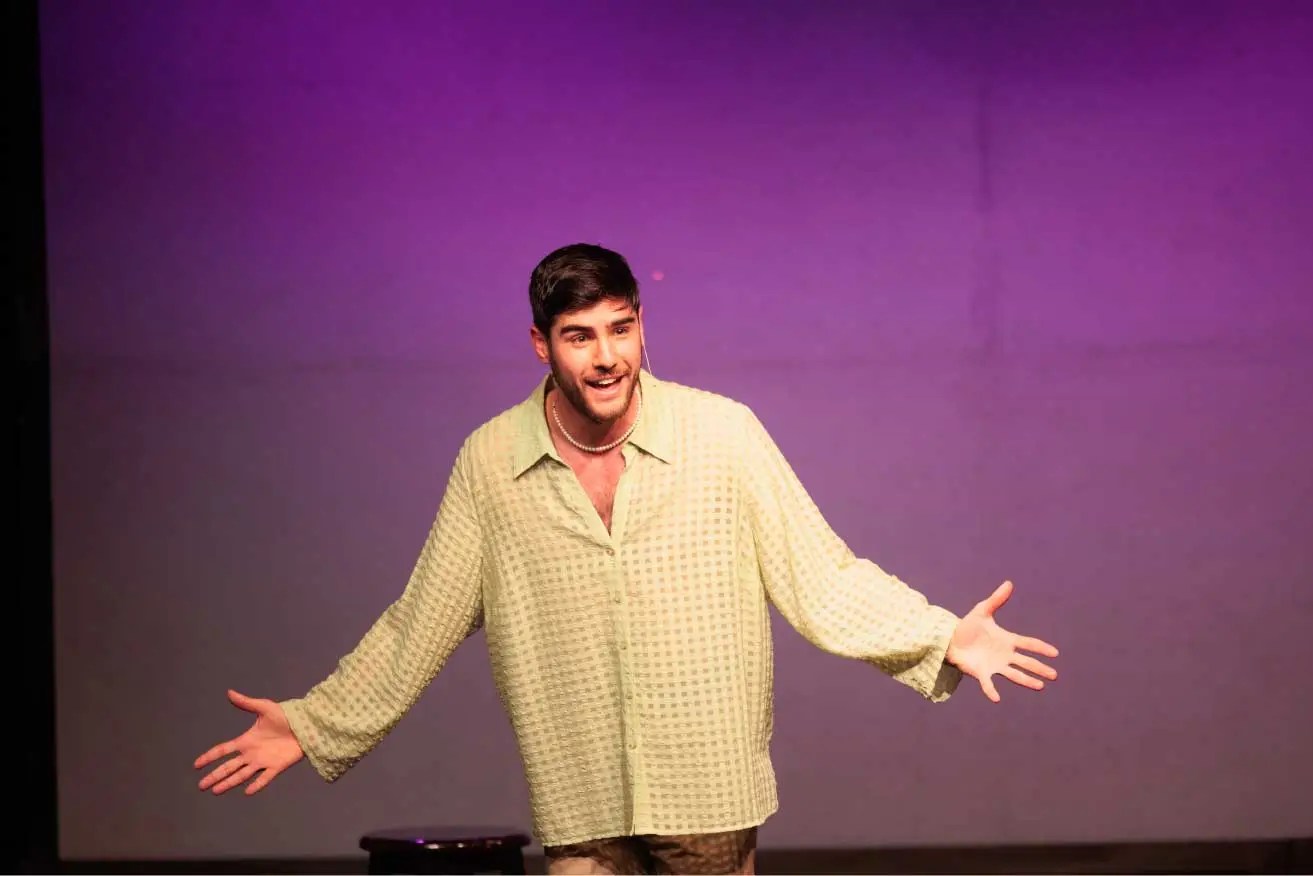
(Photo © Simon Alexander)
In The Age of Reason, Thomas Paine pointed out that the Hebrew concept of a prophet was not someone with the ability to predict the future but, rather, a poet or a musician. In both senses, Ray Bradbury’s 1953 novel Fahrenheit 451 is a hugely prophetic work, lyrical and prescient. Those who attend the Godlight Theater Company’s production of the play version (also written by Bradbury) may find themselves wondering if the author channelled some higher power to perceive such staggeringly accurate visions of America’s future, or if he simply took a look at trends in his own society and followed them to their most alarming conclusions.
For example, consider that Bradbury envisioned what we call “Reality TV” decades before there was such a thing. His tale also depicts a society in which the use of antidepressants is widespread, even though MAOIs had just been invented around the time that the novel was published. In the dystopian world of Fahrenheit 451, traditional defenders of intellectual freedom unite with its enemies for the sake of sensitivity to others or personal convenience — which is to say that Bradbury predicted the rise of “political correctness.”
Finally, the novel shows us a country wherein literature is burned and informed citizens are feared by the ruling order. One or two people who live here suspect that there was once a time when a fireman’s job was to put out fires, whereas his duty in this unspecified future era is to light up ‘Whitman on Wednesday, Thoreau on Thursday, and Ferber on Friday.” Only a few citizens, including the naïve Clarisse, are foolish enough to believe that they can sustain a principled resistance to this totalitarian mind control. You don’t have to dig too deeply to find relevance to today’s society, where the majority of Americans defend the right of their government to pry through their library records.
Joe Tantalo, who directed this New York premiere production of Farenheit 451, makes 59E59’s Theater C — which is roughly the size of a New York apartment’s living room — seem like the ideal performance space for this work. Maruti Evans’ lighting is central to the show: Red bulbs are visible through the smoke as the firemen do their duty; to indicate surveillance videos, actors speak in silhouette behind translucent panes of glass; blinding lights shine into the eyes of audience members during moments of distress. The effect of all this is both technologically savvy and timelessly ritualistic.
In the lead role of Montag, Ken King calls upon his classical training at the Moscow Arts Theater. He pronounces every word of dialogue clearly and is a likeable actor, but his line readings could be more varied; whether the subject is Edna St. Vincent Millay or Walt Whitman, he speaks in the same tone of awe and reverence. On the other hand, when Gregory Konow as Captain Beatty quotes a line of forbidden literature, it is clear that the quote is deeply meaningful to him. Teal Wicks lights up this bleak production in the role of the young and cheeky Clarisse, even if she radiates so much energy that she seems almost too childish for an 18-year-old girl. The seven other actors who round out the cast all give memorable performances.
When Bradbury’s novel was published, book burning was enough of a problem that President Dwight D. Eisenhower urged against it in one of his speeches. More than 50 years later, as some people continue to fear free expression through art and literature, Fahrenheit 451 remains relevant and powerful.
Featured In This Story