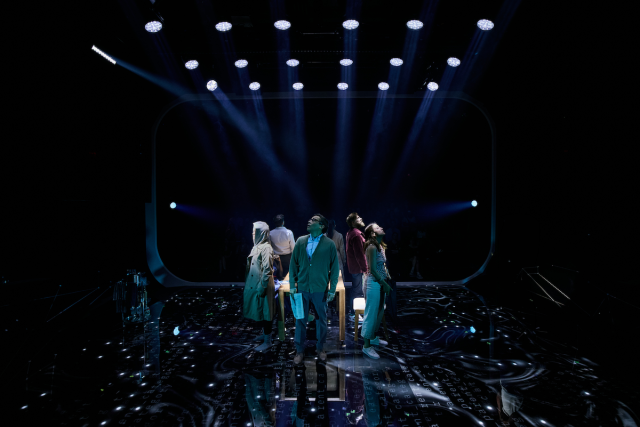
Juliette Binoche in Betrayal
(Photo: Joan Marcus)
“It’s the greatest love scene written in the modern 20th-century drama,” David Leveaux says, obviously not afraid to edge out on a very long limb. He adds, “It’s the balcony scene of late 20th century drama.”
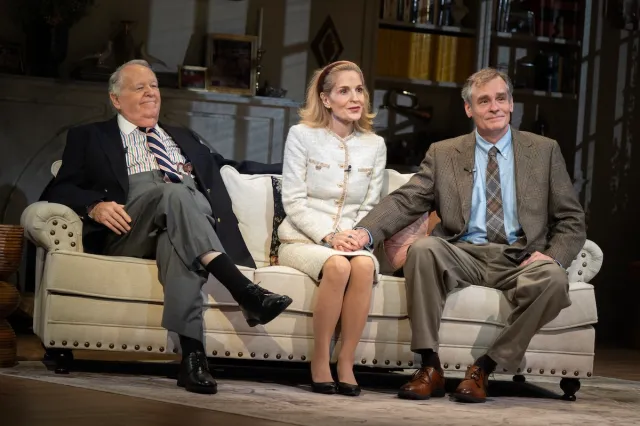
Leveaux is talking about the final sequence of Harold Pinter’s Betrayal, which is being revived this month by the Roundabout Theatre with Leveaux as director. The production stars Juliette Binoche (in her United States acting debut) as Emma, Liev Schreiber as Jerry, and John Slattery as Robert. Leveaux bases his rather bold statement on a certain amount of knowledge and experience: He has earned the right to make any kind of grand pronouncement he wants about Betrayal, because this is the fourth time he has directed this particular Pinter play.
That’s right: He’s helmed the property in England, France, Japan and now America. So if Leveaux thinks that the last scene in Pinter’s nine-scene play is worthy of favorable comparison with William Shakespeare’s handiwork, it’s because he’s given it a lot of thought while under the first-night gun in four countries. What makes the steamy love scene singled out by Leveaux especially notable is that, although it comes at the very end of Pinter’s piece, it happens to contain the action that sets the entire enterprise in motion.
You see, Betrayal is a narrative that is presented almost entirely in reverse chronological order. As the play begins, Emma and Jerry meet in a pub to reminisce with some melancholy about a seven-year affair that ended two years before. From then on–with three exceptions–each succeeding scene depicts their romantic liaison from its conclusion to its beginning nine years earlier.
In that final scene which Leveaux deems so monumental, Jerry (a literary agent) is at a party in the home of his best friend, Robert (a publisher) and his wife, Emma. Jerry has followed Emma into her bedroom to declare the passion he’s developed for her. She resists his fervent advances at first, telling him he’s drunk; she’s interrupted by Robert, who arrives for a few minutes and then departs. In the play’s last seconds, she lurches for the door but is momentarily held back by Jerry, and–in an exquisite silence–looks at him long enough to indicate she can’t and won’t leave.
Ordinarily, it’s not a good idea to give away a play’s ending. But Betrayal is different, because what’s being given away is really the beginning. The rest of play has shown the repercussions of that spur-of-the-moment decision–repercussions that include a great deal of shared ardor and dissembling, a blend of extra-marital bliss and marital despair. When Emma decides to remain in the charged boudoir rather than quit it, she and Jerry trigger behavior that affects not only themselves but their respective spouses and children. (Jerry’s wife, Judith, is talked about but never seen.)
With this agitated three-hander, Pinter is making a number of statements, not the least of them being that in an action’s outset lie the seeds of its outcome. Since this is Pinter, however, arguments persist about exactly what he intends to convey. His plays, always laconic and often considered baffling, have stirred debates for 53 years–ever since his first effort, The Room, premiered in 1957.
When asked, Pinter has consistently refused to shed any additional light on the meaning of his work. In a speech he gave upon receiving the 1970 German Shakespeare Prize,
he maintained: “I can sum up none of my plays. I can describe none of them, except to say: This is what happened. This is what they said. This is what they did.” At the same event, he also characterized as “glib” a remark he once made: the remark that his work is about “the weasel under the cocktail cabinet.”
Well, “the weasel under the cocktail cabinet” is a facile comment, but the image does indicate a link between and among the plays in Pinter’s canon. The implication is that, in his writing, Pinter examines calm surfaces about to be disturbed by hidden forces; so it’s possible that, when he tossed off the remark, he was really uttering a truth that had shot up unimpeded from his unconscious. Surely, it’s this quite British quality of mystery masked by manners that put the word “Pinteresque” into the lexicon shortly after the taciturn Pinter’s work began to be produced.
But what does “Pinteresque” really mean, and who is the man behind it? For one, he’s a man whom the Queen named to the Order of the British Empire [OBE] the year after the Beatles, as he has often pointed out. If Pinter isn’t going to give himself or his output away, there are people who will try; David Leveaux, who has also directed Pinter’s No Man’s Land with the author featured prominently in the cast, has strong opinions on the subject.
“There’s a reason why the word ‘Pinteresque’ has now gone into the dictionary,” Leveaux says, “despite the fact that it’s a word prone to wide misinterpretation. It’s generally used in a lazy sense, meaning slight bizarre and enigmatic, when what is really Pinteresque is an absolutely ruthless and honest insistence on telling it like it is.”