A Day in the Death of Joe Egg
(Photo: © Joan Marcus)
The cross-dressing stand-up comic Eddie Izzard tells anyone who asks that he’s determined to be a “serious” actor because he wants to be taken, well, seriously. So it’s fortunate that he was asked to replace Clive Owen when the current revival of Peter Nichols’s harrowing but brilliant A Day in the Death of Joe Egg played London’s West End last year. The production has now been imported to Broadway by the Roundabout Theatre Company, which last mounted Nichols’s difficult, gratifying work in 1985.
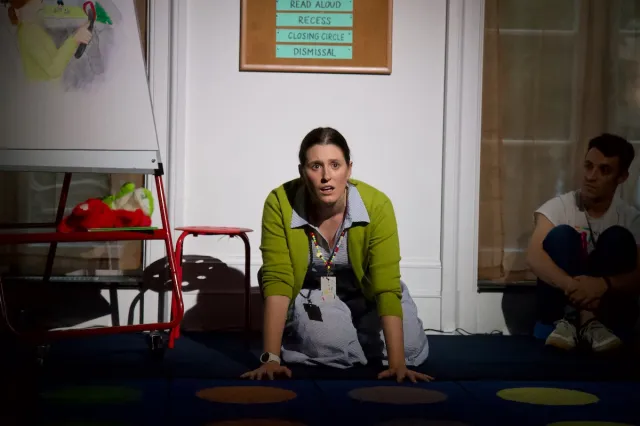
This serendipitous development has to be causing Izzard much delight, and is bound to do the same for audiences. In Joe Egg, Izzard plays Bri, the father of a brain-damaged, wheelchair-ridden 10-year-old girl. The part calls on all his emoting strengths — and then some. Bri, a teacher in charge of the trouble makers at his school, and wife Sheila (Victoria Hamilton, also making a dazzling New York debut), expend enormous energy in a daunting situation about which they feel different degrees of guilt and shame. Forever on edge but pretending otherwise, their primary survival mechanism is to improvise comedy routines for their own entertainment.
And that’s where Izzard’s background prepares him for what may be the acting assignment of his life. Although he knows his saucy way around a comedy monologue and opens
Nichols’s tragicomedy with a marvelous one, he is equally versed in improvisational techniques — wonderfully fast on his feet and quick with his tongue. When not in his own form of drag, Izzard is a stocky, even macho guy, just a bit goofy around the edges. Looking enough like Philip Seymour Hoffman to be that actor’s long-lost brother, and sharing Hoffman’s chameleon-like abilities, Izzard takes the wide American Airlines Theatre stage with supreme confidence. In fact, he’s so adept that he truly seems to be ad-libbing even when he’s clinging to the text.
At the end of the first act, when Bri and Sheila explain to the audience that they’re about to run through a few skits skewering incompetent doctors and clergymen whom they’ve encountered, Izzard makes tomfoolery his domain. Pretending to be a dim-witted medic, he’s suddenly crooning “Animal Crackers” and executing a daft soft shoe that builds into a tour-de-force of desperate silliness. The next minute, he’s an unctuous, misguided Church of England cleric. Along the way, as the impulse strikes, Izzard interpolates lines of his own devising; at one of the press previews, he threw in a droll joke about dogs that went by so rapidly, many of the spectators might have missed it.
Because Izzard is endlessly inventive as a tormented man who is losing the battle against depression, it’s likely that he never gives the same performance twice. Indeed, if there’s any drawback to his work here, it’s that he risks pulling Nichols’s delicate script ever-so-slightly out of shape; he is such a virtuoso at what he’s asked to do that he has trouble containing himself. Still, watching Izzard give free rein — or almost free rein — to his imagination is thrilling. He delivers a courageous performance as a man trying his damnedest to be courageous and yet sensing failure with every quip.

in A Day in the Death of Joe Egg
(Photo: © Joan Marcus)
Lucky as Izzard is to have landed this part, he’s even luckier in getting to play opposite Victoria Hamilton. A brunette with a round, piquant face, Hamilton’s credits couldn’t be more different from Izzard’s. Having apparently confounded her agents at the start of her career by saying that she wanted to do five years of classical theater before branching out, she now has the kind of résumé that even British actresses rarely accumulate today, and she now brings that invaluable experience to bear in her characterization of a wife and mother at the end of her frayed tether. Hamilton’s Sheila is a woman given to unconvincingly hopeful smiles and nervous laughs. As she tries to subdue and cajole Bri, she conveys the ambivalence of someone who loves her spouse body and soul but is beginning to understand that love is not always enough. What’s particularly remarkable about Izzard and Hamilton is that, though their training hardly meshes, the two of them do. They have the kind of chemistry that’s absolutely necessary if A Day in the Death of Joe Egg is to connect at all. The physical by-play between them is great to watch; there’s no mistaking the attraction that Bri and Sheila still have for one another.
Their mutual admiration is also in keeping with the style of the play. They obviously relate to each other not only as the characters must do but as actors deriving pleasure from the teamwork. This is especially noticeable during the sections of the play where they’ve been encouraged to find a balance between sticking to the lines and making things up. In this, they have been urged on not only by Nichols but also by director Laurence Boswell, who deserves equal credit with his leads for the spontaneity achieved throughout.
As the title A Day in the Death of Joe Egg suggests, the action takes place in one day — in much less than a day, really. Bri arrives home one late afternoon, minutes before his disabled daughter (Madeleine Martin, in a moving and charming debut) returns from her day care. Sheila is preparing to leave for community theater duties she’s taken on as a break from her demands at home. After she and her husband run through their impromptu sketches, Sheila departs; then Bri tends to his daughter before going off to paint. (He’s an amateur artist whose Andy Warhol-like pictures of movie star cowboys hang on the walls of Es Devlin’s effectively cluttered set.)
Upon her return in Act II, Sheila brings home the upwardly mobile Freddie (Michael Gaston, perhaps more brash than required) and the polite but insensitive Pam (Margaret Colin, less in command than usual and wearing a so-so Paul Huntley wig). Their notions about how to deal with young “Joe” clash with Sheila’s and Bri’s. Also dropping by with all the wrong things to say while she knits is Bri’s well-meaning but conventional mom, Grace (the polished Dana Ivey). The unhappy result of the sometimes awkwardly conciliatory, sometimes angry cross-talk won’t be revealed here.
In writing about Sheila and Bri and the daughter they call Joe Egg, Nichols found a way to deal with the real-life challenges he and his wife faced. They, too, were the parents of an incapacitated child, and it seems to follow that the work is a consequence of the therapeutic games the couple played with each other. It takes a brave person to even contemplate committing this kind of personal history to paper, and completing the task so skillfully is that much more valiant. Nichols’s fearlessness has once again been matched on stage, this time by Eddie Izzard, Victoria Hamilton, Laurence Boswell, and their colleagues.