
The Caretaker

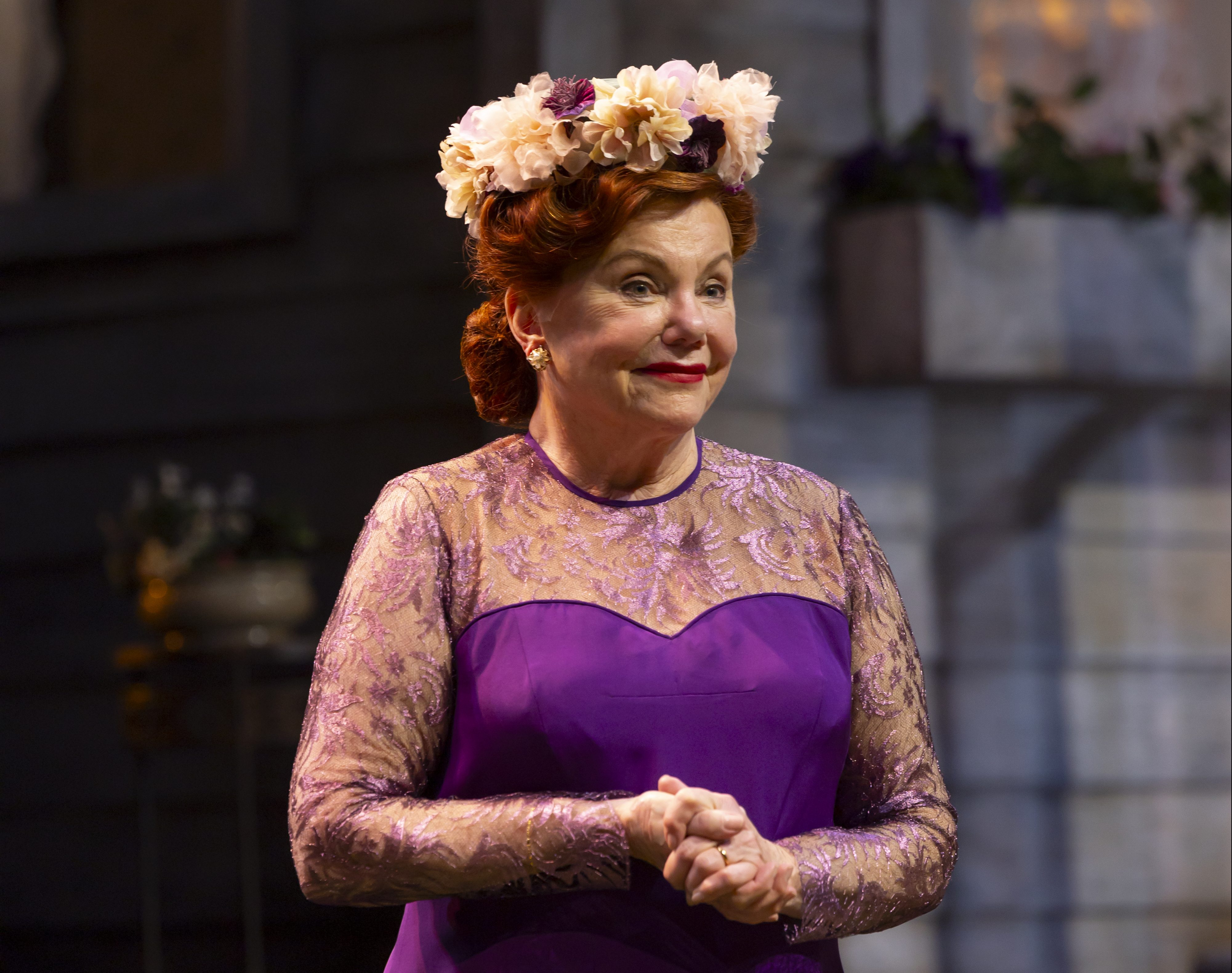
(Photo © Joan Marcus)
Harold Pinter writes his plays with precise requirements as to how they’re to be directed and acted. He has such a pronounced sense of what he wants done that, in his many stage directions, he differentiates between “pause,” “slight pause,” “silence,” and “long silence.” Not even Samuel Beckett, another dramatist with a reputation for performance strictures, is so specific. Indeed, Pinter seems to populate his works only with people who continually pause and observe silences. When he’s at his best, he convinces us that this is an accurate depiction of human communication (or lack of communication) in the real world.
It would seem that Pinter’s pieces — more than dramas by other playwrights, Beckett always excepted — don’t leave much room for diverse interpretations. But this turns out not to be the case, as the Roundabout Theatre Company’s production of The Caretaker illustrates. David Jones, who directed this version of Pinter’s 1959 opus, seems to have decided on another approach to a play that heretofore has been, at least in part, a study of free-floating menace. Jones has, to the contrary, prodded along a Caretaker that feels almost cozy.
The script is unchanged, of course. When the lights brighten on John Lee Beatty’s rendition of a cluttered room in a rundown West London house, Mick (Aidan Gillen) is sitting silently (what else?) on a bed. Hearing voices in the hallway as he stares at the objects that fill up the commodious space, he abruptly steals from the room. Seconds later, Davies (Patrick Stewart) is shown in by Aston (Kyle MacLachlan), who indicates that this is his home and who tells the apparently homeless newcomer that he’s welcome to move in until he sorts himself out. (“Sorting out” is an Britishism used to cover every degree of personal difficulty.)
Aston’s first words, spoken at the end of Act I, are “What’s the game?” Well, the game seems to be King-of-the-Squalid-Mountain; during three acts and eight scenes, the men come and go, holding conversations that register as subtle plays for power. Davies, who’s been using the assumed name Bernard Jenkins, in one of those strangers whom dramatists like to show arriving unannounced and gradually taking over. This shambling fellow in worn shoes shifts from being intimated by the returning Mick to laying unspoken claim to the abode. Eventually, he’s wearing a smoking jacket and sitting in a stuffed chair with a pipe held aloft.
Aston, a slow-moving man who gives the impression of being simultaneously thoughtful and ineffectual as he talks about the shed he’s going to build in the back, is ruminatively cordial to Davies. Only days after delivering a long speech about electroshock therapy he’s endured does he bring himself to ask his guest to shove off. Mick, the building’s actual owner and the most labile of the three men, gets his jollies by keeping the others guessing whether he’ll be hostile or conciliatory whenever he steals back into the room. As is typical of Pinter, nothing is resolved when the games of one-on-one and two-on-one have played out. It’s worth noting, however, that director Jones doesn’t necessarily follow Pinter’s instructions to the letter when, at final curtain, Davies stands at the open door to the hall, getting nowhere in a plaintive bid to Aston for a reprieve. Is he going or is he staying? Jones seems to disagree with Pinter on the answer.
I’d venture to say that most productions of The Caretaker get under the viewer’s skin — or up his nose, as the Brits say — because something sinister is transpiring that isn’t easy to pinpoint. Surely, the appropriating interloper, which Davies represents, is a universal fear. (Edward Albee has stealthy fun with this in A Delicate Balance.) The specter of Davies heaving into the play and seeming to take territorial command has been the drama’s strong point in past productions. Donald Pleasence, who originated the role, had the right kind of command; and as recently as two seasons ago when a lumbering and uncrecognizable Michael Gambon was Davies in a London revival, the intended dread was very much present.

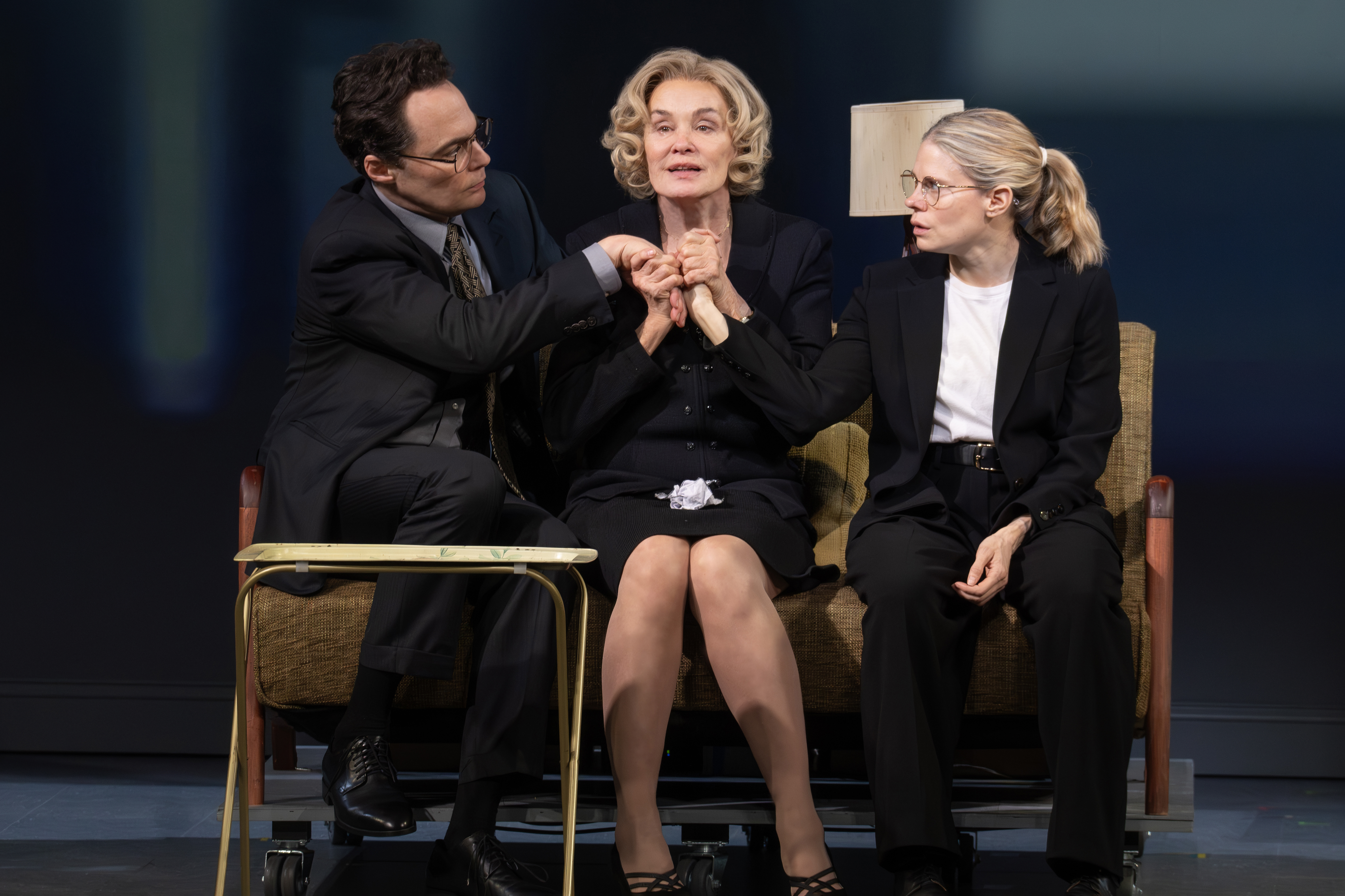
(Photo © Joan Marcus)
Little of that materializes under Jones’s watch, even though Patrick Stewart gives what is, in many ways, a superlative performance as Davies. His portrait of a crotchety old man is traffic-stopping in its attention to detail. He shuffles; he’s quick to raise his fists and just as quick to cower; he lets out old-man grunts and groans when he bends over to remove the shoes he’s hoping to replace. And he looks a proper mess in the shapeless jacket belted with rope that Jane Greenwood has put on his bent back. (This is the third play in a week — The Violet Hour and Cat on a Hot Tin Roof are the others — for which Greenwood has done impeccable costume design.) There’s a long stretch in the third act when Stewart, stock still in three-quarter view, looks the quintessence of geriatric shrinkage. Yet, in what may be an obsession with capturing the seventh age of man, the actor has neglected the one ingredient that The Caretaker must have in order to seem like more than a few benign nights in a Bowery flophouse — and that’s the very element Jones evidently doesn’t notice missing.
In contrast, Aidan Gillen has the necessary chops. Lean and quick and with a glint in his eye that comes and goes, he moves like a nervous cat. When, in Act I, he knocks Stewart about and then stands threateningly over him, The Caretaker reaches the level of fright that’s called for. The foreboding recurs whenever Gillen is around, challenging an audience to guess what he’ll do next and fooling observers with every sudden gesture. Kyle MacLachlan has given careful consideration to the behavior of a man who’s had his brain lobes tampered with. The result of his preparation is that sometimes he’s commendably in character and, at other times, he appears to be thinking about the character. (MacLachlan’s accent stands up to that of the English Stewart and the Irish Gillen.)
Perhaps the claustrophobia that’s part of the play’s strength is also absent from this production because John Lee Beatty’s set, architecturally fascinating as his realistic sets always are, isn’t sufficiently crammed with the discarded objects that are Aston’s preoccupation. The stage of the American Airlines Theatre is large and Beatty uses it all; had he and Jones decided on a tighter space with a false proscenium, the airless surroundings that Pinter wanted may have risen. On the other hand, lighting designer Peter Kaczorowski gets the look of the one naked bulb hanging above Aston’s bed, the upstage window letting in weak sunlight, and the gloomy section of hallway that’s visible. Sound designer Scott Lehrer’s best moments come when water drips into a bucket hanging just below the ceiling to catch the rain; otherwise, he honors Pinter’s avoidance of gratuitous effects. Still, upon leaving the theater, an unmoved patron is likely to feel that this Caretaker needs a caretaker.
Featured In This Story