
First Lady Suite

(Photo © Joan Marcus)
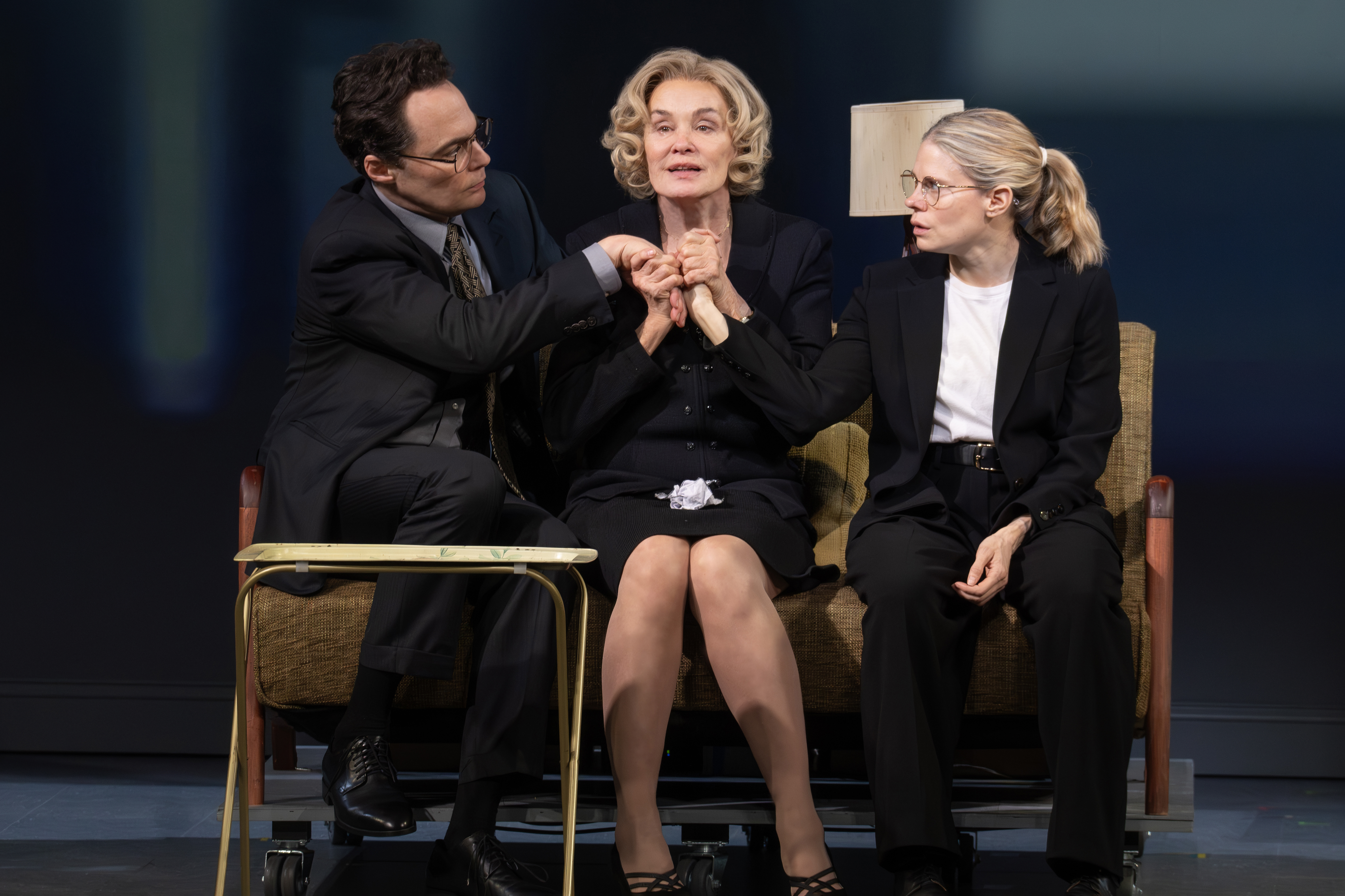
By the time it occurs to you that Michael John LaChiusa isn’t saying very much about the famous characters who populate his mid-20th-century-grounded First Lady Suite, you’ve been so consistently entertained that lack of substance seems a ho-hum consideration. On the outsized and raked Presidential seal that set designer John Story has provided as the primary playing area for the Transport Group’s new production of a work that was first seen at the Public Theater in 1993, the most interesting figure to show up is, ironically, not Lady Bird Johnson, Jackie Bouvier Kennedy, Mamie Eisenhower, Bess Truman, or Eleanor Roosevelt. No, the lady with a truly complicated plight is Lorena “Hick” Hickock, the newswoman who quite publicly befriended Mrs. Roosevelt and exchanged with her a series of letters indicating that the two may have been more than platonic friends — at least, from Hick’s perspective.
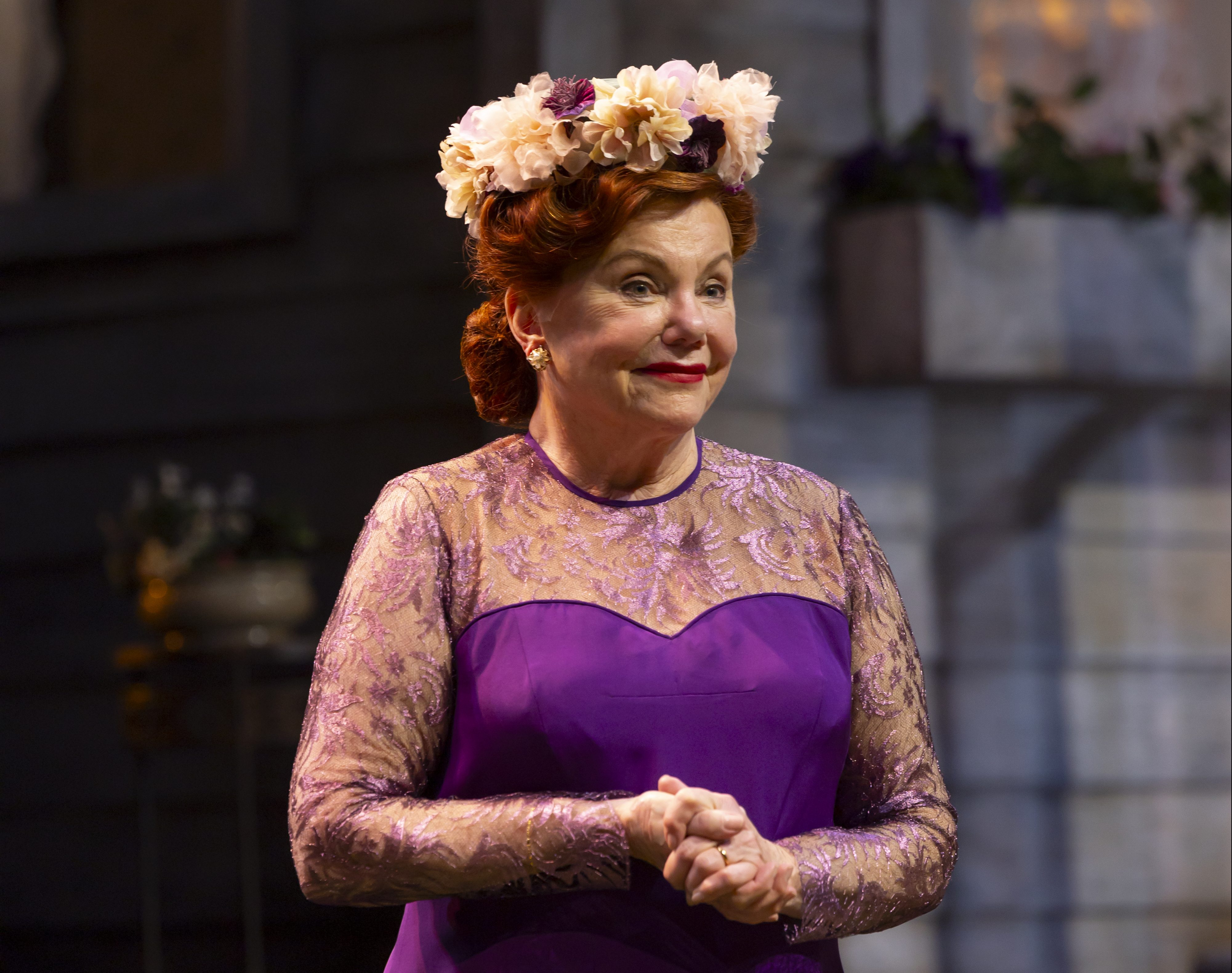
In the fourth of the musical sketches that LaChiusa has deftly run up, Eleanor Sleeps Here, Hickock (Mary Testa) is aboard a plane that Amelia Earhart (Julia Murney) is piloting with Mrs. Roosevelt (Mary Beth Peil) at her side. Perched on the floor behind them, Hick is ill at ease; eventually, she lights up a cigar even though warned by Earhart about the gas tank and then steps out on the wing, all the while questioning her decision to put her career as a scoop-happy journalist on the back burner while pursuing a relationship with the first lady. In the series of tuneful arias with which LaChiusa dots the piece, Hickock wonders if she’s really content being the lady behind the lady behind the man.
That dilemma is in keeping with LaChiusa’s view of the five first ladies who pop up here. His overall take on these women is that they’ve chosen to subordinate themselves to their husbands. Having done so, each of them is dissatisfied, just as Hickock is in her quandary about deferring to Mrs. Roosevelt. The overriding image of a woman standing behind a man is established immediately as director Jack Cummings III brings R. Lee Kennedy’s lights up on a male figure (James Hindman, who plays all of the men’s parts and then some) facing upstage with a female figure just downstage of his left shoulder.
Presented in reverse chronological order of their occupation of the White House, the women behind the men show their discomfort in varying ways. Jackie Kennedy (Robyn Hussa), caught up in details such as locating her gloves and her pillbox hat, plays a relatively minor role in “Over Texas,” the opening skit in which the focal character is her put-upon secretary Mary Gallagher (Donna Lynne Champlin). (A program note informs patrons that Gallagher was shockingly underpaid by the couture-loving Mrs. Kennedy.) The jokes here include a brief, enigmatic appearance by Lady Bird (Ruth Gottschall), clearly not a Jackie favorite. Much of the action takes place in a disturbed dream that Gallagher has as the Presidential party heads toward Dallas aboard Air Force one on November 22, 1963. Jackie, by the way, wears a version of the famous pink Oleg Cassini suit, upon which costume designer Kathryn Rohe has fixed a foreboding black collar.
Mamie Eisenhower (Cheryl Stern) is definitely the central character in the vignette “Where’s Mamie?” — although she shares much of her quality time with Marian Anderson (Sherry D. Boone), who’s hoping to get President Eisenhower to intervene in the Little Rock, Arkansas integration crisis. Mamie, fed up with being relegated to her White House bedroom, becomes determined to introduce Anderson to Ike by flying the two of them back in time (yes, LaChiusa takes many amusing liberties) to the World War II years. There, Mamie encounters her husband (James Hindman) dancing suggestively with his chauffeur and presumed inamorata, Kay Summersby (Ruth Gottschall), so she intervenes with comic consequences.
It should be mentioned that in “Olio,” the briefest of the segments, LaChiusa drops the meek helpmeet theme. Here, Bess Truman (James Hindman in heavy drag) is at a ladies political luncheon where daughter Margaret is singing. Throughout Margaret’s excruciating delivery, Mrs. Truman coughs, fusses with wrapped candies, and generally distracts attention from her modestly talented daughter.

in First Lady Suite
(Photo © Joan Marcus)
As LaChiusa’s portraits accumulate, it becomes apparent that he’s not offering particularly trenchant insights. For example, it’s too easy to reduce Mamie Eisenhower to someone who’s miffed at being left at home; there has to have been something spoof-worthy about her beyond that ’50s cliché. (Do I remember correctly that Alice Playten as Mamie in the original production of this show was a tippler, in line with rumors about this First Lady’s secret boozing?) Eleanor Roosevelt, depicted by LaChiusa as a Tootsie Roll-popping dilettante who owes her intellectual growth to Hickock, was unquestionably more substantial in life than she is here, and Jackie Kennedy’s psychological make-up is well-known to have transcended preoccupation with misplaced gloves. As for Bess Truman undermining poor Margaret, that seems another easy joke. In the late ’40s, Harry Truman was notoriously ready to fight anyone who mocked Margaret, and it’s highly unlikely that the publicity-shy Bess Truman would have behaved as crudely as — for the sake of a laugh — LaChiusa imagines.
Yet, as dolled up in Transport co-founder Cummings’s smart production, with Andy Warhol-like blow-ups of Mrs. Roosevelt et al. beaming at the audience from tiered false prosceniums, First Lady Suite is too much fun to heave brickbats at. Taking LaChiusa to task for simplifying his subjects in a kind of early feminist way isn’t so much to miss the point as to possibly be overly-analytical about it. In this early work, the composer-lyricist-librettist’s gift for tossing off engaging melody and his sly sense of humor are as abundant and nourishing as April rain. LaChiusa must have done much giggling while writing these vignettes, and that sense of fun comes across; while sympathizing with the first ladies, he also regards them as fonts of hilarity.
The cast is outstanding, whether singing as a choir — which they do in a prologue and a finale — or individually. First among equals is the incomparable Mary Testa, whose work as Lorena Hickock makes one wonder why nobody has written a musical for her. (Or has LaChiusa, who uses her often, done so?) Cheryl Stern, of course wearing bangs, is a cut-up as the teed-off Mamie, and Donna Lynne Champlin makes Mary Gallagher a compelling figure. Julia Murney, Mary Beth Peil, Sherry D. Boone, Robyn Hussa, Diane Sutherland (as John F. Kennedy’s well-paid secretary, Evelyn Lincoln), and James Hindman in his trio of roles all deliver performances on a high plane.
Speaking of planes: In LaChiusa’s opening song, the women sing of their foremost longing. “Do you know what I wished for?” they poignantly ask. “I wished for flight!” Apparently, this is LaChiusa’s preferred metaphor for women chained to wifely wind-beneath-his-wings duty; after all, he’s included planes in three of the piece’s four sections. Although the wish for flight seems rather arbitrarily chosen as a unifying theme, there’s no denying that First Lady Suite itself takes flight.
Featured In This Story