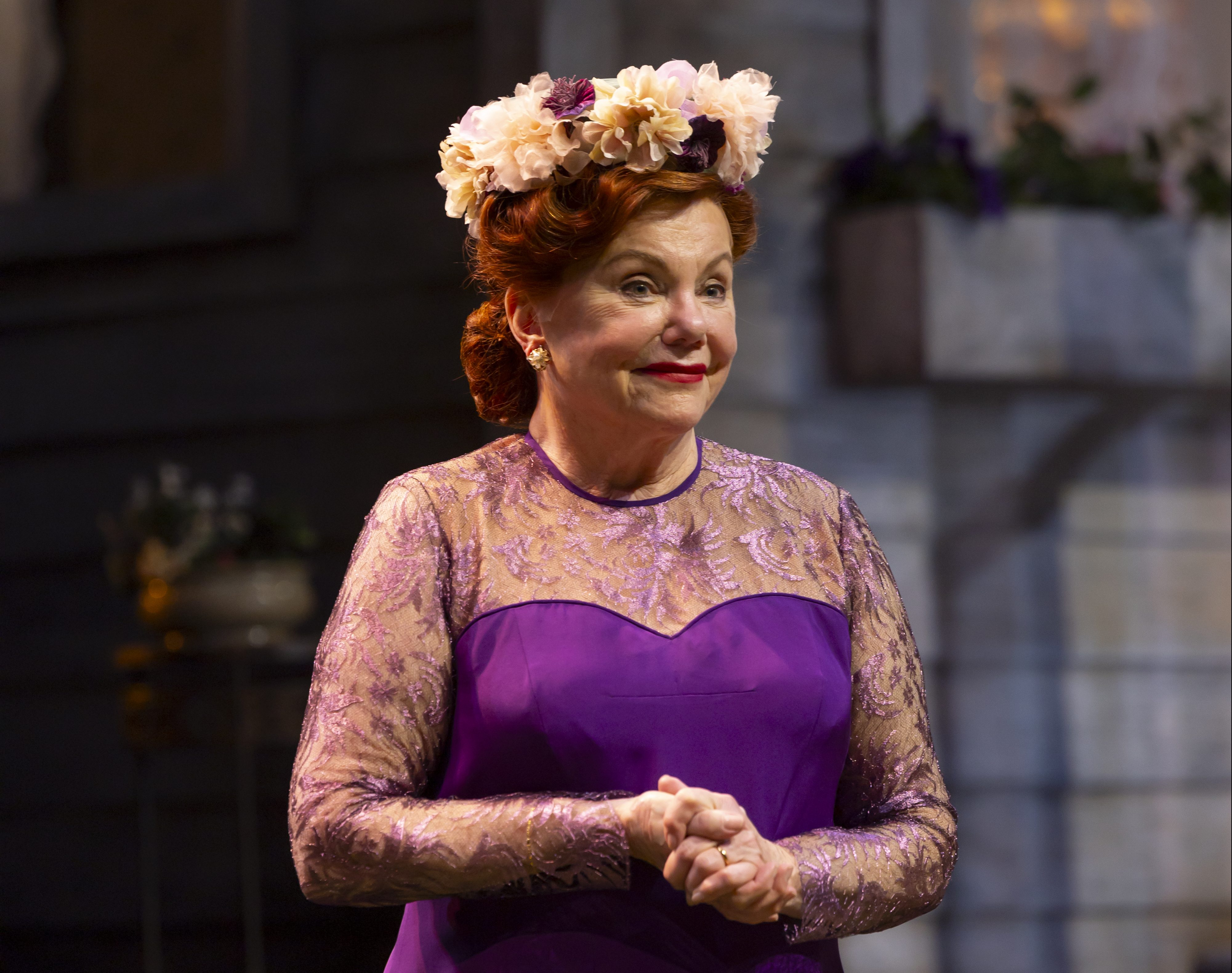


Cymbeline

in Cymbeline
(Photo: Gerry Goodstein)
Bartlett Sher, who distinguished himself directing Theatre for a New Audience’s first-rate
production of Waste two years ago, has done it again with great brio. He combines logic and invention so skillfully in his new production of William Shakespeare’s Cymbeline that he’s even figured out a way to make the play’s tricky exposition crystal clear. This is not an easy thing to do, considering that the piece–written late in the legendary dramatist’s career–involves a willful king, his good-hearted daughter and her equally good-hearted but gullible husband, the king’s conniving replacement Queen and her loutish off-spring, the king’s two long-lost sons, and various other schemers who want most particularly to see that the young secretly-marrieds are thwarted at every turn.
The ease with which Sher sets the story in motion is only the first of the many delightful tricks he pulls out of his hat before he reaches the Bard’s conciliatory finish and the
sentence “Pardon’s the word to all” is wholehertedly spoken. It takes a while to get there, though; at one point, the plot has the princess waking up beside a headless corpse she takes to be that of her missing husband. Despite this grisly turn of events, Shakespeare intends Cymbeline to be something of a merry journey, and Sher understands that. Along the way to the kind of happy ending common to the earlier comedies, Sher does things like sending a handful of players out to unfurl flowered umbrellas so that the Queen can stroll in her garden. He also has a long yellow plastic shower-curtain pulled diagonally across Christopher Akerlind’s predominantly red and black set to represent a location shift to Italy.
Moreover, the endlessly imaginative Sher has his players wear a mix-and-no-match wardrobe of period, contemporary, and cowhand clothes (Elizabeth Caitlin Ward’s
costumes are stunning when they need to be and funny when that’s what’s called for). Sher has the cast swing into a guitar-based hootenanny as they sing Shakespeare’s bucolic lyrics to country tunes (the lilting music is by composer-sound designer Peter John Still). He has one of his villains romp around the stage inside a bellicose horse made of papier mache. He has warriors battle with long and short, robin’s-egg-blue poles, and he also has one of the cowboys tame his foe with a whip. On-stage drums and clappers accompany the action at unexpected intervals.
Sher does all this–and much more–because he perceives the venerable playwright’s intentions. (This hasn’t always been true over the centuries; Samuel Johnson, for example, described the play’s plot as “unresisting imbecility.”) Sher twigs to Shakespeare’s use of situations he had dramatized before but here presents in the manner of an older, wiser, more forgiving artist. As in, say, King Lear, the Stratford strategist trots out a short-sighted king and has him underestimate a daughter’s intelligence and devotion. Also as in Lear, he causes a sagacious servant to flee the court and take other exiles under his wing. This time, however, the king is Cymbeline; the daughter, who has married Posthumus rather than the favored Cloten, is Imogen; the servant is Belarius, who is bringing up the King’s sons Guiderius and Arviragus in a rugged remove as Polydore and Cadwal. Rather than being figures in a gathering tragedy, the discombobulated characters are pawns on a game-board where the reachable goals are redemption and renewal.
For those who don’t know the story and would like to, here goes: Swearing fidelity to Imogen, Posthumus gets out of town when he realizes how angry the British monarch
Cymbeline is that his self-possessed daughter has spurned stepson Cloten. In Rome, Posthumus bets that the trouble-making Iachimo can’t seduce the unwavering Imogen. When Imogen rejects Iachimo, he steals a bracelet anyway, convincing Posthumus that his Imogen did waver. In response, Posthumus writes Imogen a dismissive note. Advised by her loyal servant Pisanio, the rattled Imogen dons men’s clothes and, as Fidele, ventures into the countryside, where she is befriended by Belarius and her unwitting brothers. Cloten rides after her, disguised in some of Posthumus’s togs, and is beheaded by the hot-headed Guiderius/Polydore. After the Romans, who’ve been threatening Cymbeline all the while, come to do battle with the Brits, all but the now-dead Queen end up back in the court for explanations and a restorative love fest.

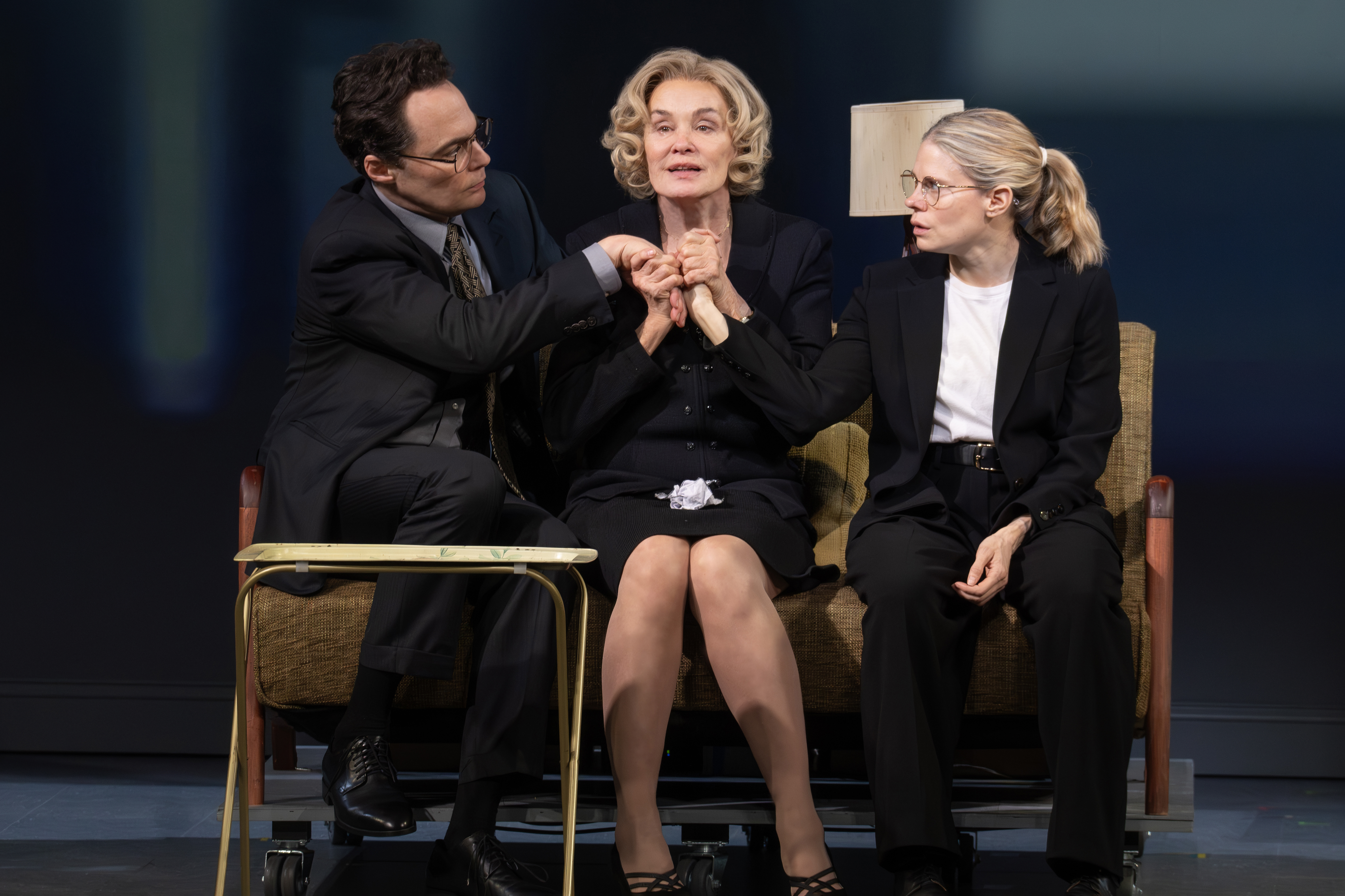
and Roderick Hill (right) in Cymbeline
(Photo: Manual Harlan)
It turns out that, for all of his amazing insights into human nature at its best and worst, Shakespeare had matured into something of a sentimentalist by the time he quilled this opus and The Winter’s Tale (he died at 52). Who can say why he became such a softie, why he revised his view that there’s no fool like an old fool. How did Lear morph into Cymbeline? Was Shakespeare just giving in to the acceptance of people’s foibles as happens in middle age? Had syphilis, which some historians have claimed he suffered from, gone to his head? Had he experienced fallings-out and rapprochements with his own daughters, Susanna and Judith, and his son, Hamnet? Whatever psychological changes the author had undergone, the old man characters in both Cymbeline and The Winter’s Tale live to be reunited with their vagabond daughters, and it’s a gay time when they do. And, in Cymbeline, not one but two sons come out of the woodwork–er, woods–to be embraced by dear old dad.
Much of the jubilation in Sher’s mounting can be chalked up to the cast, which is likeable through and through; well, maybe not in the first of the two acts, in which there is a
squidge too much declaiming. Andrew Weems as the cretin Cloten is the guiltiest perpetrator, mistaking loud for funny at first, but he soon improves and begins to hold the audience in the palm of his vengeful hands. Erica N. Tazel doesn’t have all the music in her voice that Imogen needs but she’s demure, determined, and/or boyish at appropriate moments.
Michael Stuhlbarg definitely has the music needed to play the ardent and temporarily foolish Posthumus. Earl Hindman, gruff and bow-legged as he strides around in his chaps, is a properly stentorian Belarius; and Peter Starrett and
Roderick Hill are rough-hewn yet kid-gloved as his impromptu wards. Playing the hoodwinked king and scheming queen, Robert Stattel and Randy Danson are examples
of flawed regality, and Boris McGiver as Iachimo performs knave-turned-penitent duties with aplomb. A couple of complimentary words should also be said for Philip Goodwin and Thomas M. Hammond in their multiple assignments.
Cymbeline is a play that doesn’t often see the light of illuminating day; Bartlett Sher has given audiences a cogent reason to wonder why.
Featured In This Story