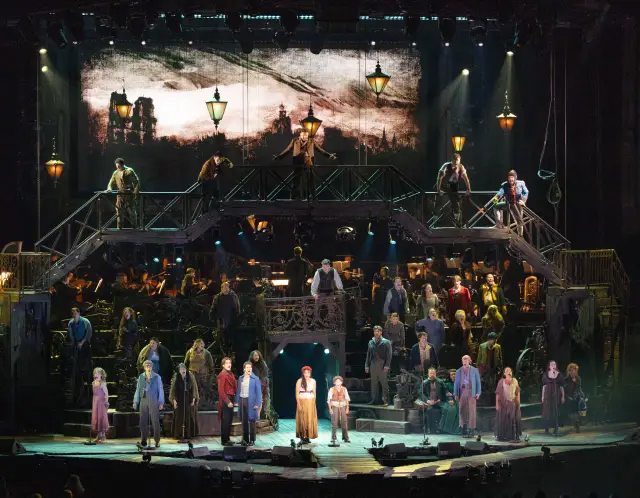
(Photo: Michal Daniel)
Liev Schreiber may not be a household name, but Schreiber’s face is familiar in a great many households. The constantly working, 34-year-old actor, whose latest role is Iago in the Public Theater’s production of Othello, has been seen by the majority of American teens in one of the three Scream movies as the oddly named Cotton Weary. If you don’t have a teen at home, you may have seen him in such indies as Big Night, The Daytrippers, and this year’s critically acclaimed two-hander Spring Forward; on cable in HBO’s RKO 281 as Orson Welles; or in such big-screen, big-budget vehicles as Twilight (with Paul Newman and Susan Sarandon), Ransom (with Mel Gibson), and Sphere (with Dustin Hoffman and Sharon Stone). Later this month, he’ll turn up as the present-day inventor who inadvertently makes a love match between 21st-century gal Meg Ryan and 19th-century aristocrat Hugh Jackman in Kate and Leopold, directed by his close friend James Mangold.
But the place where Schreiber has truly made his mark is the theater, a none-too-surprising choice for someone who studied at both the Yale School of Drama and the Royal Academy of Dramatic Art in London. While others of his generation have gravitated to Richard Foreman or Richard Greenberg, Schreiber has been the Bard’s best boy, having trod the boards of the Public Theater/New York Shakespeare Festival as Sebastian in The Tempest, Banquo in Macbeth, Iachimo in Cymbeline (for which he won the Obie Award), and the Holy Grail of acting: the title role in Hamlet. (He also played Laertes opposite Ethan Hawke in last year’s modern-dress film version of the play).
Now, he has taken on the evilest of the Bard’s villains opposite Keith David as the Moor, Kate Forbes as Desdemona, and Becky Ann Baker as Emilia. Giving Schreiber the rave of a lifetime in The New York Times, Ben Brantley wrote: “Anyone doubting that Mr. Schreiber has advanced to the top rungs of American stage actors need only check out his smart, flashy, and extremely entertaining portrait of Shakespeare’s most subtle destroyer of men.” Yet the actor initially had very mixed feelings about taking on this challenging role.
“George C. Wolfe [the Public’s artistic director] and I are friends,” Schreiber tells me. “We talk all the time, and I told him I wanted to see Keith do Othello. Then he asked me to do Iago. My first thought was that Iago was just another bad guy–this two-dimensional, Machiavellian character–and it’s such hard work to do this kind of play, so why not just save myself the tsuris? But then you get inside the play, you realize just how remarkable the characters are, and all bets are off.”

Having accepted the part, Schreiber was pleased to find that director Doug Hughes had settled on a more-or-less traditional production. (Shockingly for Public Theater devotees, the only person of color on stage is Keith David.) “So many people try to put their own ‘interpretation’ on Shakespeare, and what happens is that you get the characters and the language but you lose the narrative,” Schreiber says. “Doug let the play itself determine the structure. Shakespeare is really the master of structure and form; so, when you let the narrative lead, amazing thing happens.”
As for his own vision of Iago, Schreiber has also eschewed too much embellishment. “People are always looking for big thematic innovations in playing Iago, but I think it’s just that Shakespeare has written a portrait of a classic sociopath 300 years before Freud coined the term,” he says. “Iago’s behavior shows the lack of compassion of a sociopathic personality and, as a result, he lacks the ability to create relationships. So he has this lonely and terrifying existence. We can be compassionate or shut ourselves down. It’s not about being born evil.”
That said, Schreiber adds that there are specific triggers that cause the character to do what he does: “Yes, he may be jealous of Cassio being promoted over him. He may fear that Othello slept with his wife or worry that Desdemona doesn’t care about him. In that, we can see Iago in ourselves. We all have envy, lust and greed–and God bless us for having them! We all feel like we’re the smartest person in the room sometimes, and we all feel very isolated and struggle not to be. I think Iago decides first to try not to be isolated and then, when he feels shut out, he decides to destroy it all.”
Schreiber has had a true affinity for Shakespeare since his first encounter with the Bard’s work, when he played Bottom in a school production of A Midsummer Night’s Dream. “I took to it immediately, this language that was evocative of something bigger in life,” he recalls. “I always felt a great discrepancy between my articulateness as a ‘normal’ person and as an actor. I think that Shakespeare allows me the maximum form of expression. Something about the rhythm of his language keeps your brain from getting in the way and lets your emotions flow uncensored from the physical body.”

with Becky Ann Baker in Othello
(Photo: Michal Daniel)
This concept of rhythm in language is the reason that Schreiber feels equally comfortable performing the work of Harold Pinter. Though the actor made his Broadway debut in 1993, in JoAnne Akalaitis’ production of In the Summer House at Lincoln Center, he first came to many theatergoers’ attention two years later in the Roundabout’s production of Pinter’s Moonlight, starring Jason Robards and Blythe Danner and directed by Karel Reisz. “It was a very odd piece,” he says. “You simply had to let go of any idea of narrative and just go with language. But I found that I liked that freedom. I knew about things like Mabou Mines but I never felt I could get into that kind of company, so Pinter was my introduction to that sort of theater. Karel said to try to follow the play like it was sheet music.
“Working with Karel, Jason, and Blythe was also remarkable in that, as a young actor, I got to see their level of commitment to doing plays and not making any money,” Schreiber adds. Last season, he returned to Pinter and the Roundabout as the man who cuckolds his best friend in Betrayal, earning himself a Drama Desk nomination for Best Actor. “Somewhere in the structure of Pinter’s language is the emotion,” he says. “So, if you play the language, you get the emotion. It was fun.”
Not to mention short: Betrayal is literally only half as long as Othello. “It was great to do a play where you’re out in time for dinner,” Schreiber observes with a laugh.