
Wink-Wink, Nudge-Nudge

(Photo: Joan Marcus)
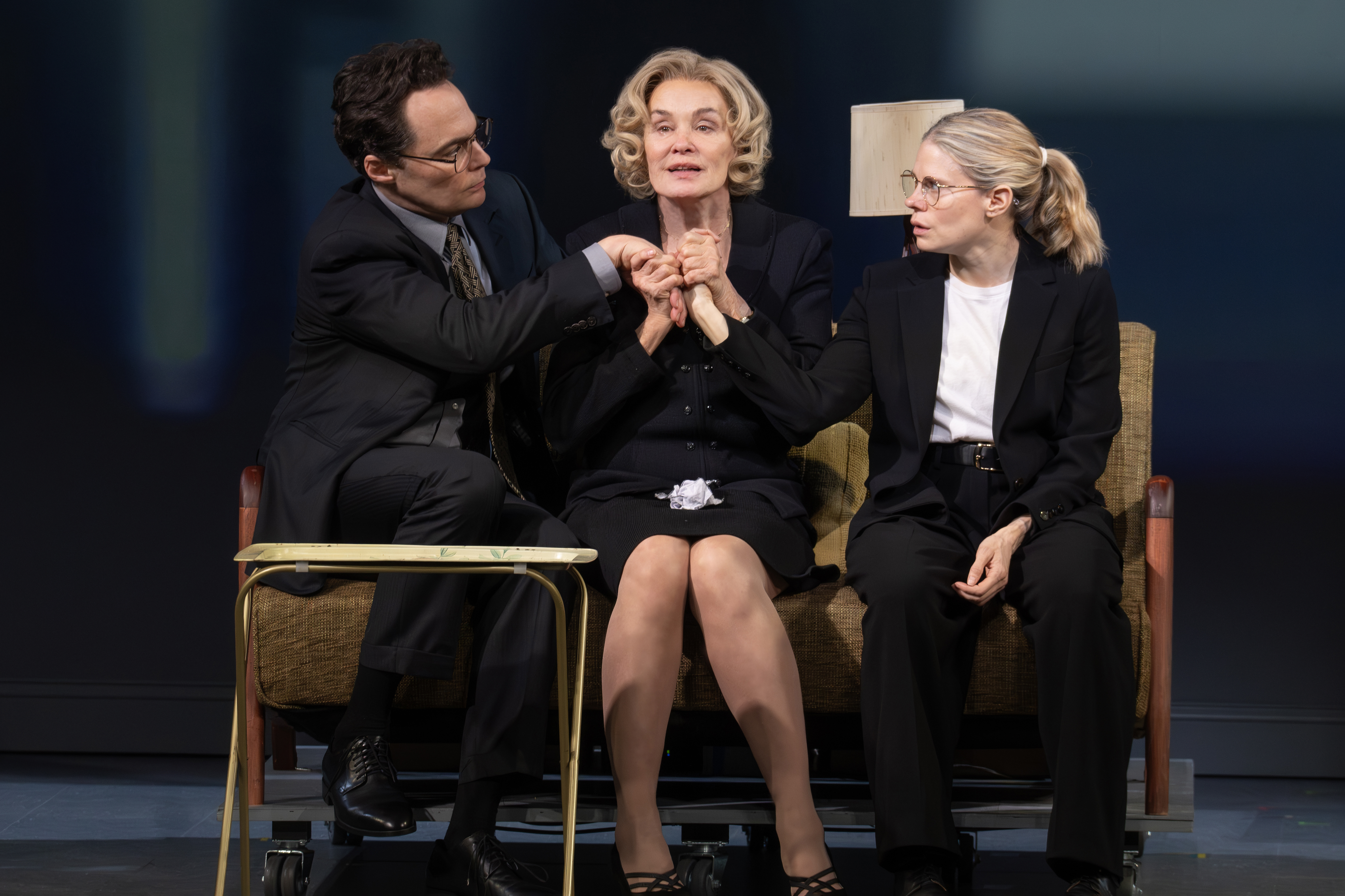
Seventeen. That’s the number of times I counted Urinetown, the musical, referring to itself as a musical. Every time it happened, the audience laughed — especially when Officer Lockstock (Jeff McCarthy) was teaching Musical Comedy 101 to the post-modern Dickensian waif Little Sally (Spencer Kayden): “You’re too young to understand this, Little Sally, but nothing can kill a musical like too much exposition.” The same audience guffawed at the mock hommages to Les Miz in Act I and West Side Story in Act II, congratulating itself on recognizing the staging references. And it giggled every time McCarthy wiggled his eyebrows, made a slashing motion with his hands, and ominously intoned, “Urinetown…the musical!” — though it looks to me like his broad satirical playing, funny the first time around, is coarsening into shtick a year into the Broadway run.
On second viewing, Urinetown remains a clever, lively send-up of musical theater conventions. And there were many moments, especially in its wordy second act, when I wanted to kick its clever, lively teeth in. You’d think from its ecstatic press that this mock-Brechtian fantasy about capitalism in a pee-unfriendly society was not only amusing but also somehow relevant, and a watershed (pun intended) for musicals to come. If so, we’re in trouble, for the only really new thing about this show — and a number of other recent big titles — is its stubborn refusal to care.
Urinetown isn’t the worst of the new breed of post-modern, ironic, self-referential, deconstructionist musicals; it’s just the most conspicuous, and the loudest and proudest in announcing its insincerity. It’s the antithesis of the classic romantic shows, ranging roughly from Oklahoma! to Ragtime, wherein music elevates emotion, defines character, and creates a world where song or dance is the natural, logical consequence of heightened feeling. Jud Fry seethes with self-loathing, Eliza Doolittle gets “the rain in Spain” right, Fredrik Egerman abandons Desirée Armfeldt — what is there to do but sing? The audience doesn’t question the convention or protest that people don’t burst into song in real life, because (a) the ramp-up to the musical moment has been so skillfully constructed; (b) the moment takes us to a realm that mere dialogue can’t; and (c) the music and lyrics are so good.
The music and lyrics of Urinetown are good, too — but they’re all in quotation marks, ironically detached from both reality and real feeling, as if the show were slightly embarrassed to be a musical. We’re just kidding, they tell the audience; we don’t expect you to believe in us any more than we do. Great show music engages the heart as well as the mind but, in this very cynical New Millennium, it’s safer to lampoon deep emotions than to try to tap them. Have you noticed how, in interview after interview, Urinetown‘s authors have proudly stated that they deliberately set out to find “the worst possible idea for a musical?” That kind of flippancy turns the show into something hip, a joke the audience can feel it’s in on. It’s fun, but it’s also as cold and smirky as a Letterman routine.
Compare Urinetown‘s wink-wink, nudge-nudge attitude with the show’s most obvious antecedents, Marc Blitzstein’s The Cradle Will Rock and Brecht and Weill’s The Threepenny Opera and The Rise and Fall of the City of Mahagonny. These works — all pre-Oklahoma! — are not “integrated” in the classic-musical sense; they use song more as commentary than as a natural extension of plot and character. But they are really about something. Cradle, in particular, is about a lot: the ruthlessness of capitalists, the need for unions, the plight of the underclass, the unholy alliance between art and commerce, the dangers of an irresponsible press, the evils of xenophobia. Cartoonish it may be in presentation (I mean, the villainous plutocrat is named Mister Mister), but the show’s passions are genuine and deep, and its stirring finale offers hope for a fairer America. Urinetown, in contrast, is about…peeing. It assumes a populist, anti-big-business stance — but that’s a posture, not an ideology. Its authors have created a musical about nothing, in the way that Seinfeld was a sitcom about nothing, and they’re similarly eager to pat themselves on the back for it.

(Photo: Paul Kolnik)
One might argue that Urinetown is a special case. What about old-fashioned musical comedy’s triumphant return to Broadway via The Producers and Thoroughly Modern Millie? (I haven’t yet seen Hairspray, so I must reserve judgment on it.) Yes, but self-reference and irony permeate these shows, too. As for warmth or conviction, forget it. We don’t ask musical comedy, as distinct from musical drama, to touch deep feelings in us; it’s the genre’s prerogative to stay bright, light, and cheerful (though, when musical comedy does go melancholy, wonderfully soul-stirring things can happen, like “My Time of Day” in Guys and Dolls or the anguished reprise of “So In Love” in Kiss Me, Kate.) What we do ask is that, on some level, musical comedy should believe in itself. And, apparently, that’s a lot to ask in 2002.
Mel Brooks has stated that The Producers is really a platonic love story: Soulless crook and gutless nebbish learn to care for each other, and become better human beings for it. He even has written an 11 o’clock number to that effect, where Max and Leo admit that life was meaningless “Till Him.” All well and good, but Brooks hedges his bets when in comes a choir of little-old-lady investors to intone “aah, aah, aah.” Thus the audience is
reassured that “It’s all a joke! You needn’t expend any real emotion here. You good people are all much too worldly to fall under the spell of sincere storytelling.” Having executed his “gotcha,” Mel keeps yanking our chains: “Leo!” exclaims Max. “I never realized…you’re a good singer!”
Are your sides black and blue from being elbow-poked yet? Brooks and co-librettist Thomas Meehan have been doing it all evening, from the mock-“Old Man River” lament at the beginning of “I Want to Be a Producer” (“Oh, I debits all de mornin’ and I credits all de eb’nin’…”) to Ulla’s coy query, “Why does Bloom move downstage right?” Translation, again: You’re watching a show that knows it’s a show. Nothing is at stake here. Heck, even Aida has more conviction than that!
Musical comedy has indulged in this sort of playful self-kidding for decades (Of Thee I Sing, 1931: “The committee shall now tell why she was chosen…with music!”), but it’s never been so pervasive, so taken for granted. Take this year’s Best-quote-unquote-Musical, Thoroughly Middling Muddle — I mean, Thoroughly Modern Millie. The adaptors of the messy 1967 movie have wisely PC’d up the text, removed some of the vulgar excesses of the original, and reconceived the heroine. Millie Dillmount is a cousin to Lorelei Lee, a gold-digging gal with a calculating heart. This being a musical comedy, she trades it all for romance (and ends up with money anyway), but Millie doesn’t believe in Millie. Her revelation occurs in a curiously hard-edged 11 o’clock song that sounds like the opposite of what it is saying. “Gimme, gimme / That thing called love,” belts Sutton Foster, but she sounds like a pushy shopper at Zabar’s deli counter.
TMM trots out the old money-can’t-buy-happiness morality and happy ending of classic musical comedy, but it believes in itself about as much as Urinetown does. Consider the show’s second couple, Dorothy Brown (Angela Christian) and Trevor Graydon (Marc Kudisch). When they fall in love — at first sight, naturally — they do so in ultra-campy fashion to the operetta strains of “Ah, Sweet Mystery of Life!” and “I’m Falling In Love With Someone.” Now, you win first prize if you can explain what two songs from Naughty Marietta (1910) are doing in a “new” score, much less one that exults, “this is 1922.” While you’re at it, I’d love to know what “My Eyes are Fully Open” (1887), “My Mammy” (1921), or “The Nutcracker Suite” (1892) have to do with Millie and her pals.

in Thoroughly Modern Millie
(Photo: Joan Marcus)
Maybe one reason these musicals seem to back away from real emotion at crucial moments is that the bolder shows of recent seasons — those whose creators still believe in the form’s legitimate storytelling powers — all lost money. Parade, Ragtime, A Class Act, Jane Eyre, and even something as misshapen as Thou Shalt Not sought to stir in their audiences something beyond a push-button response to some wisecracking allusion to some pop-culture relic. And they paid for it. Ragtime, especially, asked a lot of its viewers. They had to follow multiple storylines; examine the American dream, its failure, and how it might be resurrected; listen closely for leitmotifs and reworkings of the musical themes; and accept abrupt
transitions from drama to comedy to tragedy and back again. Most of all, Ragtime demanded (a little stridently, to some tastes) that people — here’s that
word again — care. Oh, but that might mean shedding a tear and being perceived as uncool! Honey, let’s see Urinetown instead.
Parade, too, went against the grain in going for real emotions and a real message. The show’s score and storytelling techniques, at least to this observer, were too insistent, too finger-wagging; but at least it wasn’t all a huge, smirking joke. And that’s what the musical, in this thoroughly modern millennium, is in danger of becoming. When the public decides that it’s too grown-up to accept the bursting-into-song approach on anything but ironic terms, too hip and self-aware to succumb to honest sentiment, it’s cheating itself out of
musical theater’s greatest gift: the power to move. And when musicals cater to this bland hipness with so much self-reference and prepackaged allusion that they’re no longer grounded in any kind of emotional reality, they’re cannibalizing themselves out of a meaningful existence.
Oh, sure, the musical will be around for a while. Hairspray‘s a smash;
a few writers (Ahrens and Flaherty, Maltby and Shire, Jason Robert Brown) still believe in the form in its non-ironic state; and there are always revivals. But the rise of the coldly cynical, proudly insincere, pop-culture-reference-filled, doesn’t-give-a-crap-about-anything type of show can’t be a healthy trend. How long can any organism survive once its heart has stopped beating?