
Princess Turandot

with Crispin Freeman in Princess Turandot
(Photo: Carol Rosegg)
Opera buffs will certainly want to check out the Blue Light Theater Company’s production of Princess Turandot, Darko Tresnjak’s new play inspired by the 1762 Carlo Gozzi fable that also served as the inspiration for the glorious Puccini opera Turandot. But the appeal of this colorful, fanciful, highly theatrical production should extend far beyond that subset of the general population.
The plot of Tresnjak’s Turandot is much the same as the story of the opera: The title character, a surpassingly beautiful but cruel princess of ancient China, has declared that she will be the bride of any prince who can answer the three riddles she will propose–but he who fails the trial shall have his head cut off. (“Sparks fly when a captivating prince meets a decapitating princes,” a witty line in the press release for Princess Turandot reads by way of synopsis.) Calaf, a prince in exile from a foreign land, accepts the challenge–and, much to everyone’s surprise, he manages to come up with the correct responses to Turandot’s enigmas. When the princess still balks at marrying him, he offers a compromise: If Turandot can discover his name and origin (unknown to almost everyone in Peking) before dawn, he will not only relinquish his claim to marry her but will agree to be executed. The denouement of the tale, in which the psychologically damaged princess learns to let love into her heart, is no less satisfying for being rather predictable.
Tresnjak writes in a program note that he initially based his Turandot fantasia on the Gozzi tragicomedy, citing two stories from the Tales of the Arabian Nights (likely inspirations for Gozzi) as additional sources, along with the operas by Puccini and Ferrucio Busoni. (He further notes that, in all, there are at least nine operas based on this story!) So it’s not surprising that the text of Princess Turandot is, in some respects, noticeably different from the Giuseppe Adami/Renato Simoni libretto set by Puccini. Most importantly, Tresnjak has provided no character equivalent to Liu, the loving, steadfast slave girl who serves as a foil to the icy princess in the opera. Also, play and opera offer different justifications for Turandot’s hysterical hatred of men. In her big aria in the Puccini work, “In questa reggia,” the princess tells the assembled court that she is avenging the rape and murder of her ancestress; in the Tresnjak version, she says that her bloodlust is a response to the abandonment of her mother by her father when the former proved unable to provide the latter with a male heir. (Shades of Henry VIII!)

and Josh Radnor in Princess Turandot
(Photo: Carol Rosegg)
Princess Turandot is a piquant hybrid of literary and theatrical styles, just as the Gozzi original apparently was. For example, though the action of the play is ostensibly set in China, the commedia del’arte elements of the Gozzi version are fully recreated; witness the presence of comic characters named “Pantalone,” “Brighella,” and “Truffaldino,” in contrast to the Puccini opera’s “Ping,” “Pang,” and “Pong.” The production is nothing if not eclectic, with Tresnjak (who also directed) throwing such disparate elements as classic vaudeville shtick and blatantly post-modern references into the mix. Sharp-eared audience members will also catch some opera-related, inside jokes here. For example, Tresnjak has named two of the play’s servants “Nessun” and “Dorma”–though, whenever these characters are summoned, it is always in reverse order of the title of the Turandot opera’s famous tenor aria: i.e., “Dorma!” “Nessun!” Later, when two female characters temporarily assume the guise of nuns, we learn in passing that the holy sisters’ names are “Questa” and “Reggia.” (This kind of thing may strike you as either clever or insipid; at any rate, the puns are all but thrown away, rather than dwelt on.)
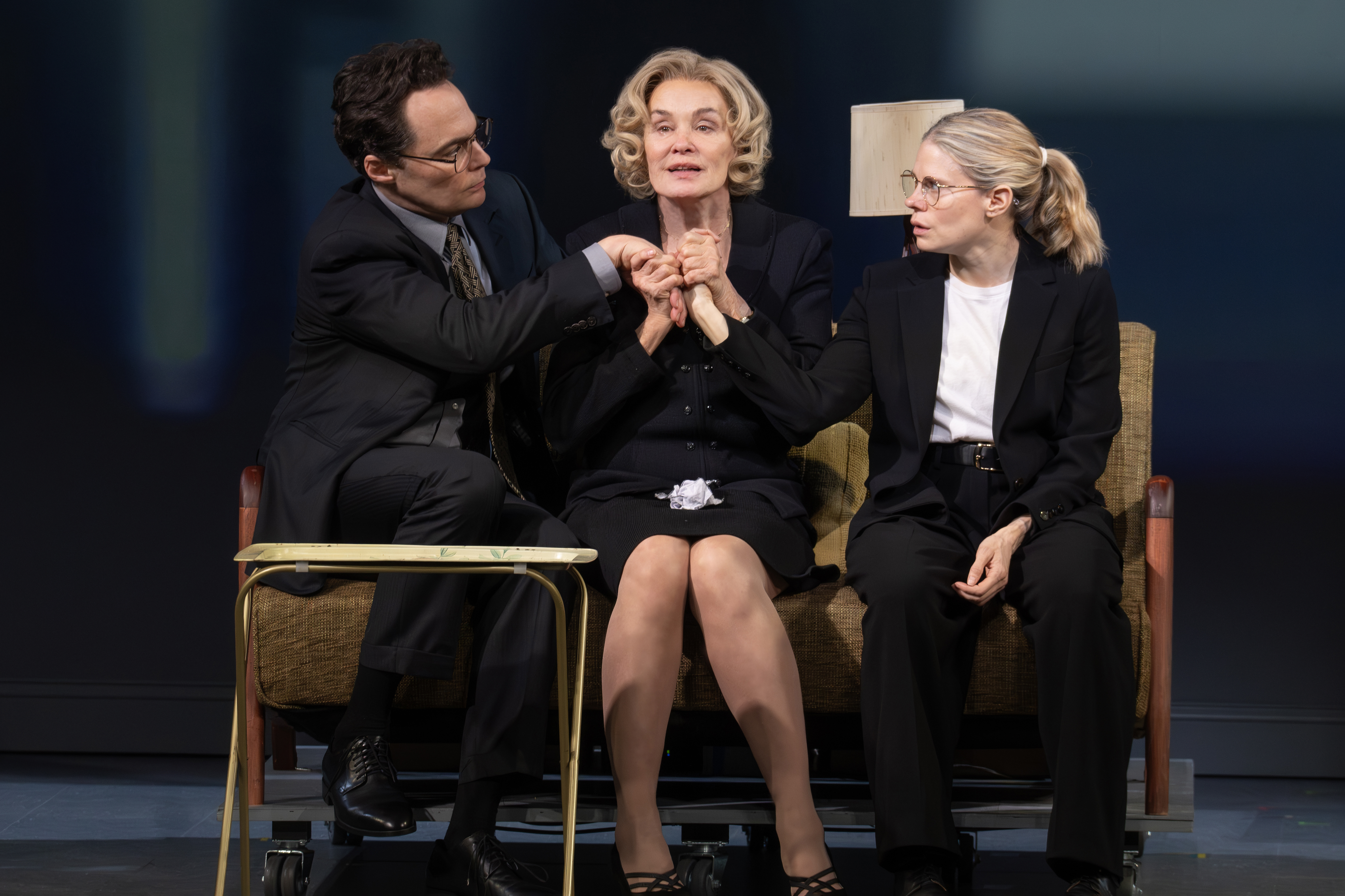
On stage at the McGinn/Cazale Theatre, Princess Turandot looks gorgeous, thanks to the bright, vivid, saturated hues of David P. Gordon’s sets, Linda Cho’s costumes, and Christopher J. Landy’s lighting. (No pastels here!) Also visually pleasing is the casting of the title role–a situation rarely encountered in the opera house, as the vocal heft required to sing Puccini’s Turandot almost always goes hand in hand with a hefty body. (This probably wasn’t, but might as well have been, the opera which inspired the phrase, “It ain’t over till the fat lady sings.”) Tresnjak’s leading lady, Roxanna Hope, is so comely that no one in the audience winces when Turandot is described as “the most beautiful woman in the world.” Hope takes great risks in her performance (egged on by Tresnjak, no doubt) and emerges victorious: her broad, campy, drag queen-like emoting and posturing in Turandot’s early scenes gives way to a much more subtle, internalized characterization as the Princess’ back story is revealed and our sympathy for the character grows. It’s a controversial choice, but I can’t honestly say that it doesn’t work.
As Calaf, James Stanley is ardent, mellifluous of voice, and regal in bearing. Jeffrey Binder, Josh Radnor, and Andrew Weems make a meal of the scenery as Pantalone, Brighella, and Truffaldino (respectively). Standouts among the remainder of the cast are Crispin Freeman as the Emperor Altoum (Turandot’s father) and Gregor Paslawsky as Calaf’s friend, Barak. Wes Day is vocally and visually striking as The Imperial Judge, and there are some hunky Imperial Guards on hand (in the persons of Leith Burke, Ron Nahass, and Aaron Michael Norris) to further delight the eye.
Featured In This Story