

Belle Epoque

in Belle Epoque
(Photo © Paul Kolnik)
At times sordid, at times sensuous, Belle Epoque is a visual feast. Inspired by the life and work of late 19th-century French painter Henri de Toulouse-Lautrec, this dance theater collaboration between Martha Clarke and Charles L. Mee is a chaotic mix of images. It does not tell a linear narrative, instead favoring an impressionistic approach that often has a hallucinogenic quality. But the performance as a whole is only partially successful; while it contains moments of stunning theatricality, there are also several passages that seem tedious.
As Henri de Toulouse-Lautrec, Mark Povinelli is excellent. He’s imperious and commanding at one moment, extremely vulnerable the next; Henri is very much the at the center of a vibrant world in which he participates, yet he always seems something of an outsider. The historical figure stood at a height of four feet, eleven inches, and Povinelli seems even shorter than that. The size differential between the actor and the rest of the cast seems especially pronounced during the dance segments, when he literally runs after the long limbed figures around him.
Vivienne Benesch, as his love interest Suzanne, is a spirited and engaging performer. However, she often telegraphs her motivations in too broad a fashion — which is somewhat understandable, considering that she’s given little text to flesh out her characterization. Joyce Castle is a bit disappointing as Yvette, a chanteuse undoubtedly meant to represent the famous cabaret performer Yvette Guilbert; Castle, whose credits encompass more opera than theater, does not have the kind of commanding stage presence that would make her performance come alive. Too often, she’s upstaged by the dancers around her. Since the songs that Yvette sings — accompanied by a quartet of onstage musicians — are a major component of Belle Epoque, this is a major drawback.
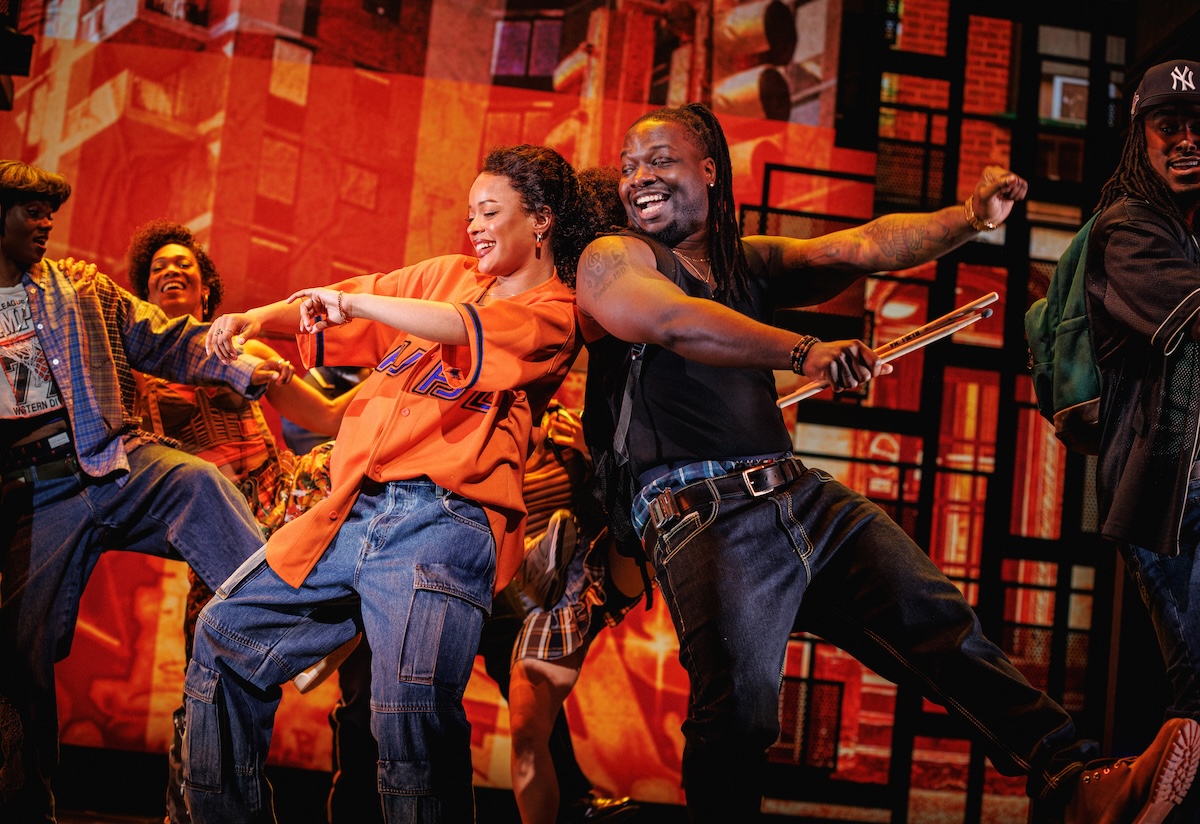
In her choreography, Clarke makes much use of the can-can, with plenty of high kicks as well as sweeping skirts and flashing petticoats. There’s also a bit of belly dancing and a marvelously performed tap duet. Many of the director/choreographer’s stage images seem directly inspired by Toulouse-Lautrec’s paintings, and the show’s visual vocabulary is enriched as a result. The company of actor-dancers is terrific, especially Rob Besserer, whose long legs and quirky way of moving his body seem appropriate for the nickname that his character Valentin is given in the program: “The Boneless.” Also a treat is Tomé Cousin as a Cuban named Chocolat, who was the inspiration for Toulouse-Lautrec’s 1896 painting “Chocolat Dancing.”

(Photo © Paul Kolnik)
Mee’s meandering approach to the text is not as effective here, as in some of his previous works, including his prior collaboration with Clarke, Vienna: Lusthaus (revisited). Several of the characters spout long meditations on the nature of love but there often seems to be a bit of a disconnect between such passages and the narrative that Clarke has created through her staging and choreography. There are moments that work, such as a bizarre juxtaposition between Henri’s lovemaking with Suzanne and a simultaneous dialogue he is having with his mother, Madame Adele (Honora Fergusson). There are also a couple of sections within the piece that directly address the criticisms of Toulose-Lautrec’s art. He is accused of painting his subjects in an unflattering manner, to which Henri responds, “I thought to see them truly, not to look away; to take them as they are is a beautiful thing.”
Robert Israel’s set keeps the main playing area of the Mitzi Newhouse’s thrust stage clear in order to accommodate the dancers. A few café tables and chairs are set off to the side, and large mirrors, frosted over to prevent too much reflection, dominate the back wall. Jane Greenwood’s sumptuous costumes capture the excitement of the era beautifully, while Christopher Akerlind’s lighting is appropriately moody and atmospheric.
The show has a running time of an hour and 15 minutes, yet it feels longer. Clarke is unable to sustain the energy of the piece; several segments are drawn out and uninteresting. For example, an extended sequence in which Moulin Rouge entertainer La Goulue (Ruth Maleczech) delivers a rather crass poem doesn’t work. Neither do several of the conversations between Henri and his friend Francois (Michael Stuhlberg), which seem to drag on infinitely. Still, there’s a squalid beauty to Belle Epoque that’s enchanting even if the piece doesn’t add up to much.
Featured In This Story