
Moving Bodies

Sex and science don’t mix. At least, that’s what young Richard Feynman’s dad keeps telling him. But this is just one of the many theories that the Nobel Prize-winning physicist–who once kept a topless bar from being closed down by claiming that he scribbled equations at one of the back tables–ends up disproving…and just one of the many topics of debate at “Feynman University,” centered around the Rockland County dinner table where the family discusses (with equal zeal) anti-Semitism and two-piece bathing suits, puberty, and the morality of the Manhattan Project.
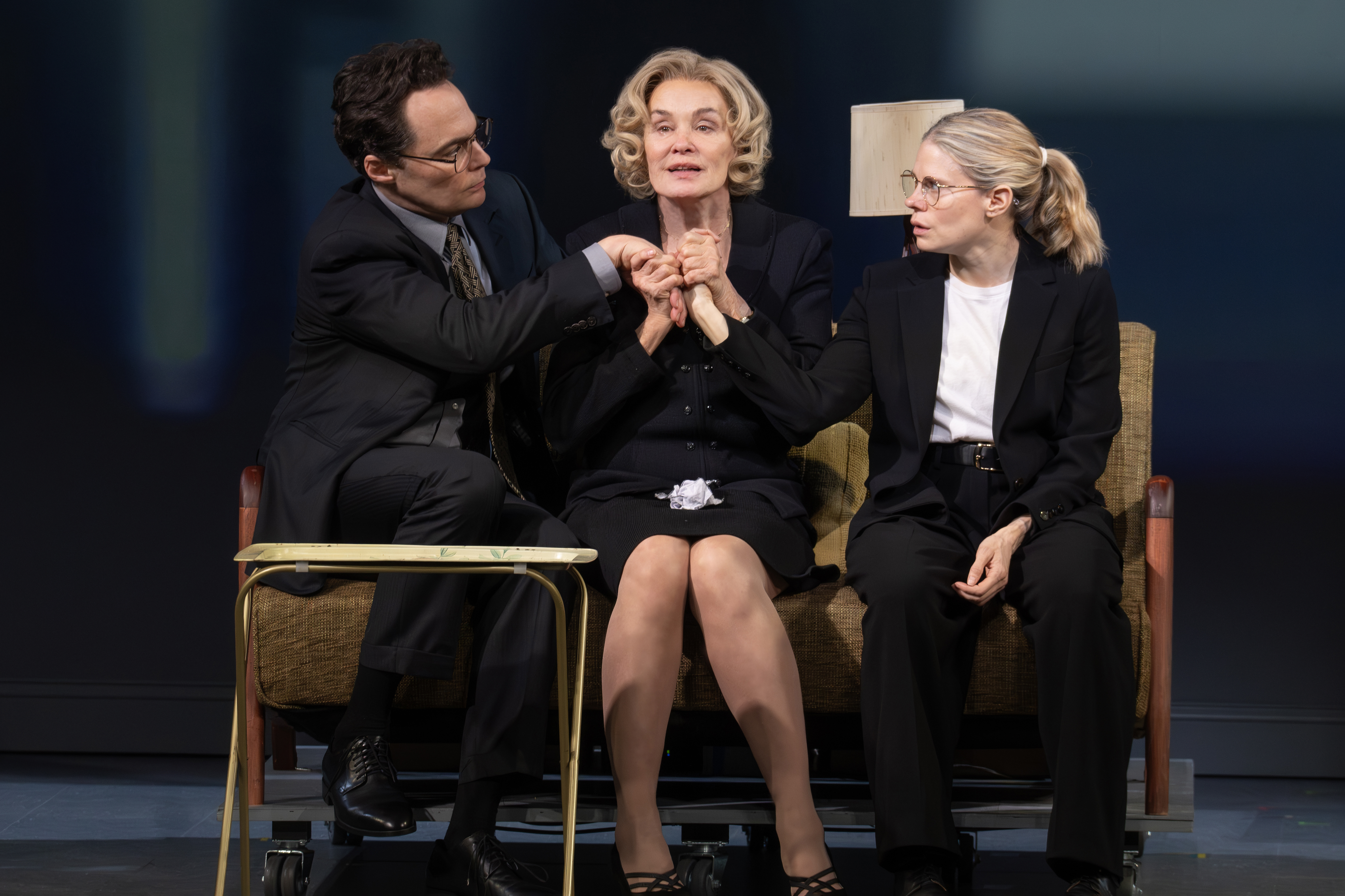
Moving Bodies, a new play by Arthur Giron, dramatizes the biography of Richard Feynman, considered one of the greatest scientific minds (second to Einstein) of the twentieth century. The play is the centerpiece of Ensemble Studio Theatre’s second annual First Light Festival, which presents new works related to scientific and technological issues and characters, and is generously funded by the Alfred P. Sloan Foundation (to the tune of half a million dollars over three years).
One of the first commissions through the Sloan grant, Moving Bodies fulfills the aims of the Festival: Feynman is plenty scientific, and certainly a character. In telling his story, Giron (a founding member of E.S.T.) touches on some of the major scientific moments of the last sixty years, including the building of the atomic bomb and the explosion of the space shuttle Challenger. Giron also initiates, though he does not explore at length, some interesting discussion regarding the mind/body, male/female split which characterized the scientific world of that time.

The play opens with the Feynman family’s trip to the 1933 Chicago Worlds Fair, where Richard and his younger sister, Joan, see a rocket in the Hall of Science and decide that they will go up in it someday. A year later, Feynman is off to M.I.T. Despite his father’s hand-me-down suits and his floozy waitress girlfriend, he manages to attract the attention of Robert Oppenheimer, who earmarks him for graduate study at Princeton (where both Oppenheimer and Einstein are teaching).
While at Princeton, Feynman receives from his sister a photo of her piano teacher, Arline Greenbaum, in a two-piece bathing suit–and he’s soon in love. Despite the fact that Arline knows she is dying (from lymphatic tuberculosis) and has been warned by her doctors against having sexual relations–and against the strong objections of Feynman’s parents and the explicit terms of his Princeton scholarship–Feynman marries Arline. They move to New Mexico, where he works at Los Alamos on the creation of the atomic bomb and she spends the rest of her short life at a sanatorium in the desert.
Boom! The bomb has been invented and dropped, and Feynman’s wife and father have both passed away. After a rather strange, surrealistic scene including Oppenheimer’s appearance as the devil in a gas mask, Feynman finds himself with nothing to do. So he goes to teach at Cornell.
[[pg]]

Clearly, the play covers a lot of ground. Director Chris Smith does a commendable job, aided by designer Kert Lundell, of setting the ever-changing scene. However, some of the transitions are jolting, particularly in the second act. Ultimately, most curious were Giron’s choices about what to dramatize–and what not to dramatize. Feynman is perhaps best known (from the best selling book Surely You’re Joking Mr. Feynman!, among others) as the wacky professor/resident comedian of CalTech’s Physics 10 class. As Joan says to him near the play’s end, “Who would have thought that what you do best is teach?” Well, from Giron’s play no one would have thought that; this whole, 40-year chapter in Feynman’s life is handled by the appearance of a young blonde (one of many roles–including show girl, waitress/girlfriend, Washington intern–played by the lovely Julie Leedes) who whisks him off to receive an award from his former students.
And what about Feynman’s Nobel Prize? We learn about that from a passing mention during a conversation between two NASA bigwigs in the men’s room, just before testimony about the Challenger in a ridiculous government-conspiracy scene. While there is a non-documentary disclaimer in the program, having the chairman of NASA say that Feynman should be killed so that he does not give testimony unfavorable to the space program seems a contestable historical detail.
A large portion of the second act dramatizes Feynman’s testimony on the space shuttle’s explosion, given while he was suffering from stomach cancer–an unfortunate result of his days at Los Alamos. It’s a dramatic, courtroom-type scene in which we hear Feynman’s somewhat cynical observations about the “big business” science has become in America over the past 50 years. Chris Ceraso, who does a commendable job of playing Feynman through his many life changes, is at his strongest as the mature scientist. That scene also stands out because it’s one of the few times when we actually get to see the professor do, and teach, science–with a demo he creates using a glass of ice water and some clamps from the hardware store to prove the potential effect on the Challenger of cold weather at the time of the launch.
But, despite containing a cameo from the adult Joan (a nice change after Amy Love’s lively but previously kid-stuck portrayal), the Challenger scene feels distant from the rest of the play, both thematically and stylistically. So it’s a bit of a relief when Feynman, in the play’s only non-chronological jump, goes back in time to his father’s funeral. There, issues both personal and scientific are put to rest.
In the touching final scene of the play, Feynman addresses his love of women in general (and his deep devotion to his deceased wife in particular) in a letter he composes to Arline two years after her death. Perhaps the brilliant, seemingly contradictory scientist is best revealed by his most confounding, illogical, act: marrying a dying woman. The scenes between Feynman and Arline (played with a welcome lack of sentimentality by Tracy Sallows) are among the play’s most honest and most illuminating about the character of the man Richard Feynman.