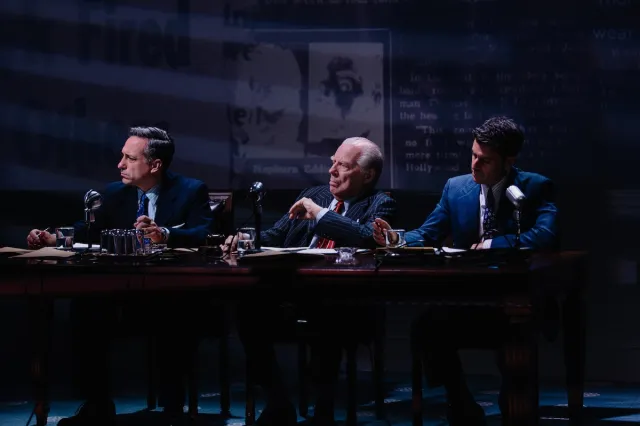
in After a Hundred Years
(© Michal Daniel)
From 1975-1979, Cambodia was ruled by dictator Pol Pot and the Khmer Rouge political party, who were responsible for a horrific genocide that claimed the lives of upwards of two million Cambodians. “There’s a tremendous amount of residue from that era that the country is still dealing with,” says Naomi Iizuka, whose new play at Minneapolis’ Guthrie Theater, After a Hundred Years, involves an American journalist who goes to Cambodia to interview a Khmer Rouge general accused of war crimes.
While the play is informed by numerous interviews that Iizuka conducted with Cambodian citizens, American NGO workers, and journalists, the particulars of the story are the playwright’s own invention. “The general is a composite of figures who actually existed in the high levels of the Khmer Rouge,” she says. “I went back and forth about whether or not to make him an actual historical figure, but that would make the play more of a docudrama and I think it’s important that it stay in the realm of fiction.”
As in her play, 36 Views, this current effort examines a multiplicity of truths. “To some degree, the journey of this play is about trying to hold in your mind contradictory and competing realities,” states Iizuka. The journalist — whose own arrogance and blind spots become apparent as the play goes on — meets a number of characters with different perspectives on Cambodia’s history, and the guilt or complicity that they may have in relation to both past and present crimes. “The play is not simply about encountering another culture,” says Iizuka. “It’s about how that other culture transforms you and makes you look at your own culture and your own past.”