

Antony and Cleopatra

(Photo: Bob Pileggi)
Bombay Dreams won’t be hitting these shores for at least a season or two, but if you’re ravenous for saris and sitars, you’re in luck. The Queen’s Company has docked in the East Village with a bizarre new interpretation of Shakespeare’s Antony and Cleopatra, inspired — if that’s the word — by the conventions of Bollywood and featuring an all-female cast. It dawned on me midway through Act I: “I’m watching a multicultural cast of women, many of them in goatees and mustaches, performing a British play set in Egypt and Rome, informed by the gaudy style of Indian cinema.” God bless America!
Written just after Othello, Antony and Cleopatra busies itself largely with love and its ability to undermine empires. While Marc Antony romps with the Egyptian queen to the neglect of his duties to Rome, the wrath of Octavius Caesar is ignited and civil war erupts. As is often the case with Shakespeare, it takes a while to untangle who is fighting whom over what (Rome is ruled by a triumvirate, threatened by Pompey’s insurgent army, and the military maneuvers are complicated and episodic). Suffice it to say that, after winning some battles but losing more, a disgraced and guilt-wracked Antony engineers his own demise, soon to be joined by his grief-stricken ladylove. Passion and politics intertwine in a downward spiral; think Bill and Monica on the Nile, by way of the Ganges.
Director Rebecca Patterson writes in a program note that “Bollywood showed me how a great love story can be a tragedy, a comedy, and a musical all rolled up into one.” Further, she states in a press clip that “the joyous, shameless, unselfconscious abandon of Bollywood films comes closest to capturing the essence of Cleopatra’s Egypt.” An intriguing concept. Why, then, hasn’t she done more with it? After an early riot of Indian music and color (applause to Aaron Copp for his simple, sun-drenched lighting design), the Bollywood motif is strangely muted. We do get drums and sitars during scene changes and there is a modicum of high-kicking and belly-shaking during Antony’s state-mandated nuptials to Caesar’s sister, Octavia. But, as any devotée of upper-channel cable knows, the essence of Bollywood is excess — crowds, pageantry, long musical numbers, wild romanticism, flagrant mysticism and fantasy. Patterson more or less stops with the silks and saris after the first 10 minutes or so (and the military costumes are entirely random, recalling the war climax of Duck Soup). Once the initial Hindu hoopla is unfurled, what follows is a surprisingly straightforward production of Antony and Cleopatra, even if the title roles are portrayed by two chicks in frequent lip-lock. Allowing for the budgetary constraints of Off-Off-Broadway, couldn’t we have gotten more dancing? More pomp? Something?
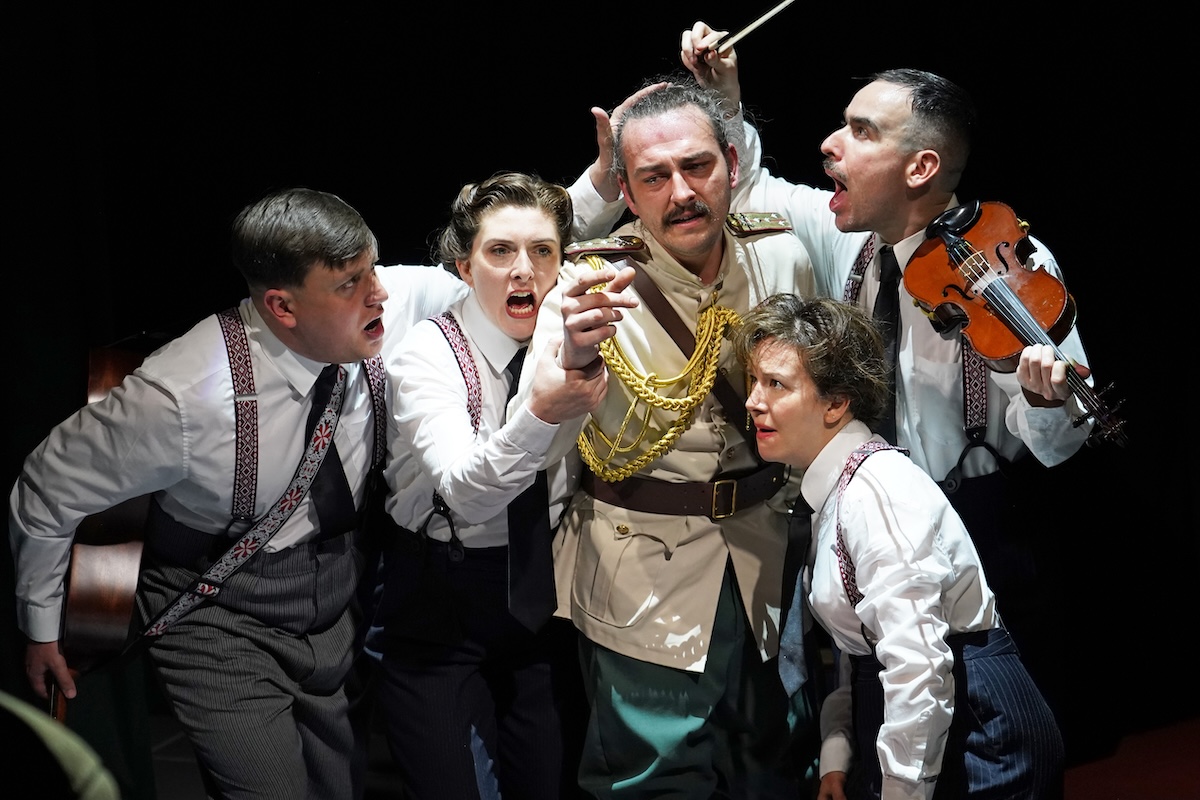
Where Patterson does honor her Bollywood muse is in the production’s unbridled, over-the-top physicality. The handsome little Connelly Theatre is cleverly maximized for playing space: Barefooted players leap alarmingly off the stage apron, sprint to the balcony to deliver war bulletins, and fling themselves to the floorboards in anguish. Especially persuasive and rousing are the battle sequences: With the assistance of actor DeeAnn Weir, who not only makes a dashing Antony but is also an expert fight director, the soldiers cross swords and kick shins like they mean it.

(Photo: Bob Pileggi)
The ruckus is welcome, because this isn’t the sort of production where you’ll hear Shakespeare spoken beautifully — not with a young and, for the most part, classically untrained troupe spitting out the text loud and clear but without much musicality or nuance. (Exception: Aysan Celik’s dignified and well spoken Pompey, sporting a matinee-idol profile to boot.) And, to further batter the Bard, the actors make some curious choices. Maureen Porter’s Cleopatra, with her raven hair and throaty, va-va-voom delivery (and clothed by a costume designer who seems to bear a grudge against her), is more reminiscent of a Syosset matron hosting a barbecue than the Queen of Egypt. Her relentless brassiness and unsubtle vamping hardly make for a traditional temptress of the Nile. (An hommage to Elizabeth Taylor, perhaps?). Still, it’s a bold and different choice — as opposed to most of the supporting cast, some of whom barely form characterizations at all — and Porter does eventually expand her emotive range when she is called upon to grieve. She and Weir’s Antony make a fetching couple and a convincing pair of lovers; indeed, there are whole stretches in the increasingly languid second half where you nearly forget the unisex conceit, what with Weir and the other “men” butching it up so effectively. Their manliness is impressive; their purpose in asserting it isn’t entirely clear.
Which leaves the other gimmick, the Bollywood trappings. It’s unfortunate that, having come up with an undeniably new twist on nontraditional Shakespeare, Patterson & Co. don’t have the budget to match their imagination or the elocution to do the author proud. Still, the sheer weirdness of the evening — bearded ladies, colorful if uncoordinated costumes, a Babel of accents, a lovers-reunited-in-heaven epilogue complete with (fake) rose petals — goes a long way toward building goodwill. This
Antony and Cleopatra is neither first-rank Shakespeare nor the radical reimagining that it purports to be. But, until its wordy second half induces drowsiness (as Jean Kerr once famously remarked, “I don’t want to see the uncut version of anything”), it comes up with enough visual zest and oddball directorial touches to keep you interested. And if the production leaves you with a longing for papadum and vindaloo, East Sixth Street is but a three-minute stroll away.
Featured In This Story