Venus in Fur

in Venus in Fur
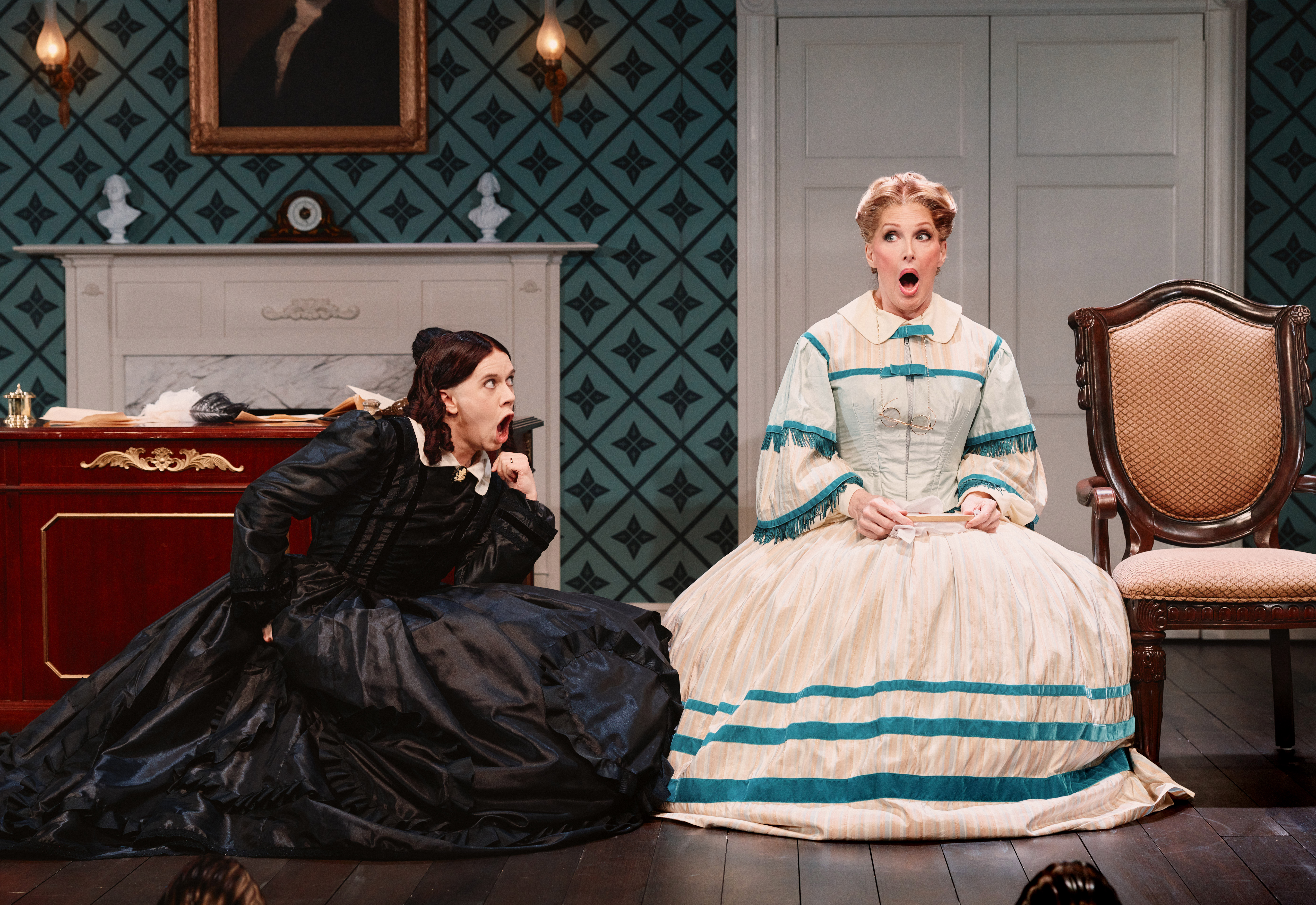
(© Joan Marcus)
Two exceptional performers — Nina Arianda and Hugh Dancy — square off like prize fighters in David Ives’ Venus in Fur, playing at Manhattan Theatre Club’s Samuel J. Friedman Theatre on Broadway. Directed by Walter Bobbie (who reprises his work from the play’s Off-Broadway debut at Classic Stage Company early in 2010), the two-hander once again proves to be a delectable exploration of how the balance of power shifts during a young woman’s audition for a new play that’s based on what some consider to be an erotic classic, Leopold von Sacher-Masoch’s Venus in Furs.
Everything about the vibrant and provocative piece seems to have been enriched by its transfer from the intimate thrust venue downtown to the larger proscenium house uptown. Bobbie has deftly recalibrated his taut direction, and in the new space, he positions the performers in ways that at times illuminate, and, at others, tantalizingly obscure, the gradual and subtle changes in the relationship between actress Vanda (original cast member Arianda), who surprisingly shares the same name as the character for which she is auditioning and director/playwright Thomas (newcomer Dancy).
Similarly, Ives has tweaked the script with care. Most notably he has added levels of humor early on as Thomas bemoans the sorts of young women who have auditioned for the role of the aristocrat who becomes the dominating mistress to a nobleman.
Interestingly the comedy strengthens the character enormously, helping to create a portrait of a seemingly indomitable, demanding man. The changes here, and elsewhere, ultimately serve to make Ives’ exploration of gender roles — and the dominant and submissive relationship between director and performer — more cutting than audiences who saw the play originally may remember.
And then, there are the performances themselves. Arianda’s work, riveting in the play’s first outing, has only deepened. In her initial moments on stage, when Vanda enters, spewing obscenities about the terrible commute she’s had in the rain, Arianda’s gift for physical comedy has a level of specificity that proves hysterical. As the play progresses, her transformation from a vapid and scattered woman of the 21st century into a 19th century woman of incredible grace, noble bearing and cleverness seems eerily natural, and when the script calls for her to shift between the realities of the rehearsal room (designed with an eye for detail by John Lee Beatty) and the play-within-a-play, there is a pinpoint crispness to Arianda’s turn that electrifies.
Dancy, in addition to sharing a remarkable chemistry with Arianda, delivers a keenly felt and sharply observed turn. He captures Thomas’ initial cockiness with aplomb and as the pair read through Thomas’ play he gracefully transforms to the gentleman of the nineteenth century, infusing the character with a regal hauteur that slowly, and fascinatingly, devolves into almost craven neediness. And, in the few moments when Thomas reverts to a position of power, his work scintillates.
Costume designer Anita Yavich not only provides some terrific street clothes for the pair, but also manages to get a few laughs that gamely support the script, and Peter Kaczorowski’s sensitive lighting design handsomely underscores the increasing tension and sensuality of this exceptional work.
Featured In This Story