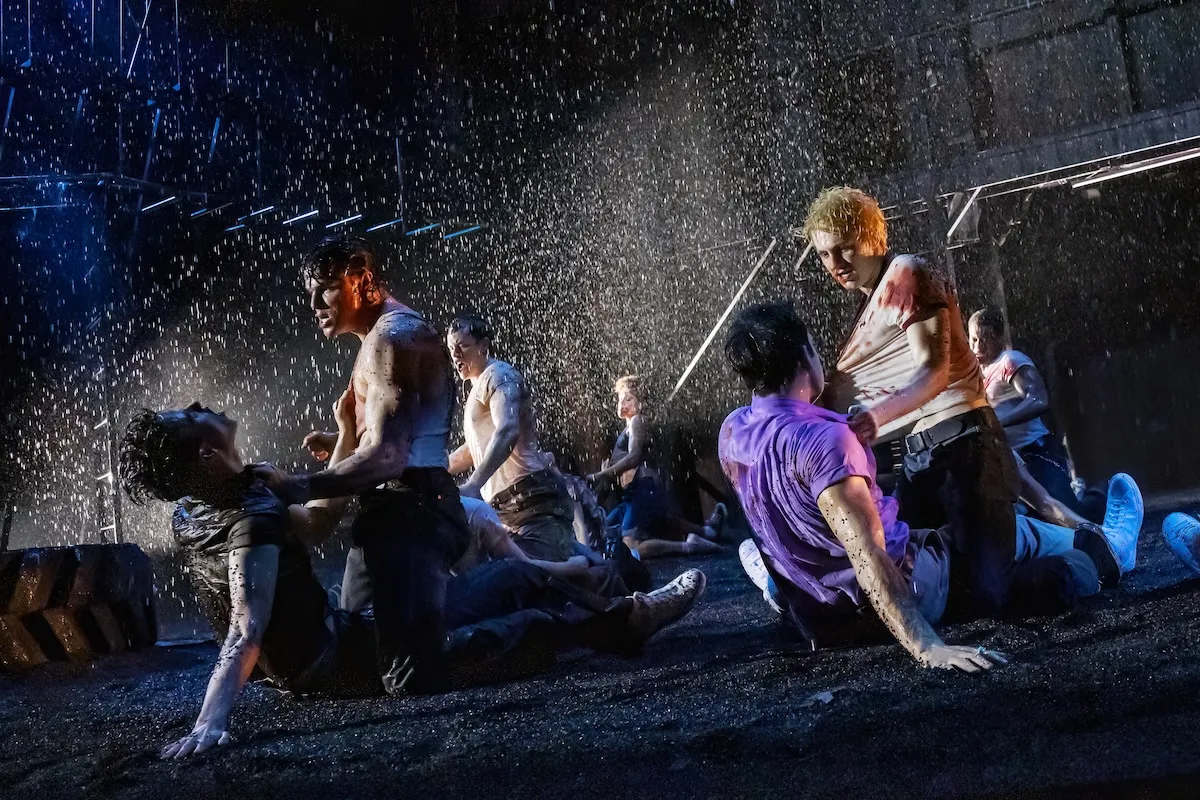

Persephone

(© Laurie Olinder)
Julia Stiles got her start as a child performer in the early 1990s with an edgy off-off-Broadway company named Ridge Theater. Now, Stiles is doing some of her strongest stage work ever in the title role of the troupe’s beautiful, unconventional, yet ultimately listless music-theater piece Persephone, now at the Brooklyn Academy of Music’s Harvey Theater.
The play is, ostensibly, about an 1890s theater troupe trying to present the Greek myth of Persephone using a revolutionary new art form. Not surprisingly, there’s some gorgeous visual imagery from such Ridge Theater regulars as set designer Jim Findlay, film collagist Bill Morrison, and especially projection artist Laurie Olinder.
The book, by Tony Award winner Warren Leight nicely emphasizes the connections between the myths of Persephone and the Bible’s Eve, two young women who trade their dreamy innocence for agency and knowledge. Meanwhile, he tracks a similar journey of discovery by the offstage theater troupe, which is negotiating its way through a revolutionary (and historically exaggerated) marriage of live performance and the new art of motion pictures. There are a number of historic details with which Leight plays fast and loose (for instance, conflating a zoetrope with an Edison kinetoscope), but he does so with a purpose.
Meanwhile, co-composers Mimi Goese and Ben Neill have written a score with an ethereal, New Age quality that is punctuated by a harmonic chorus of “sirens” and by Neill’s onstage presence playing, among other things, a fascinating hybrid of his own invention called a “mutantrumpet.” Unfortunately, the music eventually takes on a repetitive and antiseptic quality.
Goese also plays the role of Persephone’s grieving mother Demeter (as well as the offstage rival to Stiles’ smart, young ingénue) and sings all of the lead vocals of this demanding work. But the actress simply doesn’t convey enough magnetism to carry a 90-minute theater piece. Only briefly, midway through the show, does she have a grounded presence, as the goddess of the harvest mournfully searches the earth for her lost daughter. The rest of the time, she pushes too hard for dramatic and comic effects.
Indeed, Persephone is far less concerned about Greek mythology than one might imagine. It’s a semi-autobiographical fever dream about a group of veteran downtown artists casting a sardonic look at themselves and facing their own futures in a bewildering, if exciting, digital age.