

Bold Girls

(Photo © Petra Liebetanz)
As Rona Munro’s Bold Girls unfolds with a certain amount of dramatic flair, it becomes painfully clear that the playwright has much to get off her chest about the indignities that Northern Ireland’s Irish-Catholic women are condemned to endure. These women are expected to keep home and hearth together as gunfire is heard just outside their lace-covered windows and as their husbands are regularly carted away by the Royal Ulster Constabulary for real or assumed IRA activities. As Munro makes plain, these possible Provo men — some dead, others imprisoned, none ever seen — are not saints. Nor “say-unts,” as the word is pronounced in the actors’ convincing accents.
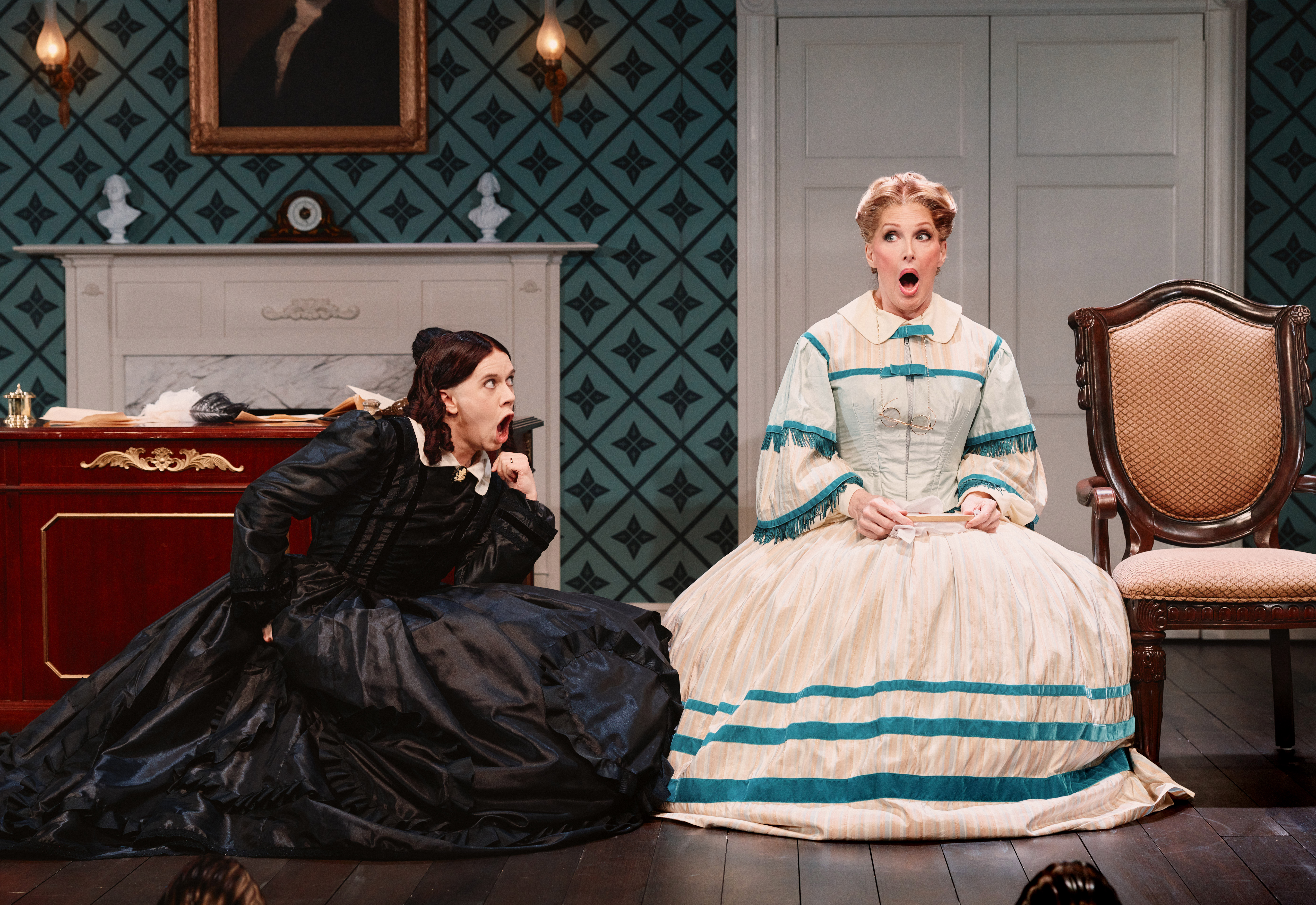
This two-act look at the characters’ constricted lives is set in 1990, when the Troubles were flaring as they aren’t quite so regularly today, and in a West Belfast kitchen/living room where housewife-mother Marie (Susan Barrett) is continuously visited by next-door neighbors Nora (Paula Ewin) and daughter Cassie (Heidi James). The one diversion the three have from their anxious existence is the occasional night out at a pub/club where there’s dancing, a raffle, and a frenzied hubbub.
The remaining character in this four-hander is a waif called Deirdre (Moira MacDonald), who appears at Marie’s door looking like a ghost. Though she eventually proves to be mortal, Deirdre retains a spectral presence as she makes herself at home in Marie’s laundry-strewn surroundings. Seemingly shameless in her fragility, she presumes to take a shower and even helps herself to some of Marie’s clothes. She causes further problems when she shows up as a waitress at the pub/club and turns out to have more information about Cassie’s past than Cassie cares to have bruited about. Deirdre, whose name is an anagram of “derider” and contains the words “dire” and “Eire,” also eventually seems to know more about Marie’s husband, Michael, who’s been dead for three years but is still mourned even though he apparently was no candidate for sainthood. (Say-unthood?) Michael’s photograph — behind which Cassie at one point stashes money she’s been saving for a getaway — hangs on a wall right under the house’s prominent crucifix.
These women range from gallant to ignoble in their responses to the pressures put on them by daily trials. As Munro sees it, there’s little room for smiling through in their repertoire of affects. They try to remain calm around each other and their children, but they nevertheless give way to extreme emotion when their patience is excessively tried. When they think they’re not being watched, they allow dread into their eyes and resignation into the set of their mouths. This happens repeatedly during the course of the 18 or 20 stage hours that Munro puts them through.
The language these characters speak is that of the nearly defeated, which doesn’t mean that it’s unmitigatedly downbeat. It’s the speech of women who see no reason to beat around the bush with each other, yet they’ve brought some wit and a modicum of valiance to bear on what is, at best, an uneasy détente with their compromised situations. (This could be seen as a reflection of the uneasy RUC-IRA détente.) Nora has a no-nonsense way about her and Cassie has a fast tongue — perhaps too fast when she uncurls it to give Marie some destructive lowdown. Deirdre says very little, but when she finally does open up, what she has to impart is poignant. Marie, in her unadulterated sincerity, spouts lines that are steel-wool poetry. Talking about Michael’s death, she says: “He wasn’t even the man they wanted, but they shot him. That made him the man they wanted.”

(Photo © Petra Liebetanz)
Much of what Munro wants to pass along is important to know, yet she doesn’t fulfill her mission as directly as she might. In the first and second of her four scenes especially, there’s an excessive supply of what feels like idle chatter; the pace isn’t nudged along by director Ludovica Villar-Hauser, who, on the contrary, seems to encourage some of the slackened performing. When the ladies get to the club, there’s so much aimless gab that an audience member wouldn’t be blamed for wondering where Munro is heading. The playwright also causes more confusion than she must have intended with the haunted and haunting Deirdre, who seems contrived to serve allegorical purposes associated with how the Northern Ireland conflict has disinherited its young. However, when Munro tightens the dramaturgical screws in the final two scenes and when Deirdre’s flesh-and-blood reality has been clearly established, the play is back on its disturbing tracks.
Dialect coach Stephen Gabis’s detailed work with Barrett, Ewin, James, and MacDonald isn’t the only reason why these actors are so convincing in their roles. Typical of 29th Street Rep emoting, where scrutinizing the manners and mores of the lower-class are tantamount to an obsession, these women never allow acting seams to show. Barrett, with her round, well-meaning face, has the stuff to appear both tough and vulnerable — sometimes simultaneously. Ewin knows how to portray a woman who only looks as if she’s all hard edges. MacDonald, wearing black eye makeup for her earlier appearances, may be the most severely tested because she has some of the artsy-er material to pull off, but she’s good at the lost-girl lines. Tall and coltish Heidi James is up for the snide remarks made by her character, who hates where and who she is; but it comes as something of a surprise when, looking just past her teens, she gives her character’s age as 35. Director Villar-Hauser, if sometimes lax elsewhere, surely shares in the actors’ accomplishments.
Mark Symczak has designed the set on which, in Marie’s rooms, many sheets have been strung up to dry. Lighting designer Douglas Cox does okay with the various mood changes. Christopher Lione has found the proper low-budget at-home wear for the women, and he really outdoes himself with the outfits that Marie, Nora, and Cassie think are stylish for club-going. Sound designer Tim Cramer shines when he has to suggest what’s happening on the other side of Marie’s walls, where children’s voices mix with the hollow boom of explosives.
The title of the play comes from a toast that Cassie makes to herself, her mother, and Marie in reference to their night’s escapade. The phrase is accurate in its succinct description of these troubled Troubles victims, but there’s a fourth bold girl here: playwright Rona Munro. A toast to her as well.
Featured In This Story