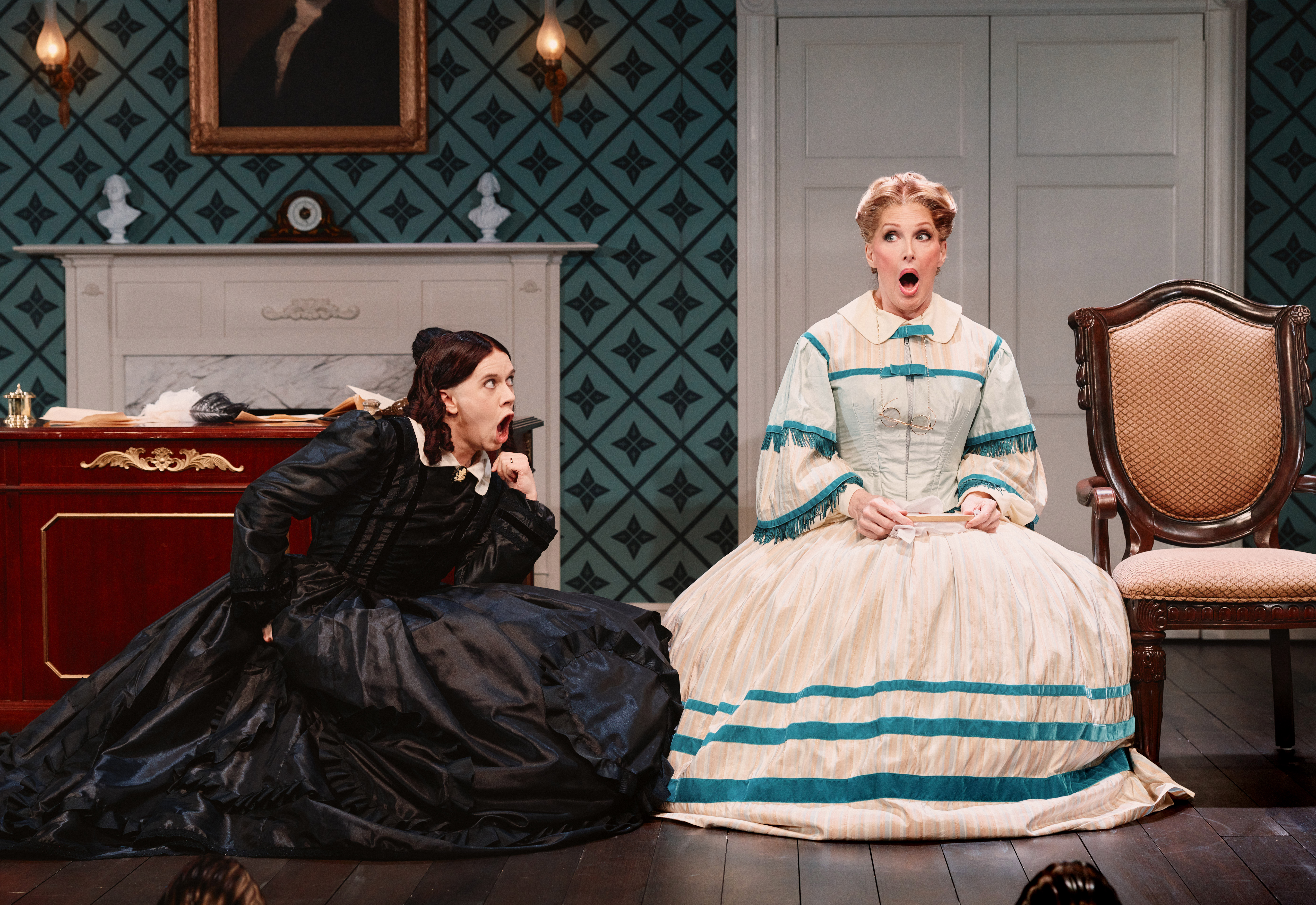

The Boys From Syracuse

(Photo: Joan Marcus)
The purists can start their sniping. The first thing to be said about the Roundabout Theatre Company’s revival of The Boys from Syracuse is that it is not The Boys from Syracuse. Richard Rodgers and Lorenz Hart’s 1938 musical-comedy version of The Comedy of Errors has been gut-renovated. A new Nicky Silver book replaces the perfectly fine one by George Abbott. Meanwhile, the score has been seriously monkeyed with — and if there was ever a score that didn’t need fixing, this is it. The production looks wrong, frequently sounds wrong, and is unevenly cast. So why did I have such a good time?
Because, bottom line, it’s still Rodgers and Hart, and it’s still musical comedy in its purest, most escapist state. Shakespeare’s farce of two sets of identical twins in ancient Ephesus — an early work and, it is generally conceded, a sloppy one — is ideal fodder for musical-comedy silliness, what with its confused identities, slapstick slaves, neglected wives, luscious courtesans, and mercenary merchants. Syracuse was the first major Bard-meets-Broadway musical and, as any fan of the team knows, Rodgers and Hart loved a challenge. They were always at their best as innovators, whether liberating the early movie musical from stage conventions (Love Me Tonight) or giving the musical stage its first-ever antihero (Pal Joey).
The Boys from Syracuse opens with a complicated ensemble number spinning yards of exposition into ingeniously witty couplets (“I Had Twins”), and from there it’s one beauty after another. Take “Falling in Love With Love”: Hart’s rueful lyric doesn’t believe in love, but Rodgers’s ecstatic waltz does, and the tension is still captivating 64 years later. And when Hart dishes up a couplet like “When the search for love becomes a mania / You can take the night boat to Albania” (a sly reference to the prostitutes who worked the old night boat to Albany), you want to dash back to 1938, give the ever-unhappy Hart a hug, and assure him that, yes, he’s deeply loved.
The brilliance of the pair shines through at the Roundabout, even if there are times when it seems that meddlesome revisionist hands are trying to obscure it. Two songs from other R&H works have been needlessly interpolated. “You Took Advantage of Me,” from the 1928 Present Arms, opens the second act, even though it’s connected to nothing. “A Lady Must Live,” from America’s Sweetheart (1930), is presented as a brothel entertainment; it’s similarly irrelevant, and it features the most vulgar musical staging since “My Defenses Are Down” in the Annie Get Your Gun revival. Don Sebesky’s new orchestrations are garish and obvious, with yuk-yuk sound effects, and David Loud conducts bizarrely, with tempos that the purist Rodgers would surely have vetoed. Hugh Martin’s superb original vocal arrangement of “Sing for Your Supper,” a surefire show-stopper, has been scrapped in favor of a lackluster new one. And where is “The Ladies of the Evening,” with Hart cracking wise about the cop-hooker dynamic?

in The Boys from Syracuse
(Photo: Joan Marcus)
But this score, from the cynic-romantic “This Can’t Be Love” to the suave and sexy “You Have Cast Your Shadow on the Sea,” is indestructible — and Silver’s new libretto, for the most part, complements it well. Scarcely a line of the Abbott is retained; I miss the lusty Luce (Toni DiBuono) snarling, “I married my husband for life, and I’m going to get some out of him!” And there are extraneous new references to The Wizard of Oz and I Love Lucy, par for the course in this pop-culture-crazy world. But Silver has replaced the Abbott quips with some sufficiently snappy dialogue of his own — as when the Madam wonders, “Has anyone seen Chlamydia?” Silver has not so much post-modernized the old book as post-Freudianized it: Characters spend an inordinate amount of time discussing their feelings, like guests on Oprah, and the juxtaposition of ancient Greece and modern psychology is pretty funny. He has given the Antipholi distinct personalities, a task at which Abbott (and Shakespeare, for that matter) failed; Antipholus of Ephesus (Tom Hewitt) is a preening soldier who bores everybody with his tired war stories, while Antipholus of Syracuse (Jonathan Dokuchitz) is a spineless milquetoast. And Silver has strengthened the love story between the latter and Luciana (Erin Dilly), who confuses him with her brother-in-law. So when she sings “This must be love for I don’t feel so well,” this reprise has an emotional heft it didn’t have before.
Or maybe that’s the doing of the aptly named Dilly, who sings sweetly, looks great, and has a comedic sense rare in an ingénue. (This planet could use more daffy sopranos, along with more Rodgers and Hart songs.) Outstanding, too, is the burlesque-savvy DiBuono, nicely partnered by Lee Wilkof’s Dromio of Syracuse with his Borscht-Belt timing and lumpy, comic mask of a face. The rest of the cast is generally competent, though there are some curious choices; these two sets of twins don’t look remotely identical, which renders the whole story more absurd than it has to be. Lauren Mitchell finds the right mixture of warmth and harpiness in Adriana but she doesn’t make “Falling in Love With Love” soar as it should. Jackee Harry’s Madam has sassiness but little else, and Chip Zien’s Dromio of Ephesus is pallid next to the more instinctively comedic Wilkof.
Scott Ellis directs fitfully; some scenes have the proper comic snap but others seem to be marking time until the next song cue. (Ellis does come up with one superb sight gag, worth watching out for, at the end of “He and She.”) Rob Ashford’s choreography seems skimpy, especially after all that heavy tapping he contrived for Thoroughly Modern Millie. So does Thomas Lynch’s set design, all flats and garden furniture. The costumes, by Martin Pakledinaz, are all over the map, from Vegas sequins to Frederick’s of Hollywood nighties to Li’l Abner striped socks and polka dots. Eclecticism can be funny in farce, but here it’s just haphazard.
So, it could be argued, is the whole evening. But just as you’re about to give up on it, Silver gets off another good one, or another Rodgers melody triumphs over its arrangement, or another Hart lyric elicits a real belly laugh. This may not be anybody’s dream production of The Boys from Syracuse, but it will take stronger hands than the Roundabout’s to kill so sturdy a musical.
Featured In This Story