
The Trial of Klaus Barbie

(Photo © Joseph Caffrey)
A monument at Dachau bears the inscription Plus Jamais, French for “Never Again.” French collaboration during the Holocaust has been one of the country’s greatest shames, and Klaus Barbie represented Vichy atrocities at their most gruesome. The man raped and murdered enough times to earn a reputation as “The Butcher of Lyons”; he tortured members of the résistance and sent children to gas chambers. After the war, he fled to Bolivia and lived under the right-wing government’s aegis for many years. Beate Klarsfeld, my distant cousin, went to La Paz and chained herself to a park bench outside his office; that stunt drew international attention and pressured the government to extradite Barbie for a trial in France.
Fred Pezzulli’s The Trial of Klaus Barbie follows the 1987 trial and the French reaction to it. The play is timely, coming a year after a French election that saw National Front leader Jean-Marie Le Pen’s name on the presidential ballot. As a new wave of fascism continues to grow throughout Europe, the world should know how many in France responded to “The Butcher of Lyons.” Those responses did not always amount to the horror that one might expect.
But Pezzulli’s play stumbles in that it seems to validate a defense that the world no longer accepts. During the trial of the Nazi criminal Adolf Eichmann in 1960, “following orders” was ruled an inadmissible defense in an international court of law. More importantly, it convinced many hearts and minds across the world that ex-Nazis could not use obedience as a moral justification for their actions; the murder and torture of millions of people knows no excuse. Twenty years later, the most infamous Nazi murderer of the French occupation tried this defense in Lyon, and Pezzulli unfortunately gives the Nazi’s rationalizations a fair hearing.
Barbie says toward the beginning of the play that he did not do anything different than American and French troops did in Vietnam. Another character, Madame Gaujot, later tells the story of her intelligence officer husband’s involvement in Algerian violence, saying with a straight face that “He reminded me of Barbie.” International justice has become a hot issue in the post-9/11 world, and many people deserve to be brought to justice before international courts; Slobodan Milosevic is standing trial for genocide in Bosnia and, just this week, a Sierra Leone court indicted Liberian president Charles Tayler for a vicious, 10-year civil war. There is an ugly history of violence in France’s occupation of Algiers and Vietnam, but the playwright’s drawing a parallel to Nazi occupations is unconvincing.
Pezzulli gives us Barbie’s interior monologue but leaves out important details; the audience learns about his commitment to National Socialism and his dream of a unified Germany and he rails about the Treaty of Versailles, yet we never hear his reactions to his victims. Thus, the playwright misses a chance to show us the psychology of hatred. In a clumsy line of dialogue during the trial, Barbie says, “I do not hate any minority.” It’s a pity that his inner thoughts don’t reveal otherwise.
The play promises a humanizing portrait of Barbie but almost defends the man in the process; while The Trial of Klaus Barbie in no way excuses his horrible crimes, it does make the man’s trial seem unfair. Barbie repeatedly screams that he has been kidnapped and brought to France illegally, but this is false; while Israeli agents kidnapped Eichmann to stand trial, Barbie was extradited.

(Photo © Joseph Caffrey)
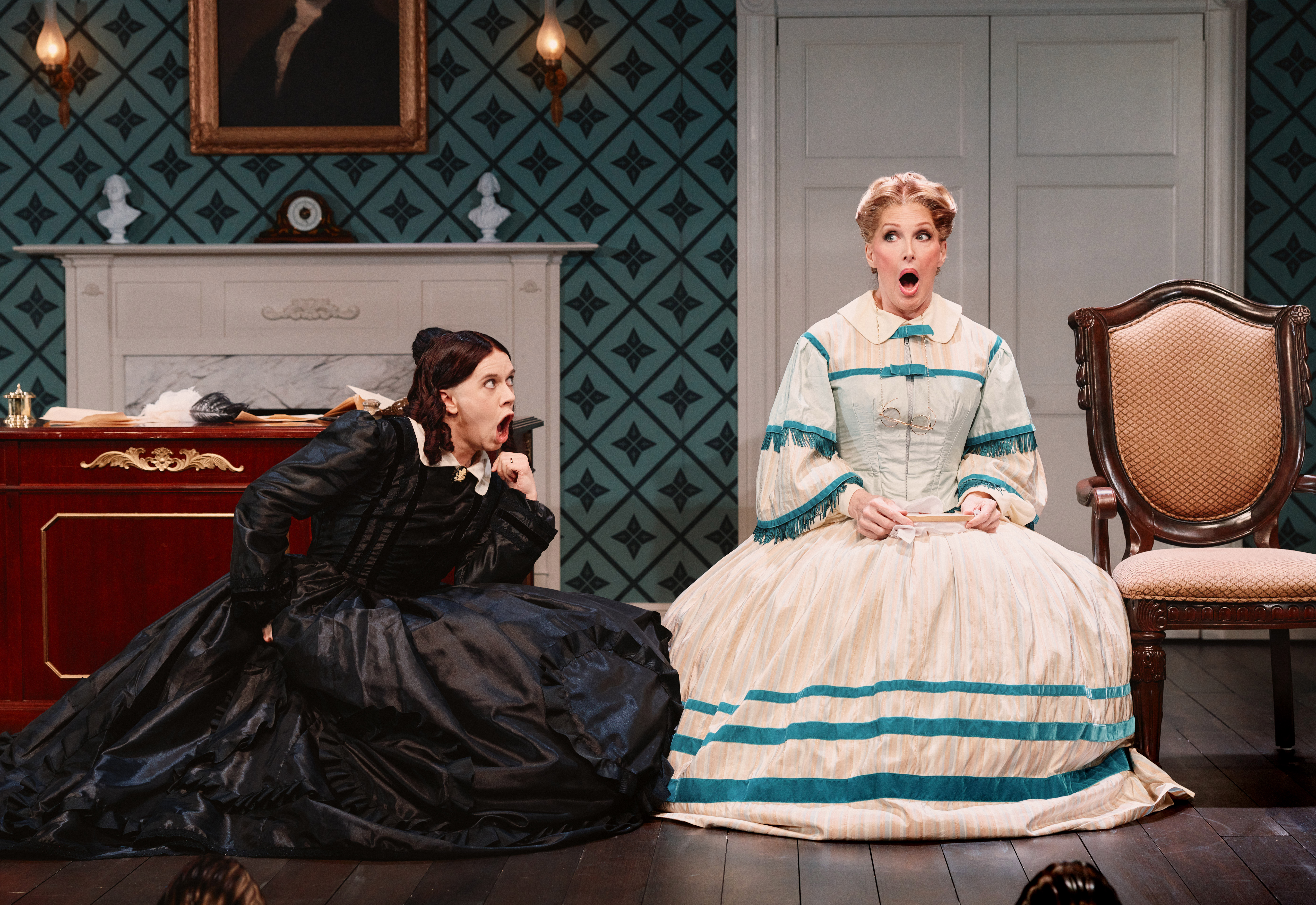
Director Manfred Bormann doesn’t help the play: Actors slip in and out of French dialects and, curiously, the bistrot where the characters meet resembles a New York deli. Flavio Romeo’s Jacques seems like an all-American sports fan when he flirts with Jacqueline, played by Macha Ross with a thick, East Coast accent. One character orders a Perrier, and another — a woman from the résistance — wanders in wearing a costume that looks like it was fashioned out of scraps found in a dressing room at Les Misérables.
Allan Knee’s performance as Klaus Barbie is full of passion; his eyes and heart seem ready to burst at a moment’s notice from a sense of great wrong, rather than guilt. This may well have been true of the real Barbie — evil men are often convinced of their goodness — but Knee delivers every line at maximum volume and energy, whereas Barbie could destroy with a few cold words. One Jewish character tells of Barbie having flirted with her after murdering her family; at that moment, she says, she felt that she had been raped.
Holocaust stories deserve to be told over and over so that history will never be repeated — but they need to be told well and responsibly. The curtain line of The Trial of Klaus Barbie comes when Barbie tells the audience, “The war is over!” Is this really the message with which the playwright wants to leave us?
Featured In This Story