
The New Moon

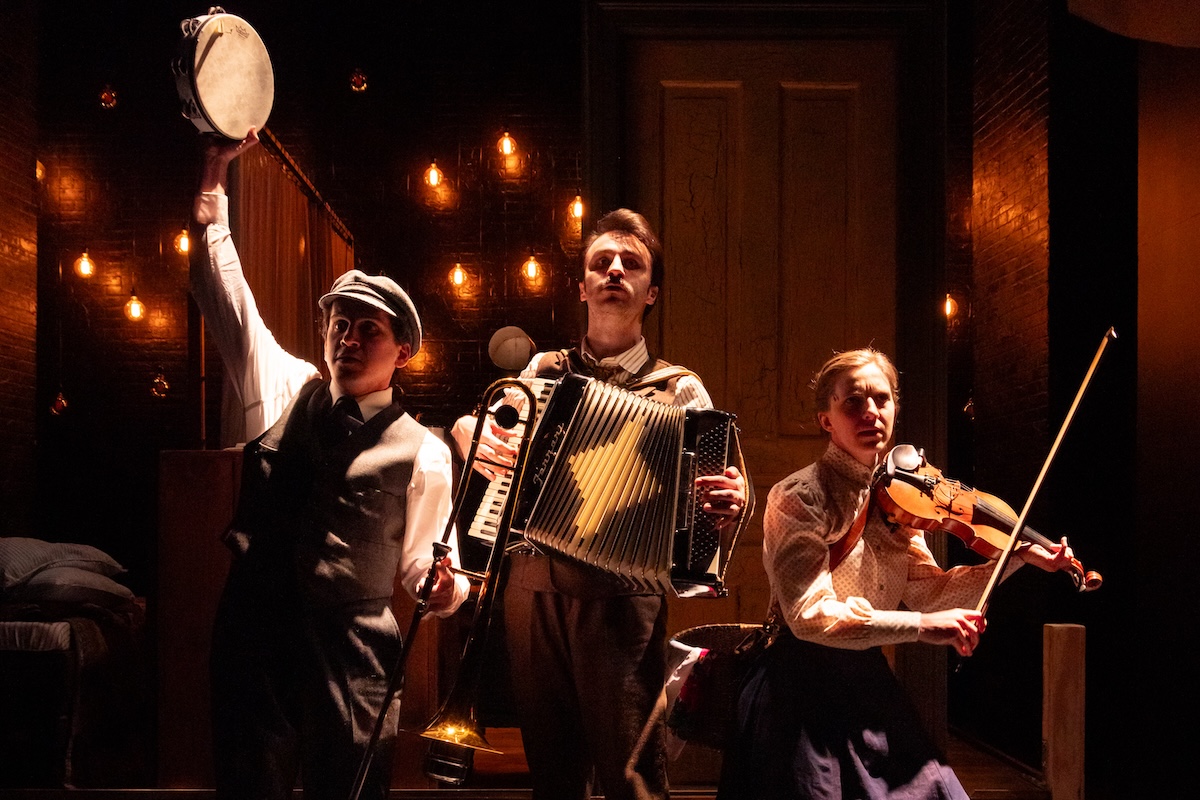
(Photo: © Joan Marcus)
The New Moon inhabits a parallel universe where no emotion, no plot point is too small to be sung. Mademoiselle Marianne has a new Paris frock? Let’s sing about it! Monsieur Le Vicomte has just arrived at the soiree in his honor? Let’s vocalize him a hearty welcome. You’re planning an uprising against the repressive swines of the French crown and you need men, stouthearted men, who will fight for the right they adore? First, toss around some half-dozen song cues and then, sing your hearts out.
In this, the first-ever operetta exhumed by City Center’s Encores! series of musicals in concert, the emphasis is on the Sigmund Romberg score — a shimmering parade of 1920s hits. Rob Fisher’s expansive orchestra takes up the vast majority of the stage, a well-trained supplemental chorus regularly pops up above it, and the actors are confined mostly to a narrow strip of downstage space. It’s just as well: In 1928, when The New Moon carved out a 15-month run, its priorities were 1) score, 2) singing, 3) sets, and 4) text. Audiences expected romantic escapism and gloriously hummable music from the genre, not ingenious plotting, witty dialogue, or thematic integrity. Oscar Hammerstein II, the show’s co-librettist (with Frank Mandel and Laurence Schwab), had just knocked out Show Boat but, for this follow-up, he reverted to the standard operetta trappings of exotic settings, strong-jawed heroes, feisty but ultimately submissive heroines, and crowded choruses.
So, from the moment Rob Fisher raises his expert baton for an overture that probably involves more light cues than the entire 1928 production did, you may as well abandon all hope of an unhackneyed story. In 1792 New Orleans, French insurgent Robert Mission (Rodney Gilfry) is hiding out as a servant in the manse of Marianne Beaunoir (Christiane Noll), whom he secretly loves though she has been courted these seven years by the priggish Georges Duval (Burke Moses). Robert is being hunted by Le Vicomte Ribaud (F. Murray Abraham) while trying to hook up with fellow revolutionary Philippe (Brandon Jovanovich). All of these characters end up experimenting with democracy on the Isle of Pines, though misunderstandings have trapped Robert and Marianne in a loveless marriage while Philippe has foresworn all romantic entanglement because…do you really want to know all this? There’s also a comic second couple given less-than-stellar material but those interludes are not unwelcome here for Peter Benson is a limber, attractive-voiced juvenile and Lauren Ward is a resourceful singer-comedienne who must have watched weeks’ worth of late shows to master so many adept soubrette reactions.

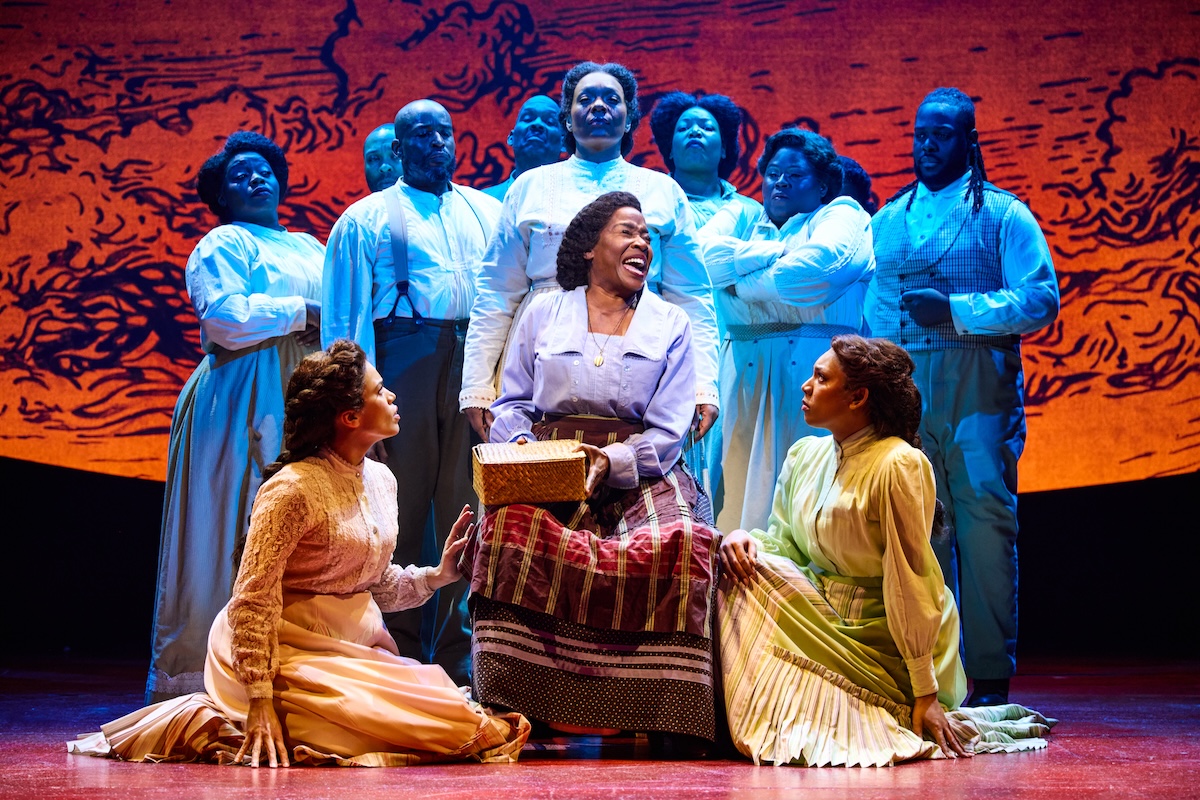
(Photo: © Joan Marcus)
Will Marianne surrender her infernal pride? Will Mission’s integrity and passion inspire the others? Gary Griffin’s sensible, un-showy direction isn’t able to muster much suspense but it does move this dramatically enervated piece gracefully from one musical highlight to the next in what could easily have been a campy, milk-the-cliché evening. Griffin realizes that even if songs such as “Stout-Hearted Men” and “Softly, as in a Morning Sunrise” (which prompted some critics to inquire whether there was any other kind of sunrise) are now chestnuts, they are superbly crafted anthems that once, a long time ago, surprised and moved audiences with their musicianship and ardor. In the deft hands of gifted vocalists and musicians, they still can have the same effect.
It’s a sumptuous tune stack — among the other hits are “Wanting You” and “Lover, Come Back To Me” — and Fisher & Co. have wisely gone back to the source. The score is presented much as it was on opening night, with elaborate vocal arrangements, hard-sell reprises, and throwaway numbers (like the bouncy “Try Her Out at Dances”) that even opera companies usually skip in revival. Not all of it is golden but we must be grateful to Encores! for supplying the whole program and letting us form our own opinions.
This production does occasionally make a mistake common to many modern stagings of operettas: It can’t resist the temptation to wink and thereby assure its audience that it’s smarter than the material. (“So,” shudders Gilfry, eyebrows wiggling, “Ribaud has tracked me down!”) And when Jovanovich, who sings brilliantly, has to utter a line like “Why will men die from a strumpet’s kiss?” you can bet that it won’t be delivered 100% straight. Mostly, though, the text is played the way it should be: as connective tissue for the ripe earful of Romberg.
In that respect, this New Moon is full and bright. Gilfry — tall, stoically heroic, and with an operatic baritone that renders amplification superfluous — rocks the house. Noll, playing a chilly miss, is a little too chilly until she alights on “One Kiss.” After that, she’s an ideal operetta heroine: spirited, sincere, and secure in her top notes. There is enough chemistry between her and Gilfry to suggest that something really is at stake here beyond getting the vocal lines right and following the conductor. Fun, familiar folk contribute generously from the sidelines — e.g., Alix Korey as a man-devouring scold and Simon Jones as an unctuous aristocrat. Danny Rutigliano performs with aplomb as a subsidiary comic who inexplicably turns traitor in Act II. (Somebody has to aid the villain to keep the plot going and he’s the one who happens to turn up.)

(Photo: © Joan Marcus)
The upward trajectory of lavishness at Encores! is reversed this time. House of Flowers was so elaborate that it was practically a full staging, but here — with the focus properly on the music — John Lee Beatty’s sets are modest and unobtrusive. What visual excitement there is comes from choreographer Daniel Pelzig, who has managed to fit a sexy apache dance into a compact space and whose comic turns for Benson and Ward are true to the second couple’s vaudeville origins.
Operetta is a bastard child born of opera, musical comedy, burlesque, spectacle — anything that worked, really. One of the charms of this New Moon is its pragmatism: The tone wavers, the scenes lurch from romance to empty jingoism to slapstick like a Hyundai with a bad clutch, but it’s all to the purpose of packing as much stirring melody into the evening as possible. Even the hackwork-heavy libretto has its moment of glory: a line of dialogue late in the second act that is so political, so timely, and so apt that prolonged applause breaks out at City Center. Whether it’s part of the original text or was inserted by book doctor David Ives is hard to say, but this may be the first time in the history of operetta that the spoken word has stopped the show.
Featured In This Story